
Understanding Islamic Divorce by Wife: A Comprehensive Guide to Khula
In the framework of Islamic jurisprudence, marriage is a sacred and contractual bond built on mutual love, respect, and tranquility. However, Islam also provides a realistic and compassionate path for those instances where a marriage becomes unsustainable. At Maulana Arabic Madrasa, we are frequently approached by women seeking clarity on their religious rights. A common question we address is how an Islamic divorce by wife—traditionally known as Khula—is executed and what conditions must be met to ensure the separation is valid. Understanding the process of Islamic divorce by wife is essential for any woman who finds herself in a marriage that is no longer sustainable or fulfilling, as it ensures her rights are upheld according to the Sharia.
The Concept of Khula: A Woman’s Divine Right
It is a widespread misconception that only a husband has the authority to end a marriage in Islam. In reality, the Sharia provides a balanced legal system that empowers a woman to initiate the dissolution of the marriage contract. An Islamic divorce by wife is a recognized right derived directly from the Quran and the Sunnah of the Prophet Muhammad (PBUH).
While a husband’s initiation is called Talaq, the process for an Islamic divorce by wife is called Khula. In this process, the wife requests to be released from the marriage, usually by offering some form of compensation to the husband—most commonly the return of the Mahr (dower). This ensures that a woman is never forced to remain in a relationship that causes her psychological, emotional, or spiritual distress.
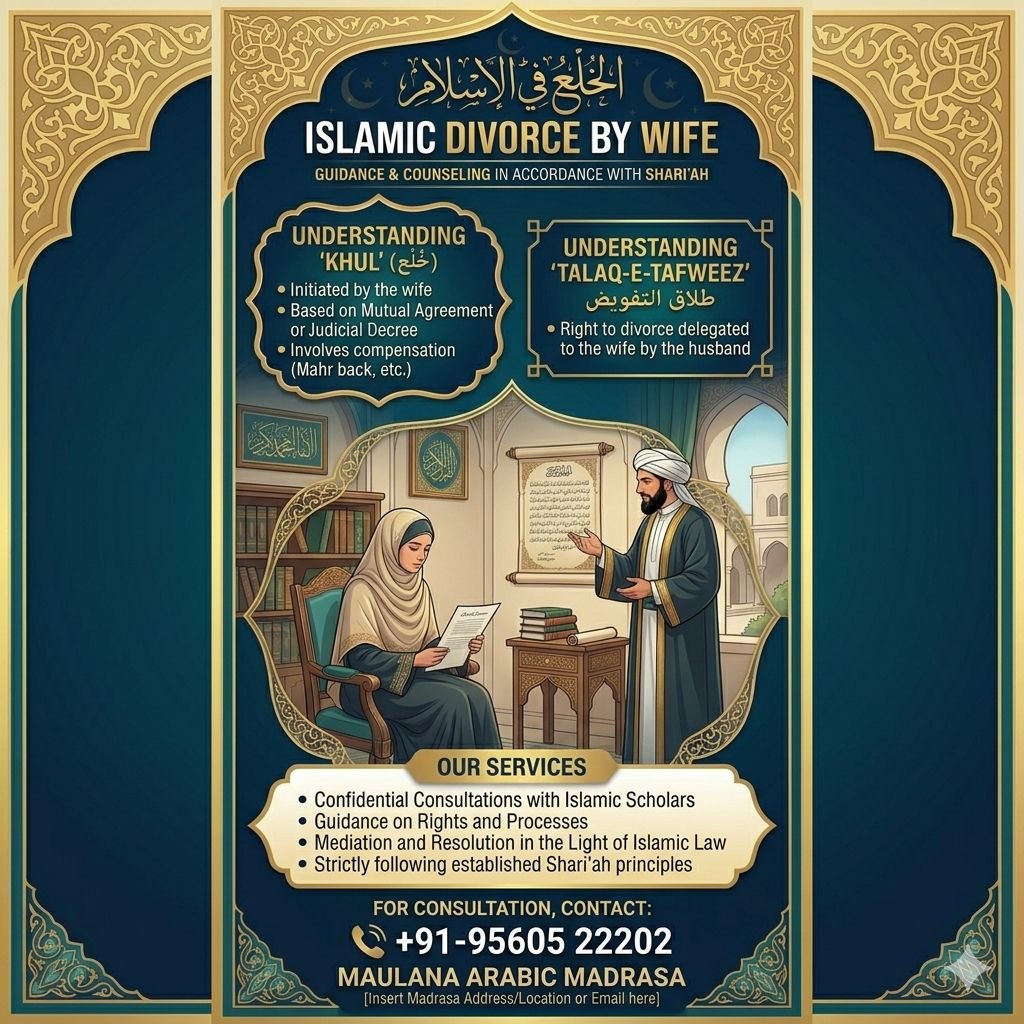
Valid Grounds for Seeking an Islamic Divorce by Wife
While marriage should be preserved whenever possible, there are several legitimate grounds recognized by the scholars at Maulana Arabic Madrasa that justify an Islamic divorce by wife. These grounds ensure that the process is not arbitrary but based on the preservation of the individual’s well-being:
Irreconcilable Incompatibility: When the couple can no longer live together within the boundaries set by Allah due to extreme personality differences or a total loss of affection.
Neglect and Lack of Maintenance: If a husband fails to provide for his wife’s basic needs, such as food, clothing, and shelter (Nafaqah), for an extended period without a valid excuse.
Abuse and Cruelty: Islam strictly forbids any form of physical, verbal, or emotional abuse. Harmful behavior is one of the strongest grounds for an Islamic divorce by wife.
Desertion: If a husband abandons his wife for a long duration, leaving her in a state of “hanging,” she has the right to move forward with Khula.
Failure of Marital Rights: If the husband is unable or unwilling to fulfill the essential duties of a spouse, the wife has the right to seek separation.
The Procedural Steps for Khula
The process of an Islamic divorce by wife requires a formal procedure to ensure that all parties are treated with justice (Adl).
Mediation and Consultation: Before finalizing the separation, it is highly recommended to seek counseling. At Maulana Arabic Madrasa, we provide mediation services to see if the issues can be resolved.
The Proposal of Khula: The wife formally expresses her desire for divorce and offers to return the dower. If the husband accepts, the Islamic divorce by wife is finalized immediately as an irrevocable separation.
Judicial Intervention (Faskh): If the husband refuses to grant the Khula despite valid grievances, the wife can approach an Islamic Council or Madrasa. Scholars have the authority to dissolve the marriage through a judicial decree, ensuring the woman is not held captive.
The Waiting Period (Iddah): After the Islamic divorce by wife is granted, she must observe a waiting period. This is primarily to ensure there is no pregnancy and to provide a period of emotional transition.
Why Trust Maulana Arabic Madrasa?
Navigating the nuances of an Islamic divorce by wife can be a daunting experience, particularly when dealing with family pressure or legal complexities. Our institution offers a safe, confidential, and scholarly environment to handle these sensitive matters. We ensure that every Islamic divorce by wife we facilitate is documented correctly, providing you with a certificate that is recognized within the Muslim community for future needs, such as remarriage.
We bridge the gap between traditional Fiqh and modern legal requirements, especially for those who have also undergone a court marriage. Our goal is to ensure your spiritual standing remains intact while you secure your personal freedom and religious peace of mind.
Contact Us for Professional Guidance
If you are considering an Islamic divorce by wife or simply need to understand your rights better, our learned scholars are here to assist you with wisdom and empathy.
📍 Address: RZ-2054, TKD Extension, Near Tara Apartment, New Delhi – 110019
📞 Phone: +91 95605 22202 | +91 84476 15753
✉️ Email: maulanaarabicidara@gmail.com
🌐 Website: www.maulan.in