
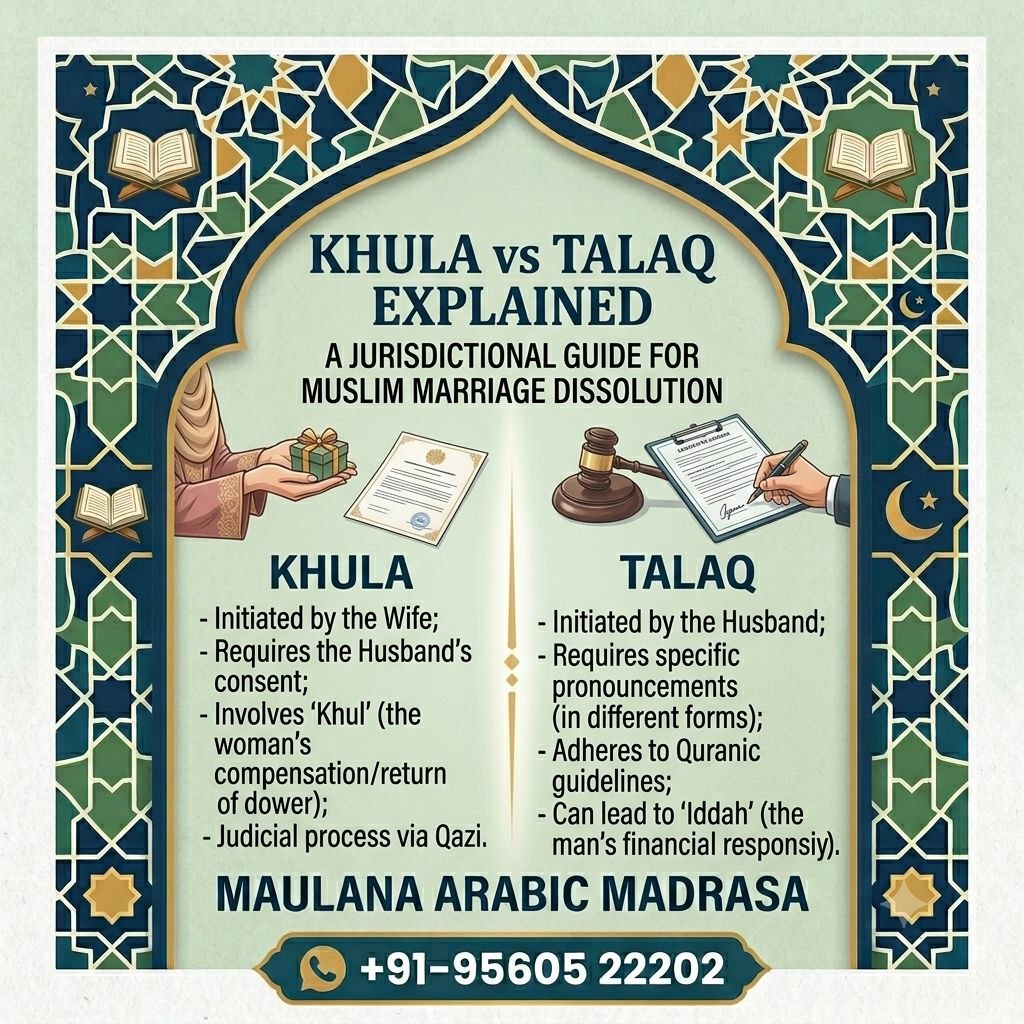
Marriage (Nikah) in Islam is considered a sacred social contract built on mutual love, respect, and tranquility. However, Islamic jurisprudence practically recognizes that certain marriages may become untenable over time. To address these difficult circumstances compassionately, Sharia provides distinct legal pathways for the dissolution of a marriage. Two primary mechanisms available under Islamic law are Khula versus Talaq Explained, both serving to end a marital contract but differing fundamentally in their origin, execution, and legal implications. By exploring Khula versus Talaq Explained, couples, students of Islamic law, and families can better understand how divine wisdom balances the rights, protections, and dignity of both husbands and wives during a marital separation.
At Maulana Arabic Madrasa, we believe that academic clarity and deep scriptural grounding are vital for resolving modern social challenges. This comprehensive guide breaks down the structural, financial, and procedural distinctions between these two methods of Islamic divorce to clear up common misconceptions.
What is Talaq? Understanding the Husband's Right
Talaq is the standard linguistic and legal Arabic term for divorce, referring explicitly to the dissolution of marriage initiated primarily by the husband. In Islamic jurisprudence, a husband holds the inherent right to pronounce Talaq if he finds that reconciliation is completely impossible.
The Right of Initiation: The absolute authority to pronounce Talaq rests with the husband. He can execute this verbally, in writing, or through an authorized representative (Wakil).
The Element of Choice: Talaq does not fundamentally require the formal consent or approval of the wife to be valid, though it carries strict ethical conditions and responsibilities.
Avoidance of Arbitrariness: While the husband has this power, Islamic law highly discourages the arbitrary or impulsive use of Talaq. The Prophet Muhammad (PBUH) explicitly categorized divorce as one of the most disliked lawful actions in the sight of Almighty Allah.
Types of Talaq in Islamic Jurisprudence
To prevent rash decisions, classical Islamic jurisprudence breaks Talaq down into categories that allow ample time for reflection, intervention, and potential reconciliation.
📄 1. Talaq-as-Sunnah (The Prophetic Method)
This is the universally approved, systematic method of divorce according to the Sunnah. It is further divided into two types:
Talaq Ahsan: The husband pronounces a single revocable divorce during a period of marital purity (Tuhr—the time between the wife’s menstrual cycles) in which no marital relations have occurred. The wife then observes her waiting period (Iddah). If the couple reconciles during this time, the marriage resumes automatically.
Talaq Hasan: The husband pronounces one revocable divorce across three consecutive periods of purity (Tuhr). This approach provides a prolonged opportunity for family elders to step in, mediate, and help the couple resolve their differences before the separation becomes permanent.
📄 2. Talaq-al-Biddat (Irregular Divorce)
This refers to an innovated form of divorce where a husband pronounces three divorces simultaneously in a single sitting (often called “Triple Talaq”). While historically recognized as legally binding by some classical schools of thought despite its sinfulness, modern statutory Islamic family laws across many countries have heavily restricted or outright invalidated this practice to safeguard family structures.
What is Khula? Understanding the Wife's Right
When discussing Khula versus Talaq Explained, it is a common misconception that Muslim women have no legal recourse to exit an unworkable marriage. Khula is the specific legal mechanism that grants a wife the right to initiate divorce proceedings based on her own choice and welfare.
The Right of Dissolution: If a woman finds herself trapped in a marriage lacking affection, experiencing abuse, or facing severe incompatibility, she can formally request a separation through Khula.
The Judicial Process: Unlike Talaq, which can be executed independently by the husband, a Khula typically involves an agreement between both spouses or a formal decree issued by an Islamic court (Sharia Council or Qadi).
The Basis of Equality: The existence of Khula perfectly demonstrates the balanced nature of Islamic family law, ensuring that women are never forced to remain in an abusive or emotionally dead marital contract against their will.
The Financial Implications: Mahr and Compensation
One of the most defining aspects of the Khula versus Talaq Explained matrix is how financial assets, particularly the dower (Mahr), are managed at the time of separation.
Financial Dynamics in Talaq: Because the husband initiates the separation independently, he bears full financial responsibility. He is strictly forbidden from demanding back the Mahr he gave his wife. Additionally, he must provide maintenance during her Iddah period and settle any outstanding or deferred Mahr immediately.
Financial Dynamics in Khula: Because the wife is seeking release from the marriage contract without a structural fault on the husband’s part, she generally agrees to return the Mahr or forgo a portion of her financial claims as compensation (Fidya) to relieve the husband of his marital obligations. However, the husband is forbidden from demanding an amount exceeding the original value of the Mahr.
⚖️ Key Differences: Khula versus Talaq Explained
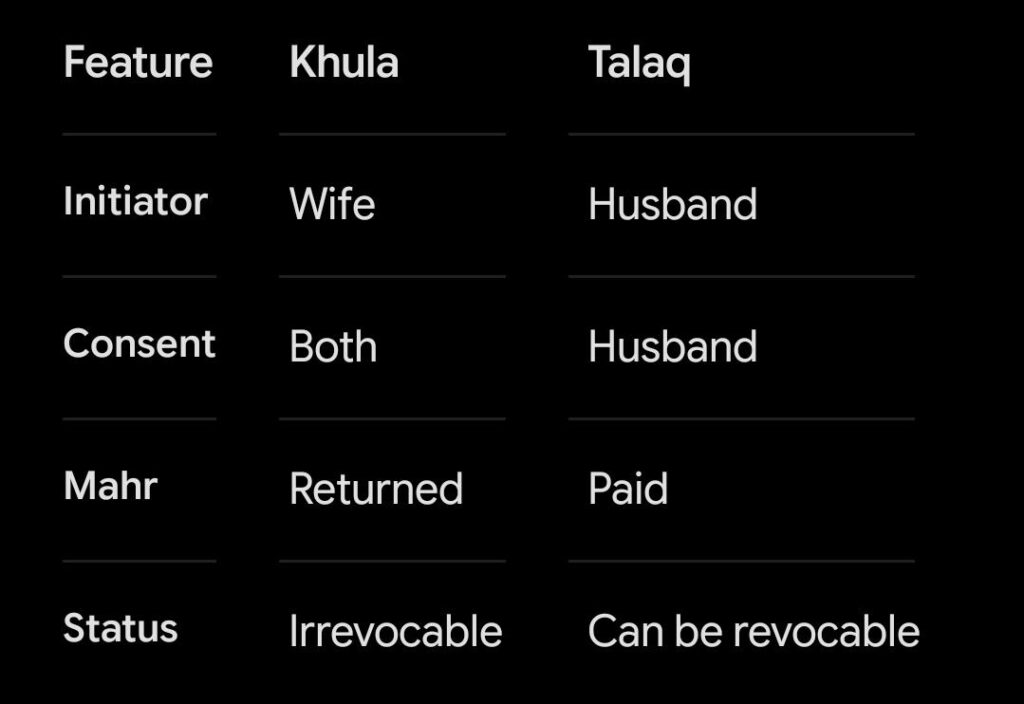
To look closer at Khula versus Talaq Explained, let us organize the fundamental differences systematically across their core operational, legal, and financial dimensions:
Legal Dimension Talaq (Divorce) Khula (Separation)
Initiating Party Exclusively initiated by the Husband. Exclusively initiated by the Wife.
Spousal Consent Does not structurally require the wife’s consent. Requires mutual consent or a judicial decree.
Status of Mahr Husband must pay and cannot reclaim the Mahr. Wife generally returns or waives the Mahr.
Nature of Decree Can be revocable (Raj’i) or irrevocable (Ba’in). Always results in an irrevocable separation (Ba’in).
Role of Court Can be executed privately without a judge.
The Waiting Period (Iddah) and Remarriage
Another critical component of understanding Khula versus Talaq Explained is the observation of the waiting period (Iddah), which serves to verify pregnancy and give clarity to the lineage of any future children.
Iddah Following Talaq: For a menstruating woman, the Iddah spans three full menstrual cycles. For a regular revocable Talaq, the husband remains entirely responsible for her housing and maintenance during this period.
Iddah Following Khula: According to the most preferred jurisprudential opinions, since Khula results in an immediate irrevocable divorce (Talaq-al-Ba’in), the couple cannot simply resume their marriage during the Iddah. If they wish to reconcile after a Khula is finalized, they must perform an entirely new Nikah ceremony with a fresh Mahr contract. Study Islamic Jurisprudence at Maulana Arabic Madrasa
Understanding complex social laws requires rigorous scholarly guidance. At Maulana Arabic Madrasa, we provide structured, in-depth academic courses covering Fiqh (Islamic Jurisprudence), Tafseer (Quranic Exegesis), and Advanced Arabic Language studies. Our curriculum empowers students to analyze contemporary family laws, social contracts, and personal matters through an authentic, classical lens. Whether you are aiming to become a community counselor, an Islamic scholar, or simply wish to deepen your personal religious literacy, our doors are open to help you achieve your educational goals.

Contact Maulana Arabic Madrasa Today
For admissions, academic inquiries, or family counseling services, reach out to our administration office using our official contact details:
🌐 Website: www.maulana.in
📧 Email: info@maulana.in / admissions@maulana.in
📱 Phone Support: +91-8447615753 / +91-9560522202
📍 Main Campus: Maulana Arabic Madrasa Educational Complex, Islamic Academy Road, New Delhi, India