
Navigating the complexities of religious jurisprudence and constitutional guarantees requires an informed perspective, especially when studying the role of the Muslim personal law board India. For students, legal scholars, and community members alike, understanding how traditional Islamic jurisprudence (Fiqh) interacts with the modern Indian legal framework is essential. The Muslim personal law board India operates as a critical guardian of Shariat application, ensuring that civil matters such as marriage, divorce, inheritance, and guardianship are managed in accordance with established religious principles. By analyzing its historical evolution, legal mandate, and current societal role, we can gain a comprehensive understanding of minority rights and religious autonomy within India’s diverse constitutional fabric.
At Maulana Arabic Madrasa, we are dedicated to providing profound academic and classical insights into Islamic jurisprudence and its application in the modern era. This detailed, 1000+ word analytical guide explores the facets of personal laws in India, the origins of institutional representation, and contemporary legal dynamics.
The Historical Genesis of Personal Laws
The legal structure governing Muslim civil matters in India dates back significantly prior to independence. It is anchored primarily in historical legislation enacted during the colonial era to preserve minority practices.
The Shariat Application Act, 1937: This foundational statute mandates that in personal civil disputes involving Muslims, the rule of decision shall be Islamic law (Shariat) rather than custom or common law templates.
The Dissolution of Muslim Marriages Act, 1939: This legislation formulated legal avenues for Muslim women to seek judicial divorce under specific statutory criteria, drawing heavily from Maliki jurisprudence.
Constitutional Guarantees (1950): With the adoption of the Constitution, these existing laws were protected under Article 372, while Articles 25 to 28 guaranteed the fundamental right to freedom of religion and conscience.
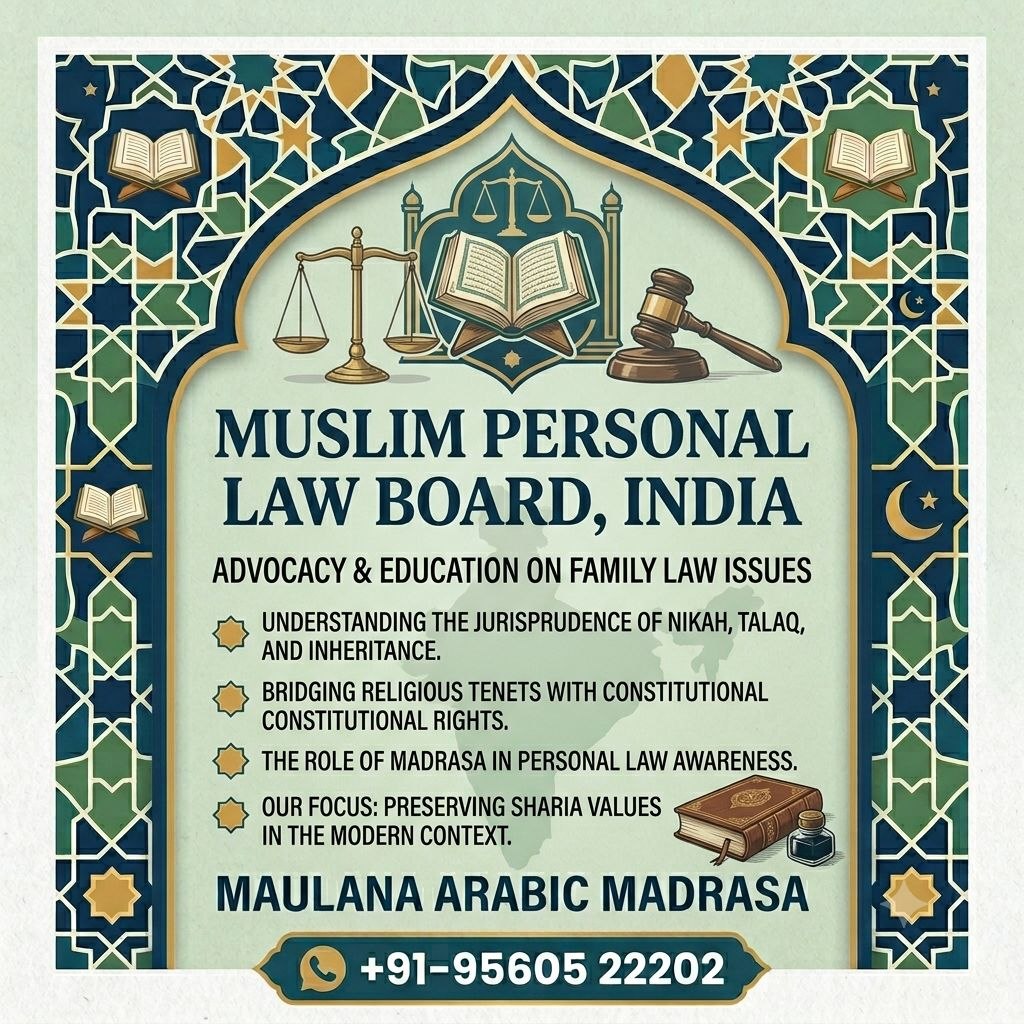
What is the Muslim Personal Law Board India?
Commonly referred to in public discourse as the All India Muslim Personal Law Board (AIMPLB), this apex body serves an influential role in private international and civil affairs within the country.
🔹 Core Institutional Objectives
The primary objective of the board is to adopt effective measures to protect the Muslim Personal Law in India and ensure the continuous application of the Shariat Application Act. It actively monitors legislative actions, judicial interventions, and administrative decisions to guarantee that statutory amendments do not inadvertently infringe upon religious micro-jurisdictions.
🔹 Composition and Representation
Unlike a statutory body created by an Act of Parliament, the board functions as an autonomous, non-governmental umbrella organization. It achieves its immense authority by bringing together scholars, jurists, theologians, and legal experts from all major Islamic schools of thought in India, including Hanafi, Shafi’i, Ahl-e-Hadith, Shia Ithna Ashari, and Bohra communities. This collective representation gives its declarations significant weight.
Interplay Between Personal Law and the Indian Judiciary
Over the decades, the constitutional courts of India have frequently interacted with religious personal laws, creating a delicate balance between fundamental rights and religious autonomy.
The judiciary approach emphasizes that while personal laws enjoy protection, statutory overrides can occur when fundamental rights or public order demand intervention. Landmark judgments concerning maintenance, modes of dissolution, and child rights have consistently required the Muslim personal law board India to provide rigorous textual and legal defenses to articulate the wisdom embedded within traditional jurisprudential balances.
📑 Key Areas Governed by Muslim Personal Law
To excel in advanced legal and Islamic studies at institutions like Maulana Arabic Madrasa, one must comprehend the distinct civil branches managed under this legal framework:
💍 Nikah (Marriage) and Meher
Under Islamic law, marriage is a sacred civil contract rather than a sacrament. The validity relies on mutual consent (Ijab-o-Qubool) expressed in the presence of witnesses, accompanied by a mandatory dower (Meher) given by the groom to the bride as a symbol of financial independence and respect.
💔 Talaq and Khula (Dissolution)
The framework provides structured methods for termination of marriage. While Talaq outlines modes initiated under structured conditions, Khula empowers a woman to initiate separation by returning or waived considerations, ensuring equity when compatibility fails.
💰 Miras (Inheritance and Succession)
The Islamic system of inheritance is mathematically precise and highly structured. It prevents the concentration of wealth by designating fixed fractional shares to specified immediate relatives, including parents, spouses, daughters, and sons, creating a balanced social safety net.
🌐 Contemporary Debates and the Uniform Civil Code (UCC)
In contemporary socio-political discourse, the relationship between the Muslim personal law board India and proposed legal reforms remains a subject of ongoing dialogue.
The debate centering around Article 44 of the Directive Principles of State Policy—which counsels the state to secure a Uniform Civil Code for all citizens—remains active. The stance of the Muslim personal law board India emphasizes that true national integration is achieved through pluralism rather than forced uniformity. The board argues that cultural and religious personal laws form the core identity of minority groups and that preserving diversity is vital to the constitutional ethos of India.
The Role of Islamic Academic Institutions
Academic centers such as Maulana Arabic Madrasa play an essential role in bridging the gap between classical text comprehension and contemporary societal application.
Contextualization of Fiqh: Educating the next generation of scholars to interpret classical jurisprudential rulings in a manner that addresses contemporary challenges without compromising core theological principles.
Legal Literacy: Promoting legal awareness among common citizens regarding their rights and duties under both Islamic law and the constitutional statutes of India.
Reformative Darul Qaza System: Supporting community-based dispute resolution centers (Darul Qaza) that offer affordable, efficient, and peaceful arbitration in family matters, reducing the burden on municipal courts.
Conclusion: Preserving Rights, Fostering Education
The landscape surrounding the Muslim personal law board India reflects a continuous conversation between ancient religious wisdom and modern constitutional frameworks. Understanding this dynamic requires a careful balance of classical legal training and an objective approach to contemporary statutory developments. By focusing on academic clarity, dialogue, and rigorous legal study, the community can effectively preserve its identity while contributing meaningfully to the broader civic framework of the nation.
Contact Maulana Arabic Madrasa Today
For admissions, academic queries, legal literacy workshops, or access to our comprehensive library of classical Islamic jurisprudence, feel free to contact us:
🌐 Official Website: www.maulana.in
📧 General Inquiries: maulanaarabicidara@gmail.com
📥 Admissions Office: admissions@maulana.in
📍 Main Campus: Maulana Arabic Madrasa Complex, Academic Zone, India