
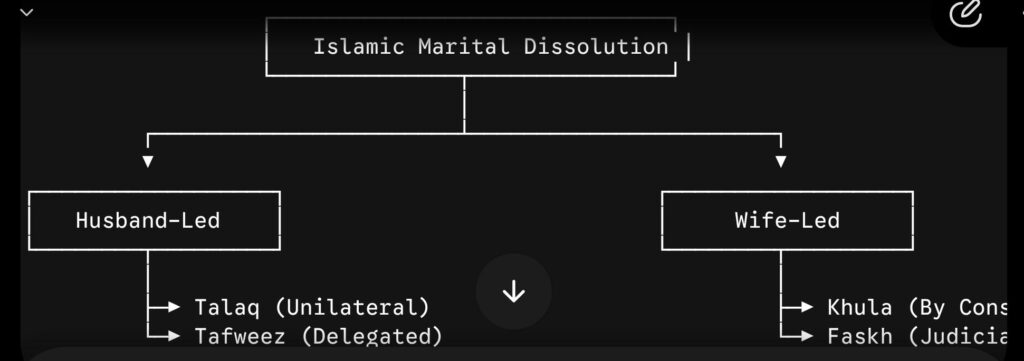
The discourse surrounding Islamic family law in India frequently centers on dissolution of marriage. While standard declarations like Talaq are widely discussed, Islam treats marital separation as a balanced, two-way corridor. Just as a husband holds the right to initiate a divorce, Shariah grants an equivalent, independent right to the wife through the process of Khula. Under personal laws, Muslim Women Can Apply for Khula in India to dissolve an irretrievable marriage when mutual compatibility fails. Understanding the procedural aspects of this provision is crucial, as a Muslim Women Can Apply for Khula in India to break free from toxic or dysfunctional marital bonds under the correct religious and legal frameworks.
At Maulana Arabic Madrasa, our mission is to empower the community with authentic Islamic jurisprudence (Fiqh) contextualized within modern judicial realities. This analytical blog post provides an exhaustive guide on the theological roots, constitutional standings, procedural protocols, and common misconceptions surrounding Khula in the Indian subcontinent.
📜 Theological Roots of Khula in Islamic Jurisprudence
The concept of Khula is rooted deeply in the foundational texts of Islam. It is not a modern amendment or a cultural concession; rather, it is a divine mandate ensuring equity within domestic partnerships.
The Qur'anic Foundation
The primary source of authorization for Khula comes from Surah Al-Baqarah, Ayat 229:
“And it is not lawful for you to take anything of what you have given them unless both fear that they will not be able to keep [within] the limits of Allah. But if you fear that they will not keep the limits of Allah, then there is no blame upon either of them concerning that by which she ransoms herself.”
This text establishes that a woman can offer a financial consideration—typically returning the Mahr (dower)—to secure her release from a marriage that threatens her spiritual or psychological well-being.
The Sunnah and Prophetic Precedent
The practical execution of this law was established during the lifetime of Prophet Muhammad (Peace Be Upon Him). The case of Jamilah, the wife of Thabit ibn Qays, serves as the definitive precedent. She approached the Prophet stating that while she did not fault her husband’s character or religion, she simply could not tolerate living with him.
The Prophet asked her if she would return the orchard Thabit had given her as Mahr. Upon her agreement, the Prophet instructed Thabit to accept the orchard and pronounce one divorce. This foundational event confirms that a Muslim Women Can Apply for Khula in India even in the absence of physical abuse or infidelity, based solely on deep-rooted incompatibility.
Legal Framework of Khula within the Indian Constitution
India’s legal framework preserves personal identity through specific statutes while operating under a unified democratic judiciary. Navigating both systems ensures that the process stands up to legal scrutiny. The Application of Shariat Act, 1937 formally recognizes personal laws for Indian Muslims. When a Muslim Women Can Apply for Khula in India, the act ensures that traditional tenets govern the dissolution. Additionally, the Dissolution of Muslim Marriages Act, 1939 provides structured options for judicial intervention (Faskh) if a husband maliciously refuses to grant consent during negotiations.
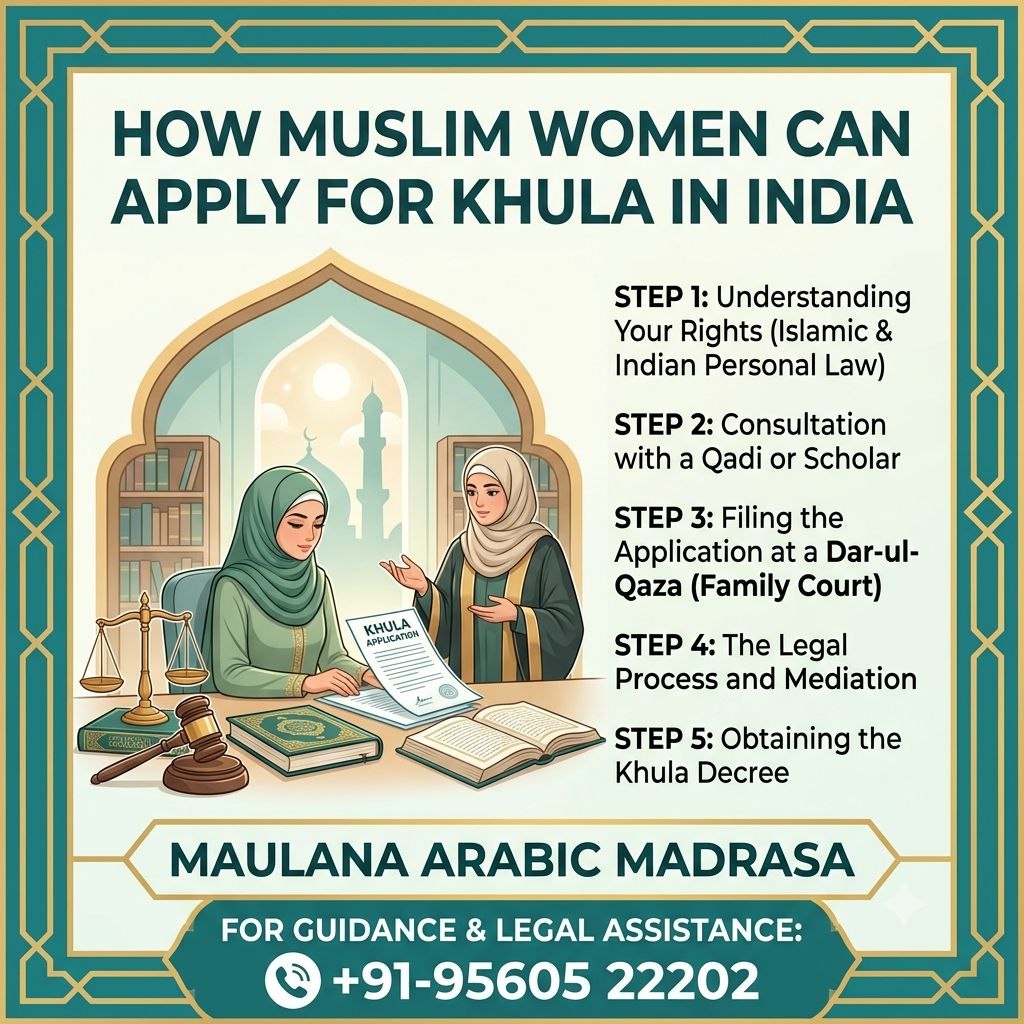
Step-by-Step Procedure to Initiate Khula
Executing a valid dissolution requires strict adherence to both spiritual prerequisites and documentary verification to prevent future legal disputes.
1️⃣ Initiating the Formal Proposal
The process begins when the wife conveys her formal desire for separation to her husband. This proposal must explicitly mention that she is seeking a Khula and outline what she is willing to offer as a ransom (Fidya), which is customarily the return of her dower amount.
2️⃣ Determining the Consideration (Fidya)
While the return of the Mahr is the standard baseline, Islamic jurisprudence discourages husbands from demanding amounts significantly higher than the original wedding gifts. The financial settlement must be mutually acceptable, realistic, and finalized without coercion.
3️⃣ Execution of the Khula Nama
Once both parties reach an agreement, a formal document known as the Khula Nama is drafted. This deed lists the terms of separation, details the returned assets, and features signatures from both spouses along with credible witnesses. At this point, a single, irrevocable divorce (Talaq-e-Bain) takes effect, immediately dissolving the marital contract.
Crucial High Court and Supreme Court Rulings
The intersection of religious practice and secular courts in India has produced vital landmark judgments that protect women’s agency.
The Power of Independent Darul Qaza: Higher judicial benches have verified that while community bodies like a Darul Qaza (Shariah court) offer essential mediation, their decrees require mutual consent. They cannot enforce a separation if one party rejects the terms.
The Right to Absolute Autonomy: In several notable rulings, Indian courts have reiterated that a Muslim woman cannot be forced to cohabit with a husband against her will. If a wife firmly decides to separate via a Muslim Women Can Apply for Khula in India, the husband cannot indefinitely block her path out of malice.
Common Misconceptions surrounding the Khula Process
Misinformation often prevents women from exercising their valid Islamic rights. Let us clarify the most common misinterpretations:
Misconception 1: The husband must absolutely agree for Khula to be valid.
Correction: If a husband rejects the request out of pure spite, the wife is not trapped. She can approach an Islamic body or an Indian family court to obtain a judicial dissolution (Faskh-e-Nikah) based on her valid grievances.
Misconception 2: A woman loses custody of her children automatically.
Correction: Custody (Hizanat) is evaluated independently of how a marriage ends. Under both Shariah principles and Indian custody laws, the ultimate welfare of the child dictates who retains custody, protecting the mother’s parental rights.
The Role of Maulana Arabic Madrasa in Dispute Resolution
Navigating the emotional and legal phases of matrimonial breakdown requires reliable counseling. As a premier institution dedicated to classical Islamic education, Maulana Arabic Madrasa provides structured consultation services to help resolve family issues with compassion and fairness.
Our panel of qualified scholars ensures that when a Muslim Women Can Apply for Khula in India, the entire procedure aligns perfectly with the authentic Sunnah while maintaining legal validity under civil statutes. We prioritize restorative arbitration (Islaah) to resolve conflicts amicably, protecting the dignity of both families involved.
Reach Out to Maulana Arabic Madrasa
If you require guidance regarding Islamic family law, marital counseling, document verification, or detailed fatwas on personal matters, please contact our administrative office through our official channels verified via www.maulana.in:
📱 Phone / Mobile: +91-95605 22202
📧 Official Email: maulanaarabicidara@gmail.com
🌐 Web Portal: www.maulana.in
📍 Rz 2054 street 27 kripa Apartment TUGHLAKABAD EXTENSION New Delhi – 110019