
Understanding the complete structure of constitutional safeguards and personal laws is foundational for every minority community in a secular democracy. For the community to grow, thrive, and confidently manage personal and civil matters, spreading accurate, verified awareness regarding Indian Muslim legal rights is an absolute necessity. Navigating Indian Muslim legal rights ensures that families can safely manage their matrimonial contracts, protect inherited properties through authentic wills, and establish educational institutions without fearing external administrative encroachment. In a rapidly changing legal landscape, staying fully informed about these personal and statutory rights bridges the gap between traditional Shariat rules and the Indian constitutional framework, allowing every citizen to live with dignity, security, and peace of mind.
At Maulana Arabic Madrasa, we are committed to both deep theological excellence and the legal empowerment of the community. Through our dedicated legal advice desk and specialized Darul Qaza (Islamic arbitration panel), we work continuously to simplify complex legal codes into accessible, daily guidelines. This detailed guide breaks down the essential constitutional protections, personal status laws, and institutional mechanisms that safeguard your legal rights in India.
Constitutional Safeguards for Minorities
The Constitution of India provides a robust, beautifully balanced framework that guarantees absolute religious freedom and protects the distinct cultural identity of every minority community.
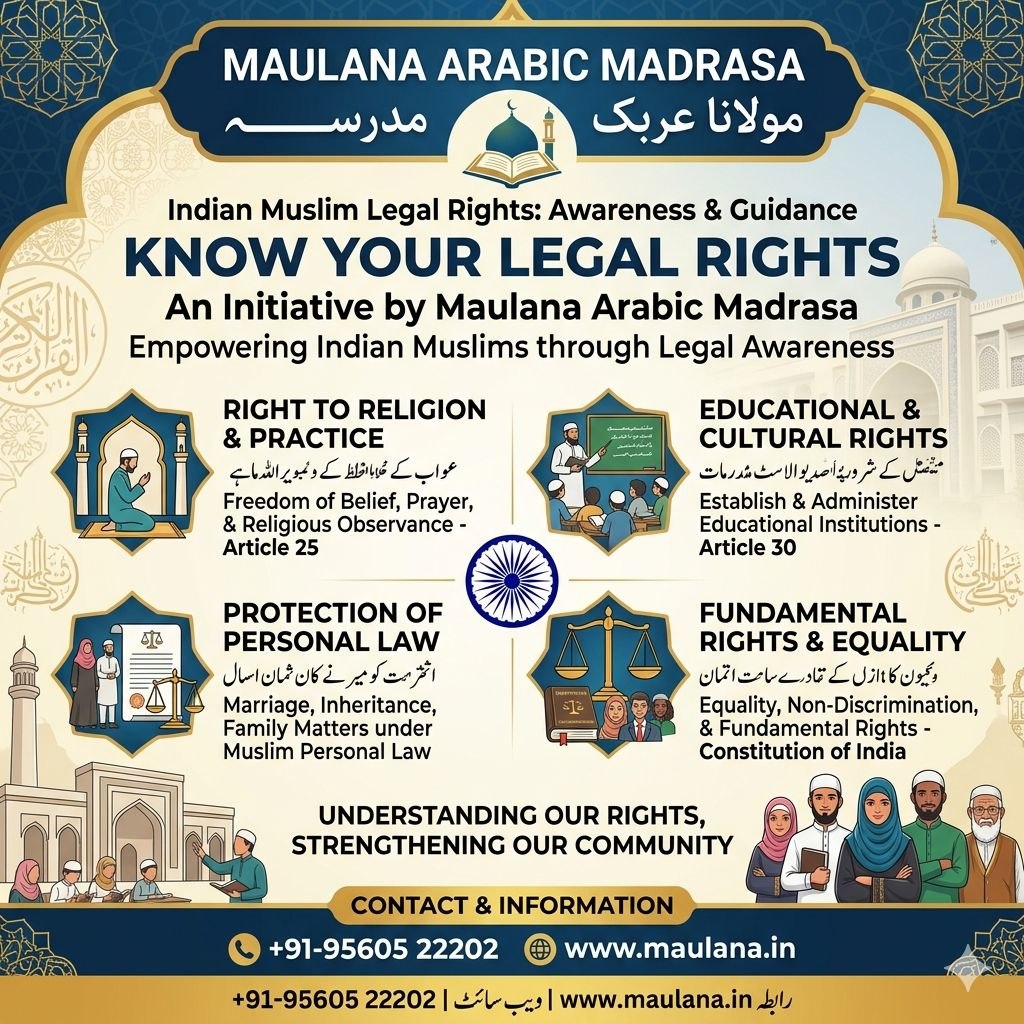
Article 25 (Freedom of Conscience): This fundamental right guarantees every single individual the absolute freedom to profess, practice, and freely propagate their religion, forming the primary shield for daily religious rituals.
Article 26 (Managing Religious Affairs): This section gives the community the right to establish and maintain institutions for religious and charitable purposes, manage its internal affairs, and own moveable or immoveable property.
Articles 29 and 30 (Cultural and Educational Rights): These historic articles grant minorities the absolute right to establish and administer their own educational institutions, like Madrasas and minority colleges, ensuring traditional heritage is passed down seamlessly across generations.
The Foundation of Personal Law: The Shariat Act of 1937
Outside of general civil laws, a Muslim citizen’s personal life—covering marriage, dissolution of marriage, dower, maintenance, guardianship, and succession—is specifically protected by dedicated legislation.
📜 The Muslim Personal Law (Shariat) Application Act, 1937
This statutory act explicitly states that in matters concerning personal status, the civil courts must apply the Muslim Personal Law (Shariat) instead of customary laws. This means that traditional jurisprudential rulings take absolute precedence when settling domestic and family updates within the community.
🛡️ The Dissolution of Muslim Marriages Act, 1939
This specific statutory provision grants Muslim women a clear, formal right to seek a judicial divorce through the court system on several well-defined grounds, including long-term desertion, failure to provide basic maintenance (Nafaqah), or severe cruelty.
💍 Marriage, Divorce, and Financial Protections
Under Islamic personal law, marriage is viewed as a highly sacred, structured civil contract (Nikah). This status provides unique legal protections to both partners, with a heavy emphasis on safeguarding the woman’s future security.
The Right to Mahr (Dower): The Mahr is an mandatory financial gift or property settlement promised by the husband to his wife at the time of marriage. It remains her absolute property, and she has the complete legal right to claim it whenever she pleases.
The Right to Separate (Khula): If a marriage becomes entirely unworkable, a Muslim woman possesses a distinct legal right to initiate a separation (Khula) through an authorized Islamic body like a Darul Qaza or through the relevant family courts, ensuring she is never trapped in an abusive relationship.
Maintenance Rights (Nafaqah): A husband is legally and religiously bound to provide safe housing, adequate food, and proper clothing to his wife throughout the duration of the marriage and during her mandatory post-divorce waiting period (Iddah).
Structural Breakdown of Property and Succession Laws
Inheritance and property distribution rules for Muslims in India operate under distinct guidelines that differ significantly from general civil property acts.
No Right by Birth: Unlike traditional joint-family systems where children acquire property rights simply by being born, under Islamic law, inheritance rights only open up immediately upon the actual death of the property owner.
The One-Third Will Rule (Wasiyyat): A Muslim citizen possesses the complete legal right to bequeath property to external individuals or charities through a will. However, to protect the natural legal heirs, Shariat law restricts this independent bequest to a maximum of one-third of the total net estate.
Protection of Willed Property (Waqf): The Waqf Act of 1995 provides an organized statutory framework for dedicating lands or buildings permanently to religious, pious, or charitable purposes, ensuring these properties are safe from private commercial exploitation.
Resolving Disputes Amicably via Darul Qaza
While civil family courts are always available, navigating lengthy public court battles can be emotionally draining and financially exhausting for families facing domestic gridlocks.
To address this, authorized institutional bodies like the Darul Qaza at Maulana Arabic Madrasa serve as highly efficient, community-trusted arbitration councils. Operating strictly within the boundaries of the Arbitration and Conciliation Act, our panel of qualified Qazis listens to family issues, conducts professional marital mediation sessions, and issues clearly documented settlements.
Choosing an institutional arbitration path saves months of stressful litigation, keeps sensitive family matters completely private, and delivers a balanced, Shariat-compliant decree that is highly respected by civil courts as strong evidentiary proof.
Why Choose Maulana Arabic Madrasa for Guidance?
When facing complex domestic disputes, property partition questions, or documentation updates, you need an institution that blends deep scriptural expertise with a practical understanding of Indian administrative needs. Our academy stands out as a trusted guide:
Flawless Shariat Credibility: Our expert legal panel consists of senior Muftis heavily trained in classical Islamic personal law text frameworks.
Empathetic Mediation: We treat every personal family matter with absolute confidentiality, dignity, and a focus on peaceful resolution.
Certified Administrative Proof: The formal, stamped certificates issued by our center provide you with clear institutional documentation to update national identity records like passports and civil IDs smoothly.
Connect with Our Central Coordination Office
If you require expert personal legal counseling, wish to draft an authentic Islamic will, or need to resolve a matrimonial matter under the guidance of senior scholars, contact our central administrative desk today:
📱 Helpline / WhatsApp Support: +91-95605 22202
📧 Official Support Email: maulanaarabicidara@gmail.com
🌐 Central Web Portal: www.maulana.in
📍 Central Campus Headquarters: Maulana Arabic Madrasa, Rz 2054 street 27 Tughlakabad extension, New Delhi – 110019
📍 Regional Coordination Office: SCO 35, Sector 16D, Chandigarh – 160015