
In our rapidly evolving modern society, everyday believers routinely encounter complex scenarios that test their ethical and spiritual boundaries. From navigating digital currencies and automated stock trading to handling complex family inheritance disputes, contemporary life constantly demands precise, scriptural clarity. When traditional texts do not explicitly mention a modern technological tool or financial system, Muslims look to senior Islamic scholars (Muftis) to analyze the situation and provide a clear path forward. Examining a real-world Fatwa example is the single most effective way to demystify how classical Islamic jurisprudence operates in the modern era. Reviewing a detailed Fatwa example allows ordinary believers to witness firsthand how timeless principles of Shariat are systemically extracted from ancient texts and applied to modern issues, ensuring the community maintains complete religious compliance without disconnecting from modern economic and social advancements.
At Maulana Arabic Madrasa, our central Darul Ifta (Department of Islamic Edicts) carries the heavy responsibility of addressing these modern dilemmas daily. Our panel of expert jurists bridges the gap between classical Arabic jurisprudence and contemporary global realities. This extensive guide provides an in-depth breakdown of how an authentic decree is constructed, exploring a concrete case study across modern banking and personal ethics.
The Anatomy of a Decree: How a Case is Framed
To understand how a scholar derives a ruling, one must first look at how a formal query is structured. An authentic decree is never a casual, one-line opinion; it is a highly disciplined legal document that consists of four core structural phases. We can see this structure clearly when analyzing any classical Fatwa example issued by our academy.
Istifta (The Request): This is the initial written petition submitted by a believer or an organization, detailing a real-world ethical problem with absolute transparency.
Takhrij (Textual Extraction): The research team searches classical texts to find direct foundational commands from the Quran, prophetic traditions (Hadith), and consensus (Ijma) related to the topic.
Tahqiq (Contextual Analysis): The Mufti examines the operational details of the modern issue—such as checking the technical software logic behind a digital transaction—to map it accurately against classical definitions.
Al-Jawab (Final Decree): The official, stamped decree written in clear, actionable language that provides the final religious ruling alongside its textual justifications.
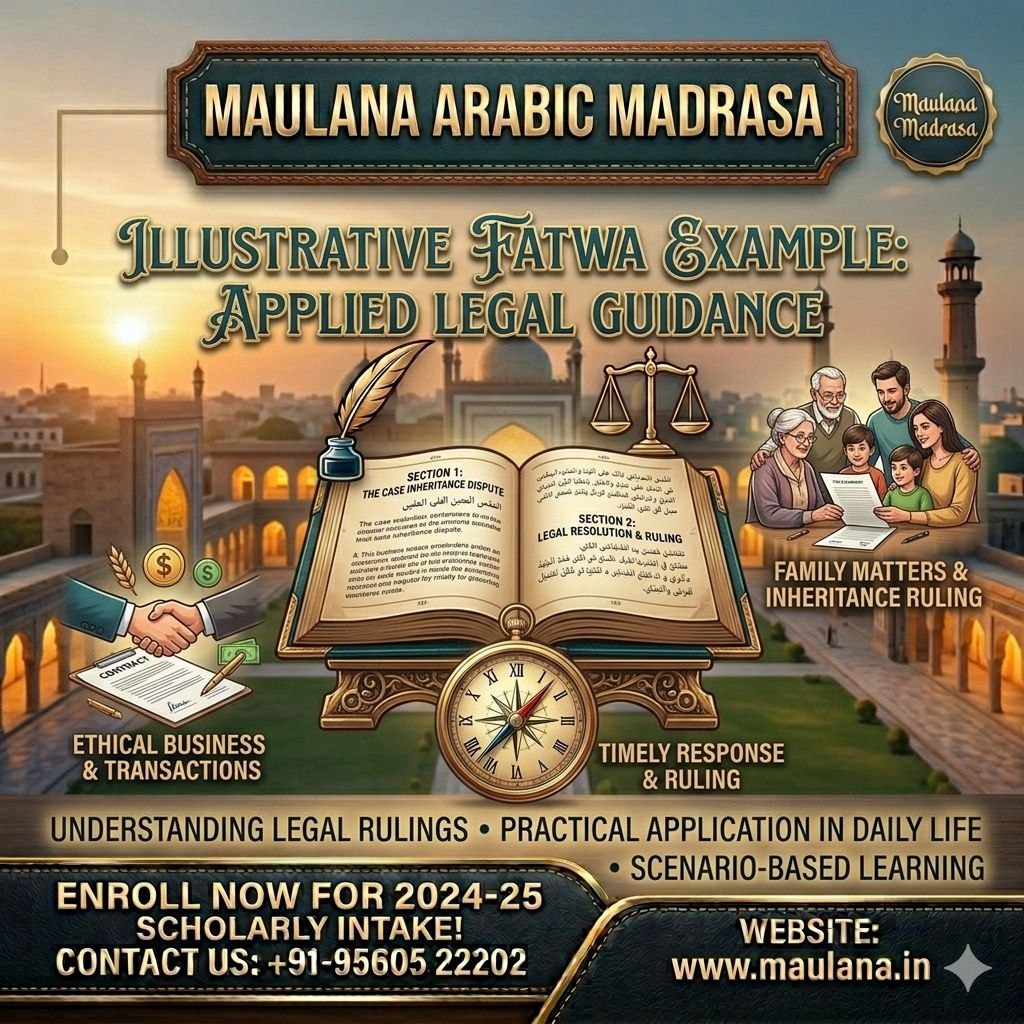
Case Study: A Contemporary Fatwa Example on Modern Finance
To illustrate this complex process clearly, let us analyze a highly relevant, real-world Fatwa example regarding Online Stock Intraday Trading. This actual scenario highlights how a modern career path is systematically evaluated under traditional Islamic principles.
📝 The Istifta (The Question Received)
“Assalamu Alaikum. I am a software engineer looking to transition into full-time stock trading. I specialize in intraday trading, where I buy corporate shares and sell them within a few hours before the market closes to lock in minor price movements. I never take physical delivery of these shares; the transactions are entirely digital and settled online. Is this specific business model permissible (Halal) under Shariat law, or does it violate Islamic financial ethics?”
🔍 The Scholarly Analysis & Research Phase
When our judicial board received this query, they broke down the mechanics of intraday trading against the classical Islamic laws of commerce (Kitab al-Buyu). This research stage is vital for creating a reliable Fatwa example that the public can look to for guidance.
The Principle of Possession (Qabd): A foundational Islamic ruling states that a believer cannot sell an item they have purchased until they have taken full, undisputed possession of it. In digital trading, while the transaction happens instantly, the legal ownership settlement often takes up to 48 hours (T+2).
Speculative Risk (Gharar): Shariat strictly prohibits transactions driven by extreme uncertainty or blind speculation, which closely mirror gambling elements. Intraday trading relies heavily on rapid, high-stress market rumors rather than long-term asset growth.
The Official Al-Jawab (The Stamped Decree)
Based on the extensive textual evidence, our Darul Ifta issued a definitive response. The text from this standard Fatwa example states:
“While long-term value investing in Shariat-compliant companies is entirely permissible (Halal), short-term intraday trading where shares are bought and sold without taking structural delivery or completing ownership settlement is not permissible (Gharam/Najayz). Selling an asset before acquiring full risk-bearing possession violates core prophetic commands. We advise the questioner to pivot toward delivery-based, long-term equity holding where full ownership is established before any resale.”
Core Operational Domains of Daily Decrees
To give you a broader view of how these legal principles apply across other areas of life, our academic board addresses queries across multiple core paths. For instance, an Ibadaat (Worship) query often evaluates a Fatwa example such as using medical inhalers or insulin drops while fasting.
In the realm of Muamalat (Finance), a typical Fatwa example covers modern dilemmas like earning cashback rewards, digital credit card points, or multi-level marketing setups. For Munakahat (Family Law), scholars regularly review queries regarding executing marital contracts via video conferencing or digital signatures. Finally, under Aadaab (Ethics), a frequent Fatwa example involves analyzing the permissibility of animal-derived enzymes in modern gelatin foods or pharmaceutical products.
The Vital Role of Institutional Verification
As this modern Fatwa example demonstrates, deriving a reliable religious decree requires exceptional academic discipline. Trying to find quick answers on unverified forums can easily lead to misinformed decisions that might conflict with your spiritual values.
Deep Textual Mastery: A qualified Mufti spends decades studying complex Arabic grammar and comparative law to ensure every decree is rooted firmly in classical traditions.
Contextual Awareness: True scholarship requires understanding how modern systems function in the real world. Our council consults with financial experts and medical doctors to analyze technical details before writing a single word for a contemporary Fatwa example.
Balanced Guidance: True jurisprudence avoids extreme rigidity while completely rejecting compromised principles, offering everyday families balanced, practical paths forward.
Partner with Maulana Arabic Madrasa for Authentic Guidance
Navigating complex modern issues while safeguarding your faith requires an institution backed by generational trust, deep academic roots, and complete transparency. At Maulana Arabic Madrasa, our Darul Ifta treats every personal, financial, and family dilemma with the utmost spiritual seriousness.
Stop leaving your critical ethical decisions to casual online searches. Reach out to our central board, submit your queries through our secure channels, and receive a thoroughly researched, stamped Fatwa example or personalized decree tailored precisely to your circumstances. Contact our administration desk today to learn how to submit a question or to access our complete verified archives!
Connect with Our Central Coordination Office
If you have an urgent question regarding personal, financial, or family matters, or if you require an official, stamped physical copy of a decree for your records, reach out to our central desk today:
📱 Direct Phone / WhatsApp Helpline: +91-95605 22202
📧 Official Academic Email: maulanaarabicidara@gmail.com
🌐 Central Web Portal: www.maulana.in
📍 Central Campus Headquarters: Maulana Arabic Madrasa, Rz 2054 street 27 Tughlakabad extension New Delhi 110019