
For devout Muslims striving to live in full compliance with theological frameworks, modern life frequently presents intricate ethical scenarios. Whether managing cross-border commercial contracts, resolving complex inheritance structures, or determining personal spiritual duties, individuals must constantly look toward structural religious guidelines to ground their actions. When diving into traditional jurisprudence, two major concepts routinely dominate the legal conversation, leading many believers to seek a clear distinction regarding Fatwa vs Islamic ruling. Understanding the subtle structural differences highlighted in a Fatwa vs Islamic ruling comparison is incredibly vital for everyday believers; it allows the community to accurately gauge the legal authority, structural enforceability, and situational boundaries of any religious decree they encounter, protecting them from falling into misinformed interpretations or relying on unauthorized opinions found online.
At Maulana Arabic Madrasa, we believe that deep, authentic religious education is the absolute foundation of a healthy, harmonious community. Through our central judicial board, we actively work to simplify complex legal terminologies, helping ordinary families implement classical Shariat guidelines across their modern daily routines. This comprehensive guide provides an exhaustive look into the distinct definitions, operational boundaries, and practical executions of these two foundational pillars of Islamic jurisprudence.
Defining the Core Frameworks of Jurisprudence
To properly compare these two theological pillars, we must first break down their distinct individual meanings, source materials, and execution methods within classical law.
⚖️ Unpacking the Islamic Ruling (Hukm Shar’i)
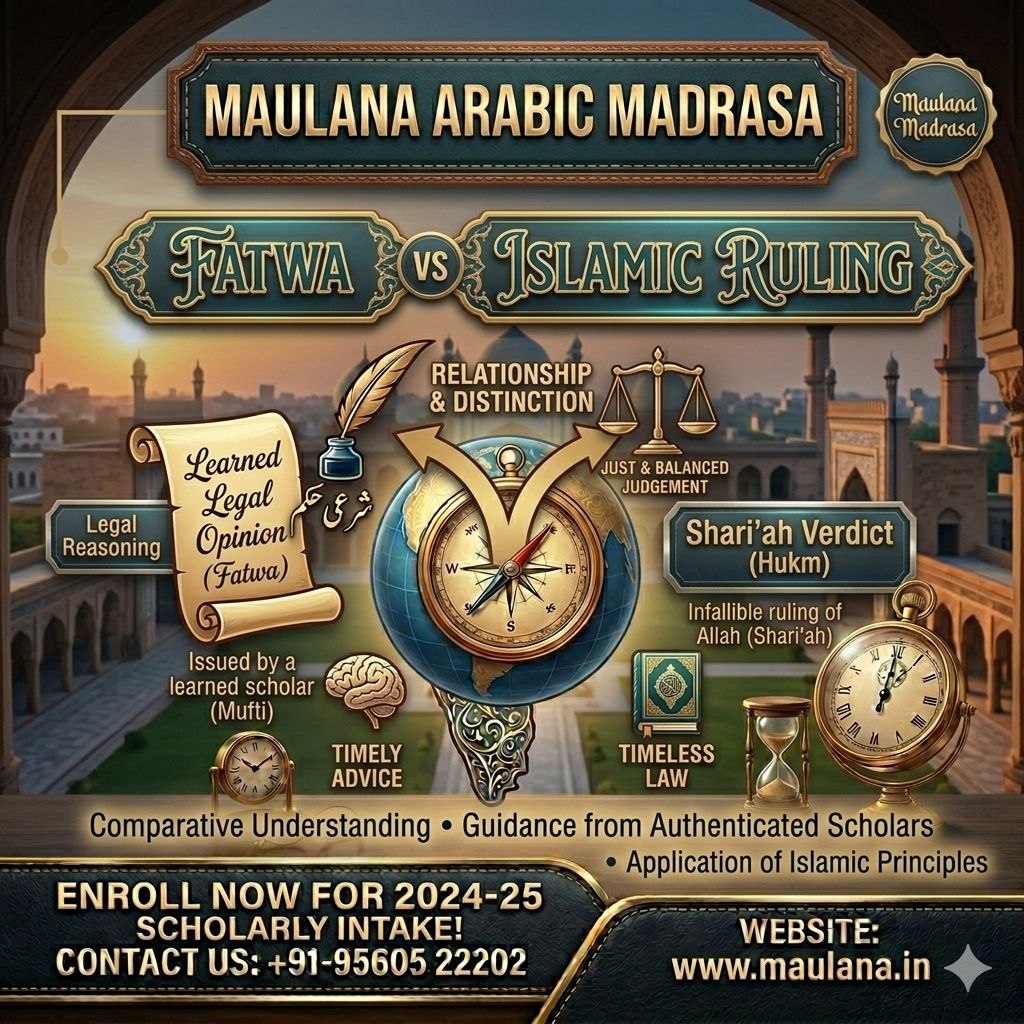
An Islamic ruling—traditionally referred to by scholars as a Hukm Shar’i—is a universal, absolute, and unchangeable decree derived directly from the foundational texts of the faith: the Holy Quran and the authentic traditions of the Prophet (Sunnah). These rulings apply universally to all responsible believers across all eras and geographic locations. For example, the daily obligation of performing five prayers (Namaz), the absolute prohibition of alcohol (Khamr), and the clear-cut rules of standard inheritance fractions are permanent structural realities that do not shift based on personal opinions or regional borders. This is a foundational element to consider when analyzing the application of a Fatwa vs Islamic ruling in daily life.
Unpacking the Fatwa (Legal Opinion)
A Fatwa, conversely, is a contextual, advisory legal opinion issued by a highly trained jurist (Mufti) in response to a specific, unique question submitted by an individual or a contemporary organization. It represents an expert application of universal rules to a highly specific set of real-world circumstances. While an Islamic ruling states that consuming intoxicants is strictly prohibited, a Fatwa is what determines whether a newly manufactured, complex medical drug containing a trace amount of chemical alcohol is permissible (Halal) for a patient under life-threatening conditions. Therefore, checking a direct Fatwa vs Islamic ruling dynamic helps clarify that one is a broad foundation while the other is a situational application.
The Structural Breakdown: Enforceability and Scope
Understanding how these concepts function in practice requires checking who possesses the right to issue them and how binding they are on everyday families.
Universal vs Individual Application: An Islamic ruling stands as a universal banner for the entire global Muslim community. A Fatwa is heavily tailored to the specific context of the person or community asking the question, taking into account their unique geographic location, local civil laws, and personal hardpress conditions.
Advisory Nature vs Absolute Command: Disobeying a clear, foundational Islamic ruling (such as completely refusing to pay Zakat) constitutes a direct spiritual violation. However, because a Fatwa represents a scholar’s expert interpretation of a unique situation, an individual who feels uncertain about a specific decree can consult a different qualified judicial board for a secondary opinion. This reality highlights why evaluating a Fatwa vs Islamic ruling matters for individual choice.
The Power of Enforcement: In an established, classical judicial ecosystem, a court judge’s verdict (Qaza) carries mandatory civil enforceability. A Fatwa remains fundamentally advisory—it provides a spiritual map to guide a believer’s personal conscience and moral standing before the Almighty.
How Our Council Generates Contextual Decrees
Issuing a valid decree requires an exceptional degree of academic discipline and tracking. At Maulana Arabic Madrasa, our judicial department approaches every question with massive spiritual seriousness, keeping the conceptual distinction of Fatwa vs Islamic ruling at the center of our methodology.
Sawal (Intake): A user submits a highly detailed, written question regarding a personal matter, real estate issue, or modern business challenge.
Tehqeeq (Research): Our research scholars cross-reference the problem with classical legal texts to identify the absolute, foundational Islamic rulings that govern that broader category.
Ifta (Contextualization): The Mufti analyzes the applicant’s specific local limitations and modern administrative contexts to derive a precise, customized legal opinion.
Tasdeeq (Issuance): The text is verified, signed, and stamped with our institutional seal before being safely delivered to the applicant, serving as a practical demonstration of a Fatwa vs Islamic ruling moving from theory to reality.
Addressing Contemporary Modern Challenges
As global economics, healthcare systems, and digital landscapes advance at blistering speeds, the intersection of Fatwa vs Islamic ruling becomes incredibly obvious across several modern domains:
📱 Digital and Financial Assets
The core Islamic ruling strictly prohibits any form of exploitative finance or gambling (Qimar). However, as complex digital assets, cryptocurrencies, and automated trading algorithms enter the market, our panel must analyze the structural mechanics of each individual platform to issue a precise Fatwa regarding which digital instruments are completely clean for public investment.
🔬 Advanced Medical Ethics
While the preservation of human life is a primary, foundational Islamic ruling, modern technologies like life support systems, organ donations, and complex genetic therapies present intricate moral puzzles. Our Muftis evaluate detailed medical reports case-by-case to tell grieving families exactly how to proceed in full alignment with their spiritual values, resolving the practical loop of Fatwa vs Islamic ruling.
Why Choose Maulana Arabic Madrasa for Clarification?
When your family’s peace of mind, financial ethics, and spiritual well-being are on the line, navigating complex legal terminology demands an institution backed by complete integrity, deep historical roots, and communal respect:
Highly Specialized Mufti Panel: Our Darul Ifta consists of senior jurists who have spent decades mastering comparative Islamic law and classical Arabic grammar across world-renowned traditional seminaries.
Absolute Data Privacy: We understand that personal marital dilemmas or corporate financial audits require complete discretion. Our portal utilizes top-tier data security to keep your records entirely private.
Clear, Practical Language: We actively avoid abstract academic vocabulary, delivering our responses in straightforward, actionable language that modern families can implement immediately.
Connect with Our Central Administration Office
If you have a critical question regarding any personal, financial, or family matter, or if you require an official, stamped physical copy of a decree for your administrative records, reach out to our central coordination desk today:
📱 Direct Phone / WhatsApp Helpline: +91-95605 22202
📧 Official Support Email: maulanaarabicidara@gmail.com
🌐 Central Web Portal: www.maulana.in
📍 Central Campus Headquarters: Maulana Arabic Madrasa, Rz 2054 street 27 Tughlakabad extension New Delhi 110019