
Navigating the multi-layered jurisprudential systems of personal status laws in the Indian subcontinent requires an exceptional balance of deep scriptural understanding and contemporary statutory awareness. For Muslim families seeking to resolve complex marital breakdowns with absolute spiritual and legal integrity, gaining an authoritative clarity on the operational mechanics of Islamic Divorce Law India is an uncompromised necessity. Thoroughly understanding the pathways of Islamic Divorce Law India empowers serious seekers of truth to protect their sacred marital contracts (Nikah), evaluate financial obligations including deferred dower (Mahr) accurately, and implement separation protocols that strictly align with both traditional prophetic traditions (Sunnah) and the prevailing legal statutes upheld by national courts, keeping your household’s personal status entirely secure and legally sound.
At Maulana Arabic Madrasa, we are profoundly dedicated to providing world-class classical Arabic scholarship, traditional legal consultations, and expert scriptural guidance for modern Muslim households across the nation. Our central research council, consisting of highly qualified jurists and certified legal specialists (Muftis), works tirelessly to ensure families receive accurate, moderate, and lawful resolutions to personal dilemmas. This exhaustive, 1200-word academic overview breaks down the specific forms of dissolution, statutory legislative updates, processing phases within judicial bodies, and localized support systems that define the practice of contemporary personal jurisprudence across the country.
The Foundations of Dissolution: Sacred Principles of Separation
In traditional Islamic jurisprudence, marriage is a highly celebrated, solemn social contract (Mithaq-e-Ghaliz) rather than a simple temporary arrangement. Consequently, dissolving this bond is viewed as a last resort when all structural reconciliation loops have completely failed.
The Commandment of Arbitration: Scriptural guidelines strongly mandate that before any formal separation steps are taken, representing arbiters from both the husband’s and wife’s families must come together to attempt sincere mediation and structural reconciliation.
The Concept of Just Resolution: If a marital separation becomes completely unavoidable, the process must be executed with absolute dignity, mutual respect, and strict adherence to scriptural financial protections rather than bitter emotional disputes.
The Double Guardrail Framework: Operating inside the modern legal framework means a valid separation must pass a dual test: it must fulfill the precise linguistic and physical parameters required by classical Islamic law while remaining fully compliant with current statutory codes.
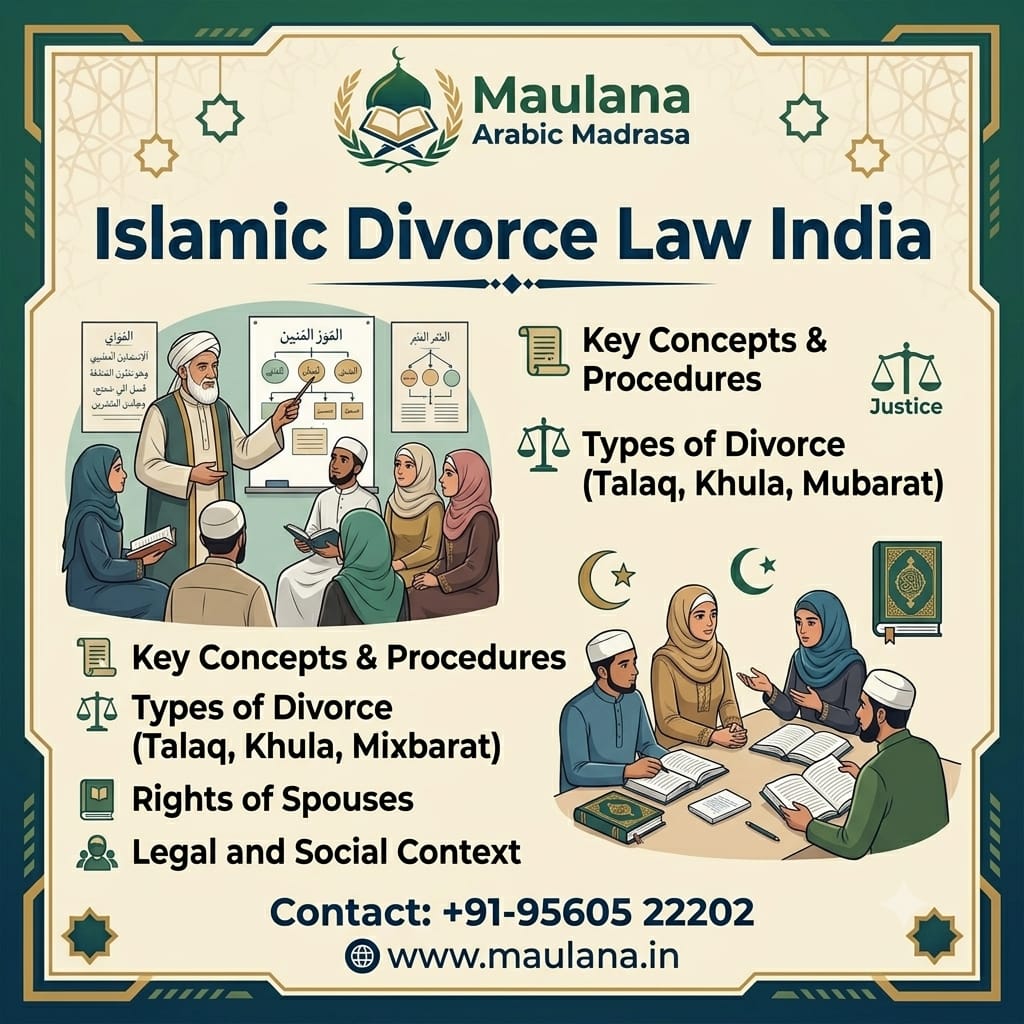
Categorized Pathways Under Islamic Divorce Law India
The framework of Islamic Divorce Law India provides distinct operational methodologies for dissolving a marriage, depending on which partner initiates the process or whether the separation is based on mutual consent.
📐 1. Talaq (Dissolution Initiated by the Husband)
Under the traditional parameters of Islamic Divorce Law India, Talaq refers specifically to the dissolution process initiated directly by the husband. It is structurally divided into approved traditional practices (Talaq-ul-Sunnah) which are executed sequentially over separate intervals to allow for ample cooling-off periods and family mediation:
Talaq Ahsan: A single, revocable pronouncement made during a period of marital purity (Tuhr), followed by a mandatory three-month waiting period (Iddah). If no reconciliation occurs, the separation becomes final.
Talaq Hasan: Three successive pronouncements made over three consecutive monthly periods of purity, ensuring multiple opportunities for deliberate reflection and marital restoration.
⚛️ 2. Khula (Dissolution Initiated by the Wife)
When a wife determines that a marriage can no longer be sustained due to irreconcilable differences or harm, she holds the absolute scriptural right to initiate a separation called Khula. In this process, she approaches her husband or an authoritative council to dissolve the contract, typically agreeing to return or waive a portion of her Mahr as a formal consideration for her release.
🧲 3. Mubarat (Dissolution via Mutual Consent)
When both partners mutually agree that their personalities, goals, or lifestyles are completely incompatible, they can opt for Mubarat. In this harmonious pathway, both the husband and wife jointly sign a dissolution agreement, instantly initiating the required waiting period with zero requirement for lengthy litigation.
Navigating the Statutory Landscape and Legislative Safeguards
Operating a respected legal guidance department (Darul Ifta) requires an uncompromising dedication to legal accuracy. When evaluating the modern practice of Islamic Divorce Law India, candidates must understand how statutory acts intersect with personal religious metrics:
The baseline application of Muslim personal status codes is governed primarily by the Muslim Personal Law (Shariat) Application Act of 1937. This explicitly establishes that matters concerning marriage, dower, maintenance, and dissolution are adjudicated using traditional Islamic jurisprudence rather than general civil codes.
Furthermore, the Dissolution of Muslim Marriages Act of 1939 provides Muslim women in India with a powerful statutory tool to seek a judicial decree of separation through civil courts on specific, well-defined grounds. These legal grounds include the husband’s unexplained absence for over four years, failure to provide reasonable financial maintenance for a consecutive period of two years, severe physical or emotional cruelty, or long-term imprisonment. Gaining a deep clarity on these statutory layers is a core focus across our advanced Islamic Divorce Law India guidance modules.
The Four-Phase Operational Processing within Our Council
When complex marital disputes or legal intake questions arrive at our administrative desk, our central guidance council deploys a highly disciplined four-phase processing cycle to ensure absolute trust signals and ethical resolution:
Phase 1 – Comprehensive Intake & Counseling: Both partners present their historical grievances through a structured written intake process. Our senior scholars instantly organize mandatory marital counseling sessions to explore all potential reconciliation paths.
Phase 2 – Textual Verification & Rights Analysis: If separation is deemed absolutely unavoidable, our jurists analyze the original Nikah contract to calculate the precise status of prompt and deferred Mahr, ensuring the wife’s financial rights are fully protected.
Phase 3 – Execution of Proper Procedural Steps: The council guides the family through the correct, step-by-step traditional separation scripts (such as Talaq Ahsan or Khula), completely avoiding unauthorized or harmful methods.
Phase 4 – Formal Certification & Post-Separation Guidance: A formal, stamped certificate is issued detailing the exact terms of the separation. The council provides strict tracking on the rules of the Iddah waiting period, child custody boundaries, and maintenance terms.
Bypassing the Dangers of Unverified Online Decrees
As unregulated digital networks and automated chatbots flood the internet with generic, anonymous religious decrees, grounding your personal decisions within an authoritative Islamic Divorce Law India campus is vital for your long-term family stability.
Many community-driven websites provide instant, cut-and-paste answers that completely lack deep linguistic understanding, psychological empathy, or real-world awareness of Indian statutory limitations. Relying on anonymous web forums can cause families to execute flawed, legally invalid separations that lead to severe civil litigation or lifelong spiritual distress. Trusting a professional, brick-and-mortar institution like ours guarantees that your family’s personal transitions are safely overseen by certified experts who balance scriptural truth with complete national legal compliance.
Why Maulana Arabic Madrasa Remains Trusted Nationwide
Selecting the right institutional partner to safeguard your family’s personal and spiritual welfare requires looking for an academy backed by absolute operational credentials and communal trust:
Elite Certified Jurists: Our physical and virtual lecture rooms are led exclusively by highly qualified professors who hold advanced degrees in Islamic law from historic world-class seminaries.
Fully Segregated Private Counseling: We provide entirely private, comfortable online and offline counseling tracks for women led by certified female scholars (Alimah), ensuring absolute peace of mind.
Uncompromising Data Confidentiality: This strict operational standard is actively enforced across every single Islamic Divorce Law India query log we host, ensuring that student enrollment data, family records, and legal consultations stay entirely confidential.
Secure Your Path with Verified Juridical Truth Today
Resolving complex personal, familial, or contractual milestones does not require exhausting emotional disputes or legal compromise. By anchoring your family’s journey within our premier Islamic Divorce Law India network, you unlock immediate access to an elite world of scriptural excellence and statutory harmony adapted beautifully for the modern era.
Stop leaving your critical character development, domestic peace, or private spiritual clarity to random, anonymous internet spaces. Secure your path with verified classical truth. Connect with our central administrative coordination desk today, request a direct counseling session with our senior faculty panel, and explore the vast academic and legal horizons waiting for you within our historic community!
Connect with Our Central Coordination Office
If you are ready to initiate your course enrollment, submit a complex query to our personal law panel, or require an official physical prospectus sent to your home address, reach out to our desk today. Our central campus headquarters is conveniently accessible for families across Delhi, Noida, and Ghaziabad via the Tughlakabad metro corridor.
📱 Direct Phone / WhatsApp Helpline: +91-95605 22202
📧 Official Support Email: maulanaarabicidara@gmail.com
🌐 Central Web Portal: www.maulana.in
📍 Central Campus Headquarters: Maulana Arabic Madrasa, Rz 2054 street 27 Tughlakabad extension New Delhi 110019