
Marriage (Nikah) in Islam is viewed as a highly sacred, solemn contract (Mithaq-e-Ghaliz) designed to bring lifelong emotional tranquility, mutual spiritual growth, and familial stability. However, islamic jurisprudence realistically recognizes that certain marital unions may face irreconcilable breakdowns despite the couple’s best efforts toward mutual accommodation. When all channels of reconciliation fade and separation becomes the only constructive path forward, mastering the legal and religious requirements of the Muslim Divorce Procedure India system becomes an uncompromised necessity to protect your familial rights. Navigating the authentic, contemporary Muslim Divorce Procedure India framework empowers serious individuals to maintain flawless compliance with standard Quranic boundaries, execute proper financial settlements such as the completion of Mahr (dower) distributions, and avoid complicated statutory violations under modern Indian civil statutes, ensuring your transition into a new life stage remains dignified and secure.
At Maulana Arabic Madrasa, we are profoundly dedicated to providing world-class scriptural guidance, expert textual analysis, and compassionate mediation counsel for complex personal and matrimonial affairs. Our central legal council (Darul Ifta), consisting of veteran traditional jurists and certified legal consultants, handles daily inquiries across marital disputes with absolute accuracy and care. This extensive, 1200-word tactical guide maps out the various legal routes, precise timeline parameters, mandatory scriptural phases, and essential documentation requirements that define a valid legal separation across the nation.
The Core Jurisprudential Pillars: Understanding Legal Classifications
The architecture of personal separation under the application of the Muslim Personal Law (Shariat) Application Act framework recognizes distinct operational methods. A baseline Muslim Divorce Procedure India roadmap divides these separations by identifying which party initiates the legal process.
Talaq (Initiated by the Husband): The unilateral release from the marital tie by the husband, which must strictly follow the prophetic guidelines to avoid spiritual and structural validation errors.
Khula (Initiated by the Wife): A formal separation pathway where the wife purchases her release from the marriage contract, typically by returning the Mahr or an agreed-upon financial asset to the husband.
Talaq-e-Tafweez (Delegated Talaq): A unique contractual power given to the wife within the original Nikahnama (marriage contract), permitting her to dissolve the union under specific pre-determined violations.
Mubarat (Mutual Dissolution): A highly smooth, peaceful separation method where both husband and wife mutually agree to terminate their marriage contract, erasing negative friction completely.
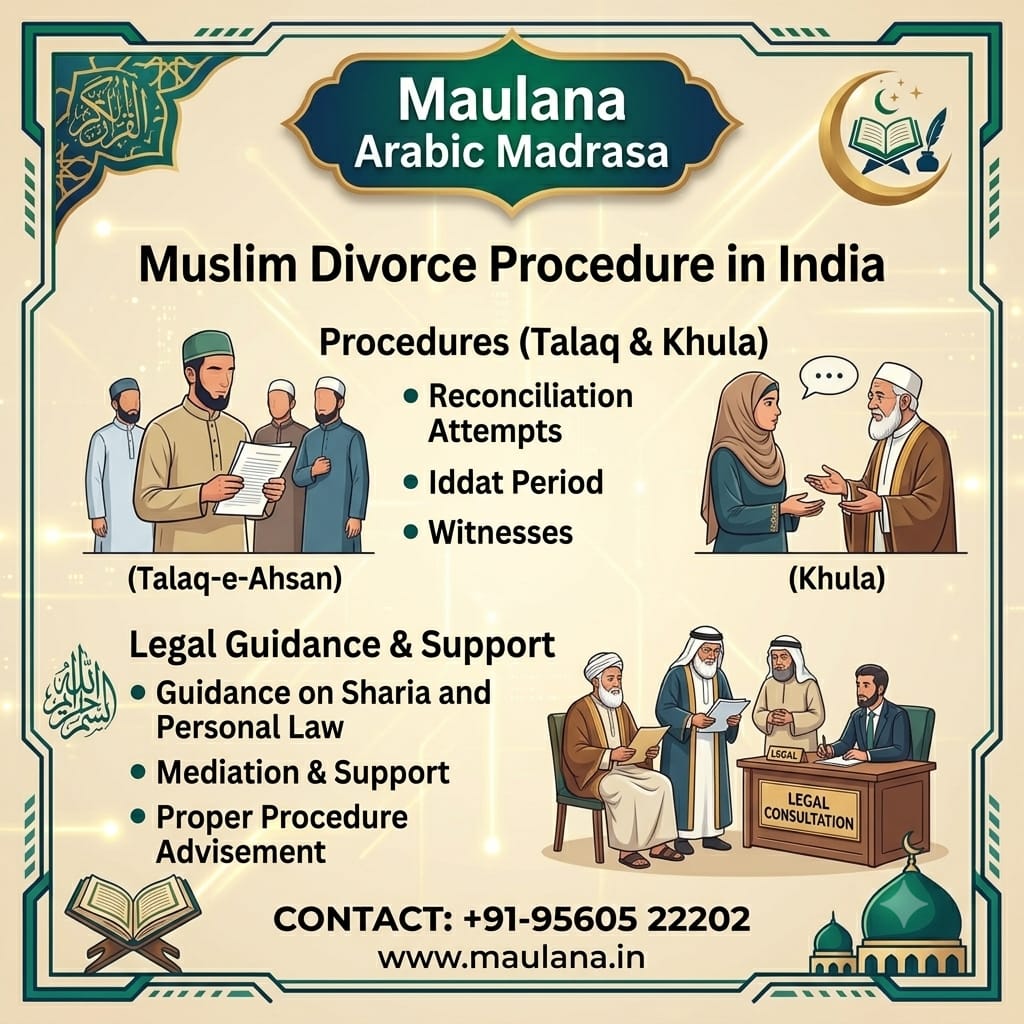
Detailed Operational Routes: Unpacking the Valid Procedures
To ensure your separation doesn’t fall into invalid, illegal, or obsolete formats, your chosen Muslim Divorce Procedure India layout must strictly align with authentic prophetic formats. Our central idara systematically guides families through the two universally approved traditional methods.
📐 1. Talaq-e-Ahsan (The Most Approved Format)
This stands as the most righteous, highly recommended method of separation because it leaves the maximum possible window open for peaceful marital reconciliation.
The Single Pronouncement: The husband makes a single, clear announcement of divorce during a period of Tuhr (the phase between the wife’s menstrual cycles when no marital relations have occurred).
The Idah Mandate: The wife immediately enters her mandatory waiting period (Iddah), which lasts for exactly three menstrual cycles (or until delivery if she is pregnant).
The Revocation Window: During this 3-month block, the husband can easily revoke the separation through verbal affirmation or a return to normal marital relations, making a brand new marriage contract unnecessary. If the period expires without revocation, the divorce becomes final and irrevocable.
⚛️ 2. Talaq-e-Hasan (The Good Format)
This alternative approved route involves a sequential, phased processing framework spread across three consecutive months to prevent impulsive decisions.
The First Declaration: The husband pronounces the first declaration of separation during a valid period of Tuhr.
The Second Declaration: If reconciliation attempts fail, a second declaration is pronounced during the subsequent Tuhr period.
The Final Declaration: The third and final pronouncement is made during the third consecutive Tuhr. Upon this third announcement, the separation becomes instantly absolute and permanent, completely ending the marriage contract.
The Four-Phase Processing Loop of Our Institutional Shariah Council
Simply making oral announcements at home without official registration can create severe civil verification blockages later in life. When couples approach our main campus office seeking formal processing, our council implements a strict four-phase Muslim Divorce Procedure India management loop:
Phase 1 – Istifta & Arbitration Intake: The council records the comprehensive historical context of the dispute. In alignment with Quranic law, we appoint dedicated arbiters from both families to exhaust every possible channel for mutual peace and emotional healing.
Phase 2 – Clear Execution & Document Review: If arbitration fails and the parties firmly choose to separate, the exact scriptural method (Ahsan, Hasan, or Khula) is executed. The council reviews critical records, specifically verifying that the complete Mahr has been delivered to the wife.
Phase 3 – Strict Iddah Monitoring: The council provides explicit guidance on tracking the Iddah period accurately. During this time, the husband remains entirely responsible for providing safe accommodation and full maintenance costs to the wife.
Phase 4 – Formal Certification: Upon the successful completion of the waiting period, our central legal bureau issues an official, stamped Arabic and English Divorce Certificate (Talaqnama or Khulanama), which serves as a vital document for updating passport, banking, and civil status details.
Safely Avoiding Obsolete, Illegal, and Unverified Practices
As unverified online chat portals and automated digital forums try to issue rapid religious opinions, safeguarding your family with a certified, institutional Muslim Divorce Procedure India pathway is vital for your long-term legal safety.
Serious candidates must remain fully aware that the practice of Talaq-e-Biddat (Triple Talaq in a single sitting) has been completely criminalized and banned across the country under the Muslim Women (Protection of Rights on Marriage) Act. Engaging in or attempting to execute this illegal format carries severe penal consequences, including up to three years of imprisonment. This statutory reality is exactly why relying on a professional, brick-and-mortar institution is critical. Ensuring your Muslim Divorce Procedure India runs through our traditional, multi-layered arbitration process completely shields your household from unforced legal errors and ensures absolute validation under both sacred Islamic jurisprudence and Indian civil court systems.
Why Maulana Arabic Madrasa is Trusted Nationwide
Selecting the right institutional partner to guide your family through complex personal transitions requires finding an academy backed by pristine academic credentials, structural discipline, and deep community trust:
Elite Certified Mufti Council: Our legal department is led exclusively by highly qualified professors who hold advanced specializations in Islamic jurisprudence (Ifta) from globally recognized historic universities.
Complete Confidentiality Protocols: We understand the delicate, deeply private nature of matrimonial disputes. All consultations, mediation logs, and personal family records are kept entirely confidential under strict internal data locks.
Seamless Civil and Shariah Alignment: Our documentation processes are carefully designed to serve as rock-solid, highly reliable evidence if you ever need to present your case before a modern Indian family court.
Secure Your Rights and Spiritual Clarity Today
Resolving a deeply broken marital contract does not have to result in chaotic, bitter disputes or spiritual compromises. By routing your family’s needs through our premier Muslim Divorce Procedure India framework, you gain immediate access to an elite community of traditional experts dedicated to preserving human dignity, protective legal rights, and scriptural truth.
Stop leaving your critical marital status, financial dower settlements, or private spiritual peace to anonymous online forums or unverified self-proclaimed advisors. Secure your personal path with clear, verified truth. Connect with our central administrative coordination desk today, request a direct, private consultation session with our senior jurists, and restore structure to your family’s journey.
Connect with Our Central Coordination Office
If you are ready to schedule an arbitration session, require an official certificate for a concluded separation, or need an expert legal opinion (Fatwa) regarding your specific marital status, reach out to our central coordination desk today. Our primary campus headquarters is easily accessible via the Tughlakabad metro corridor:
📱 Direct Phone / WhatsApp Helpline: +91-95605 22202
📧 Official Support Email: maulanaarabicidara@gmail.com
🌐 Central Web Portal: www.maulana.in
📍 Central Campus Headquarters: Maulana Arabic Madrasa, Rz 2054, Street 27, Tughlakabad Extension, New Delhi, 110019, India