
Maulana

يَٰٓأَيُّهَا ٱلَّذِينَ ءَامَنُوا۟ ٱتَّقُوا۟ ٱللَّهَ حَقَّ تُقَاتِهِۦ

Maulana Arabic Idara ll Courses HAFIZ-E-QUR’AN ll Alim/Alimah ll Deeniyat ll Fiqh courses starts from 15th December
Online Islamic Advice India
Uncategorized

Online Islamic Advice India: Authentic Spiritual Guidance At Your Fingertips

In today’s fast-paced, digital world, finding trustworthy solutions to life’s complex questions in light of the Holy Qur’an and Sunnah can be a challenge. To help you navigate your day-to-day personal, family, and financial matters, Maulana Arabic Madrasa offers a reliable platform for Online Islamic Advice India. Seeking reliable Online Islamic Advice India ensures that you receive authentic, textually backed, and compassionate answers from qualified Islamic scholars without having to step out of your home. Why Seek Online Islamic Advice? Living in a rapidly changing world brings unique contemporary situations that require careful evaluation through the lens of Islamic jurisprudence (Fiqh). Whether you are dealing with modern financial contracts, intricate marital issues, or daily spiritual doubts, professional advice helps keep your life aligned with the commands of Allah (SWT).Turning to a certified online platform ensures that you do not rely on unverified internet search results or casual opinions. Instead, you connect directly with scholarly wisdom rooted deeply in classical Islamic traditions. The Benefits of Choosing Our Digital Counseling Portal Historically, seeking counsel required traveling long distances to meet an Imam or a Mufti at a traditional Darul Ifta. While physical consultations hold immense value, our dedicated portal for Online Islamic Advice India removes geographical barriers and brings classical knowledge directly to your screen.✨ Absolute Privacy & Confidentiality: Many personal, financial, or marital issues require strict privacy. Our digital counseling portal ensures your identity and questions remain entirely confidential.✨ Accessible Anywhere, Anytime: No matter which part of the country or the world you reside in, authentic scholarly support is just a few clicks away.✨ Responses from Authorized Ulama: Every query is handled by trained scholars who have spent years studying Arabic grammar, Tafseer, Hadith, and Islamic legal frameworks.✨ Clear, Documented Solutions: When you request Online Islamic Advice India, you receive structured, well-explained responses that you can save and read at your own pace. Core Areas Covered by Our Learned Scholars At Maulana Arabic Madrasa, our panel of experienced Muftis and Alims address a wide range of subjects. No matter how simple or complex your query might seem, our team provides comprehensive guidance across multiple aspects of life.👥 1. Family Counseling and Marital HarmonyMaintaining a peaceful and righteous household requires constant patience and adherence to Islamic ethics. Our platform provides sensitive and precise advice on:Resolving misunderstandings between spouses, parents, and children.Clarifying the rights and duties of family members under Sharia law.Step-by-step guidance on Nikah (marriage) requirements, Talaq (divorce), and inheritance issues.💰 2. Halal Business, Finance, and InvestmentsModern commerce moves fast, bringing complex elements like digital banking, stock market trading, corporate partnerships, and e-commerce transactions. Before stepping into a financial venture, seeking Online Islamic Advice India helps protect your earnings from Riba (usury/interest) or Gharar (deceptive uncertainty), keeping your income completely pure and blessed.📿 3. Clarifications on Daily Worship (Ibadah)From the precise rules of physical purification (Taharah) and daily prayers (Salah) to the intricate calculations of Zakat, fasting procedures, and the rites of Hajj or Umrah, you can clarify your questions instantly. We help you correct your daily practices to ensure your acts of worship are valid and executed properly.🧠 4. Mental Peace and Spiritual GrowthIn an age filled with anxiety and stress, it is common to face spiritual low points or intrusive doubts (Waswasah). Our scholars provide therapeutic, faith-based advice combined with recommended Duas and prophetic remedies to help restore your mental peace and strengthen your connection with Allah (SWT). Our Methodology for Delivering Sound Counsel When you ask for Online Islamic Advice India, your question undergoes a rigorous, systematic review process by our academic board to ensure absolute theological accuracy:Contextual Assessment: Scholars carefully read and break down your query to fully understand your specific living conditions and intent.Scriptural Reference: The primary sources—the Holy Qur’an and authentic Hadith collections (such as Sahih al-Bukhari and Sahih Muslim)—are thoroughly consulted.Classical Juristic Review: For modern complex dilemmas, our Muftis utilize established Ijma (scholarly consensus) and Qiyas (analogical reasoning) from reliable classical Fiqh schools.Final Formulation: The advice is drafted in simple, accessible English, verified for clarity, and sent directly to you with proper references. Why Trust Maulana Arabic Madrasa? Maulana Arabic Madrasa (Maulana Arabic Idara) is a premier institution built on the foundations of traditional Islamic sciences while embracing modern communication tools. Choosing our portal for Online Islamic Advice India guarantees that you are consulting a highly reputable board of educators.Our scholars combine deep textual knowledge with a realistic understanding of contemporary social dynamics. This balanced approach ensures that the guidance you receive is not only highly authentic but also completely practical for your daily life. Step-by-Step: How to Submit Your Query Getting clarity on your pressing spiritual or personal matters is incredibly simple through our digital outreach channels. Follow these simple steps to connect with us:Step 1: Clearly write down your situation or question. Include all essential details, as missing facts can alter the context of an Islamic ruling.Step 2: Send your detailed text or query directly to our official administrative email address or reach out over WhatsApp.Step 3: Our dedicated board of scholars will evaluate your query against classical texts and prepare a well-formulated, balanced answer.Step 4: Receive your detailed Online Islamic Advice India directly in your inbox or phone, complete with clear references and actionable spiritual steps. Get in Touch for Authentic Guidance Do not let confusion, doubts, or complex situations create spiritual unease in your heart. Rectify your business transactions, bring peace back to your family life, and clear your mind by opting for reliable Online Islamic Advice India today.Our compassionate administrative team and highly learned scholars are always ready to assist you on your path to righteousness. Reach out to Maulana Arabic Madrasa through the official channels listed below:🏢 Institution Name: Maulana Arabic Madrasa (Maulana Arabic Idara)📍 Registered Office: Gali No. 27, Tughlakabad Extension, New Delhi, India – 110019📱 Phone / WhatsApp Support: +91-95605 22202📧 Official Email Address: maulanaarabicidara@gmail.com🌐 Official Website: www.maulana.in


Islamic Legal Advice Online India
Uncategorized

Navigating Sacred Law Digitally: Reliable Islamic Legal Advice Online India

For millions of Muslims residing across the diverse landscape of the subcontinent, balancing the spiritual demands of faith with the blistering pace of modern life requires continuous access to reliable religious clarity. When intricate contemporary dilemmas arise regarding corporate financial partnerships, modern real estate contracts, or sensitive family dynamics, finding a trustworthy platform for Islamic legal advice online India becomes absolutely paramount. Accessing authentic Islamic legal advice online India enables everyday believers to separate unverified social media opinions from pure, textually grounded decrees issued by deeply learned scholars, ensuring that families protect their faith from misinterpretation while moving forward confidently with practical, shariat-compliant solutions to their unique daily challenges.At Maulana Arabic Madrasa, we are profoundly dedicated to preserving classical legal traditions while making sacred knowledge entirely accessible to contemporary, tech-savvy households. Through our centralized internet portal, our experienced board of jurists actively bridges the gap between ancient Arabic legal methodologies and the everyday cultural and administrative realities of modern Indian life. This comprehensive guide outlines the critical importance of verified virtual consultation, the rigorous academic checking behind our process, and how you can safely access our digital services. The Digital Shift: Why Access Online Guidance? In an era where remote connectivity defines our daily schedules, seeking classical theological direction has naturally transitioned into the digital space.Absolute Privacy and Discretion: We understand that personal marital disputes or sensitive business audits require total confidentiality. Utilizing a verified platform for Islamic legal advice online India ensures your private details are kept entirely safe from local gossip.Overcoming Geographical Barriers: Whether you reside in a bustling metropolitan city like Delhi, a remote town in Uttar Pradesh, or a corporate hub in South India, access to elite, peer-reviewed scholarship is now available right at your fingertips.Vetting Modern Technical Realities: As complex financial tools, online trading platforms, and modern medical procedures emerge daily, our specialized web portal provides rapid, thoroughly researched answers to ensure complete spiritual safety. The Strict Academic Standards Behind Our Digital Board The ease of digital access should never compromise the intellectual rigor required by classical jurisprudence. When you seek out Islamic legal advice online India through our institution, your queries are processed exclusively by senior Muftis who have spent decades mastering foundational legal sciences:Advanced Arabic Linguistics (Sarf and Nahw): Ensuring every foundational text from the Holy Quran and prophetic traditions (Hadith) is interpreted with flawless grammatical accuracy.The Mechanics of Extraction (Usul al-Fiqh): Utilizing the logical engine of classical lawmaking to safely apply ancient principles to modern, unencountered situations.Thorough Contextual Awareness: Our scholars consult directly with financial analysts, legal professionals, and medical experts to fully comprehend the technical mechanics of a modern problem before rendering an opinion. The Multi-Layered Method of Processing Web Queries To maintain the pristine integrity of divine law, our virtual portal functions exactly like a traditional, physical Darul Ifta. Every single request for Islamic legal advice online India passes through a disciplined, four-phase checking methodology:Phase 1: Detailed Intake (Istifta): The applicant submits a detailed, clearly worded question through our website portal, mapping out a real-world dilemma with absolute transparency.Phase 2: Textual Extraction (Takhrij): Our specialized research team dives deep into foundational Hanafi legal textbooks to anchor the problem in absolute, established historical precedents.Phase 3: Council Evaluation (Tahqiq): The central board evaluates the specific regional limitations and modern Indian civil laws to craft a balanced, precise response.Phase 4: Verification and Stamping: The finalized response is reviewed by a panel of senior scholars, signed, and stamped with our official institutional seal before being securely emailed back to the applicant. Core Operational Domains of Our Online Helpdesk To provide comprehensive coverage for the community’s needs, our internet platform handles thousands of diverse queries annually across several core lifestyle domains:Worship and Personal Devotion (Ibadaat): Providing rapid clarity on the exact rules of prayers, Zakat calculations, and determining medical exemptions during the holy fasting months.Commercial Contracts and Finance (Muamalat): Applying our digital desk for Islamic legal advice online India to check the validity of digital banking rewards, complex corporate equity investments, and modern insurance policies.Marital and Household Ethics (Munakahat): Assisting families with clean marital contracts (Nikah), documentation for separation (Khula), and providing clear mathematical blueprints for inheritance asset distribution in accordance with Shariat guidelines. Navigating the Internet Safely: Avoiding Unverified Forums While the internet offers unmatched convenience, the rise of anonymous blogs and automated forums presents a significant risk to a believer’s spiritual well-being. Finding authentic Islamic legal advice online India requires extra caution:Reject Anonymous Rulings: If a website response does not explicitly name the certified, deeply learned Mufti who authored the text, it cannot be trusted for serious religious compliance.Beware of Instant AI Fixes: True jurisprudence values patient analysis and human empathy. Avoid platforms that offer instantaneous, automated answers to highly complicated family or corporate problems.Prioritize Brick-and-Mortar Backing: Always seek out digital portals tied directly to physical, historical seminaries that hold generational community trust and maintain transparent peer-review processes. Interaction with Indian Civil Frameworks For Muslims living within the framework of India’s multi-cultural legal landscape, utilizing professional Islamic legal advice online India carries immense social value. Under national personal law statutes, minority communities retain the constitutional right to manage personal internal matters according to their respective traditions.An official, stamped digital decree from our board provides families with an authoritative, mutually respected blueprint. This helps settle complex household or estate disputes quietly, harmoniously, and fairly through community arbitration, avoiding expensive, lengthy civil court battles that can shatter family ties for generations.🤝 Partner with Maulana Arabic Madrasa TodaySafeguarding your spiritual values while managing the fast-moving realities of modern life demands mentorship rooted in absolute academic integrity. By choosing our centralized hub for Islamic legal advice online India, you gain a safe, secure, and reliable partner for all your personal, financial, and ethical questions.Stop leaving your critical career choices, family assets, or spiritual steps to casual search engine results. Connect directly with our central administrative desk, submit your questions through our secure web channels, and let our experienced, peer-reviewed council guide you with absolute scriptural precision.

Islamic Guidance Today
Uncategorized

Authentic Sharia Fatwa Online: Seek Credible Islamic Guidance Today

In today’s fast-paced digital world, finding credible solutions to everyday personal, social, and financial matters in light of Islamic jurisprudence can be challenging. To bridge this gap, Maulana Arabic Madrasa provides an authentic platform to obtain a sharia fatwa online, ensuring that Muslims worldwide can access accurate religious guidance from the comfort of their homes. Seeking a sharia fatwa online helps individuals resolve complex modern dilemmas through well-researched, textual evidence from the Holy Qur’an and the authentic Sunnah of Prophet Muhammad (PBUH). What is a Sharia Fatwa? A fatwa is a formal legal opinion or ruling given by a qualified Islamic scholar (a Mufti) on a specific point of Islamic law (Sharia). It is not a random personal opinion; rather, it is a deeply considered legal deduction derived from classical Islamic jurisprudence (Fiqh).When global dynamics change rapidly, new questions emerge regarding digital transactions, modern medical procedures, complex marital discords, and unique social interactions. A fatwa clarifies whether a specific action is Halal (permissible), Haram (forbidden), Makruh (disliked), or Mustahabb (recommended), keeping your actions fully aligned with the commands of Allah (SWT). The Need for Sharia Fatwa Online Services Historically, individuals had to travel long distances or visit local Darul Ifta centers physically to present their questions to a Mufti. While traditional methods remain deeply respected, the introduction of sharia fatwa online portals has made sacred knowledge highly accessible, secure, and private.✨ Instant Access to Qualified Muftis: You do not need to wait for days or travel miles to resolve an urgent spiritual or legal dilemma.✨ Complete Privacy and Confidentiality: Many sensitive topics regarding family disputes, inheritance issues, or personal health require strict confidentiality. An online portal allows you to ask questions anonymously.✨ Written and Documented Evidence: When you receive a sharia fatwa online, you get a clearly written response backed by specific references from Quranic verses and reliable Hadith books, which you can easily save for future reference.✨ Global Reach: No matter where you reside—whether in Asia, Europe, America, or the Middle East—you can easily connect with authentic scholars who understand global contexts. Core Areas Covered by Our Darul Ifta At Maulana Arabic Madrasa, our highly trained and authorized Muftis analyze everyday queries systematically before issuing a formal ruling. The digital portal handles a vast range of subjects, ensuring no question goes unanswered.👥 1. Family and Marital AffairsFamily dynamics can sometimes lead to misunderstandings that require immediate, objective legal guidance. Our scholars provide accurate rulings on:Nikah (Marriage) requirements and conditions.Issues regarding Talaq (Divorce), Khula (wife-initiated separation), and iddah periods.Rights and responsibilities of spouses, parents, and children under Islamic law.💰 2. Islamic Finance, Trade, and BusinessModern commerce is full of complexities like digital banking, cryptocurrency, stock market investments, and insurance policies. Getting a sharia fatwa online ensures that your hard-earned income remains completely pure and free from Riba (usury/interest) or Gharar (excessive uncertainty). We provide guidance on halal business setups, partnership agreements (Mudarabah and Musharakah), and proper corporate ethics.📊 3. Inheritance and Property DistributionThe Islamic system of estate distribution (Mirath) is precise and divinely ordained. Even minor errors can lead to violating the rights of legal heirs. Our portal helps families accurately calculate inheritance shares according to Sharia principles, eliminating disputes and ensuring absolute justice among relatives.📿 4. Acts of Worship (Ibadah)From the intricate rules of purification (Taharah) and daily prayers (Salah) to the calculation of Zakat, fasting procedures in Ramadan, and the rites of Hajj, you can easily verify the correctness of your rituals. The Methodology of Issuing a Fatwa Every sharia fatwa online issued by our academy undergoes a rigorous verification process. Islamic jurisprudence requires deep academic accountability, and our Muftis follow classical methods to ensure reliability:Textual Assessment: The query is thoroughly analyzed to understand the user’s core intent and specific circumstances.Qur’anic and Hadith Verification: Scholars look for direct textual commands from the Holy Qur’an and authentic collections of Hadith (such as Sahih al-Bukhari and Sahih Muslim).Consensus and Analogy: If the matter is modern, scholars utilize Ijma (scholarly consensus) and Qiyas (analogical reasoning) based on established classical fiqh schools.Final Review and Approval: Before the final written response is emailed or sent to the user, a senior supervisory scholar verifies the ruling to avoid any ambiguity. Why Choose Maulana Arabic Madrasa? Maulana Arabic Madrasa is a premium institute dedicated to preserving traditional Islamic sciences while adopting modern digital mediums. Requesting your sharia fatwa online through our institution guarantees structural benefits:🎓 Authenticated Scholars: Our panel consists of certified Muftis who have spent years mastering Arabic grammar, Tafseer, Hadith studies, and classical Fiqh frameworks.🌍 Contextual Awareness: Our scholars recognize that Muslims living in different parts of the world face varying legal and cultural situations, providing answers that are both textually sound and practically applicable.⚡ User-Friendly Process: The system is built to ensure a smooth, lag-free user experience, keeping your interaction straightforward and direct. How to Submit Your Query Online Getting a credible verification for your day-to-day issues is exceptionally simple. Follow these straightforward steps to receive your written ruling:Step 1: Draft your question clearly. Provide all necessary background details, as incomplete information can change the nature of an Islamic ruling.Step 2: Send your detailed question directly to our official academic email address or contact our helpline via WhatsApp.Step 3: Our dedicated board of scholars will study the matter carefully, reference the classical texts, and compose a balanced response.Step 4: Receive your official sharia fatwa online directly in your inbox, complete with references from classical Islamic jurisprudence. Get in Touch for Authentic Guidance Do not let doubts create spiritual unease or confusion in your life. Clear your mind, rectify your business practices, and settle your family matters in strict accordance with divine guidance by accessing a reliable sharia fatwa online today.Our supportive administrative team and learned scholars are always ready to assist you on your spiritual path. Reach out to Maulana Arabic Madrasa through the official contact channels listed below:🏢 Institution Name: Maulana Arabic Madrasa (Maulana Arabic Idara)📱 Phone / WhatsApp Support: +91-95605 22202📧 Official Email Inbox: maulanaarabicidara@gmail.com🌐 Official Web Portal: www.maulana.in

Is Fatwa Binding
Uncategorized

Understanding Shariat Jurisprudence: Is Fatwa Binding on a Believer?

For millions of devout Muslims trying to balance their spiritual obligations with the rapid pace of modern life, navigating complex ethical dilemmas requires clear, authoritative guidance. When unique situations surface regarding intricate corporate partnerships, modern medical breakthroughs, or sensitive family disputes, turning to classical Islamic law becomes absolutely essential. In these moments of uncertainty, a foundational question often dominates religious discussions: Is fatwa binding, and what are the exact spiritual and social consequences of choosing to follow or look past a scholar’s decree? Unpacking the definitive answer to the query “Is fatwa binding” helps everyday believers separate widespread media misconceptions from authentic theological realities, ensuring that the community understands the precise structural boundaries of an expert legal opinion within traditional jurisprudence.At Maulana Arabic Madrasa, we are deeply committed to providing authentic religious education, preserving our rich classical heritage, and offering clear solutions to modern challenges. Through our central Darul Ifta (Department of Islamic Edicts), we carefully guide Muslims across India through the intricate layers of Islamic law. This detailed, comprehensive guide explores whether an edict carries mandatory legal weight, how it functions across different regions, and how to approach these decrees with absolute clarity and peace of mind. Defining the Concept: What Exactly is a Fatwa? To properly answer if a Fatwa is binding, one must first understand its true theological definition and purpose within classical Islamic law. A fatwa is fundamentally an advisory religious opinion issued by a highly qualified scholar in response to a specific question. It represents a scholarly application of eternal Shariat principles to a unique real-world scenario.The scholar who issues this opinion does not invent new religious laws. Instead, they spend decades mastering classical Arabic grammar, Quranic commentary, prophetic traditions, and comparative jurisprudence to extract precise guidance from existing sacred texts. Therefore, looking at the structural framework of Islamic jurisprudence reveals that a fatwa functions as an educational and diagnostic tool rather than a coercive command. The Definitive Answer: Is a Fatwa Legally Binding? From a strict classical jurisprudence perspective, a Fatwa is binding only on the conscience of the believer who respects the scholarly authority of the jurist, rather than being a legally enforceable order. Unlike a judge’s binding court sentence, which is backed by structural legal authority and state enforcement, a fatwa remains fundamentally advisory in nature.Because a decree represents a human scholar’s sincere interpretation of divine text applied to a specific human situation, it holds immense moral and spiritual weight. While a believer cannot be legally forced by an institution to comply with it, ignoring a thoroughly researched, scripturally sound decree simply out of personal convenience can leave one’s conscience vulnerable to spiritual error.Furthermore, if an individual receives a decree that feels excessively rigid or fails to account for critical local hardships, they are fully permitted within Islamic law to consult a different reputable judicial board. This freedom highlights the built-in flexibility of traditional Islamic jurisprudence, proving that no single institutional Fatwa is binding in an absolute, restrictive sense. Interaction with Local Civil Frameworks in India When asking if a Fatwa is binding, it is crucial to analyze how these decrees interact with secular legal systems. In countries like India, the legal framework recognizes the rights of minority communities to manage personal matters like marriage, divorce, and inheritance according to their religious laws under specific personal acts.Within this framework, a fatwa serves as an expert guide for community arbitration. It helps families settle internal disputes smoothly and amicably without stepping into expensive, adversarial civil courts. However, the Supreme Court of India has explicitly clarified that a fatwa does not have independent legal enforcement power over an unwilling individual. This means that while a Fatwa is binding morally for those who choose to submit to its spiritual guidance, it cannot override the constitutional rights of a citizen.⚙️ The Disciplined Methodology Behind Our DecreesIssuing a religious decree is a massive spiritual responsibility. To ensure that every written piece provides the highest level of textual clarity, the judicial council at Maulana Arabic Madrasa follows a strict, multi-layered processing methodology.The process begins when an individual or organization submits a detailed, clearly worded question regarding a personal, financial, or ethical dilemma. Our research scholars deeply analyze the query, cross-referencing it with foundational legal textbooks to anchor the problem in established Islamic rulings.Next, the head jurist evaluates the specific local conditions, modern administrative realities, and human limitations involved to craft a precise, customized response. No opinion is issued lightly; every line is anchored in scriptural evidence. Finally, the text is reviewed, verified, signed, and stamped with our official institutional seal before delivery, ensuring that even though no external Fatwa is binding by physical force, it carries the highest academic authority possible. Evaluating Contemporary Financial and Medical Scenarios As global banking systems, digital economies, and medical breakthroughs shift rapidly, the question of whether a specific Fatwa is binding arises daily across several core fields.In the realm of modern finance, while the foundational prohibition against interest is absolute and unchangeable, evaluating complex modern financial instruments requires case-by-case analysis. Our scholars review corporate stocks, mutual funds, insurance policies, and digital currencies to help professionals grow their wealth ethically. When a believer asks for guidance on a specific trade, the resulting decree provides a clear spiritual roadmap for their business operations.Similarly, advanced medical procedures, organ donations, end-of-life care decisions, and genetic therapies often present profound moral questions for grieving families. A personalized decree evaluates the detailed medical reports to offer compassionate, textually grounded solutions that prioritize human life in alignment with Shariat values, helping families make difficult choices with total spiritual reassurance. Why Trust Maulana Arabic Madrasa for Guidance? When dealing with deep personal matters, family harmony, or complex financial contracts, you need an educational institution backed by decades of community trust, strict academic rigor, and total transparency. Our Darul Ifta is led by senior jurists holding advanced post-graduate degrees in Islamic jurisprudence from world-renowned traditional seminaries.We treat every personal or corporate query with absolute confidentiality, utilizing secure intake channels to

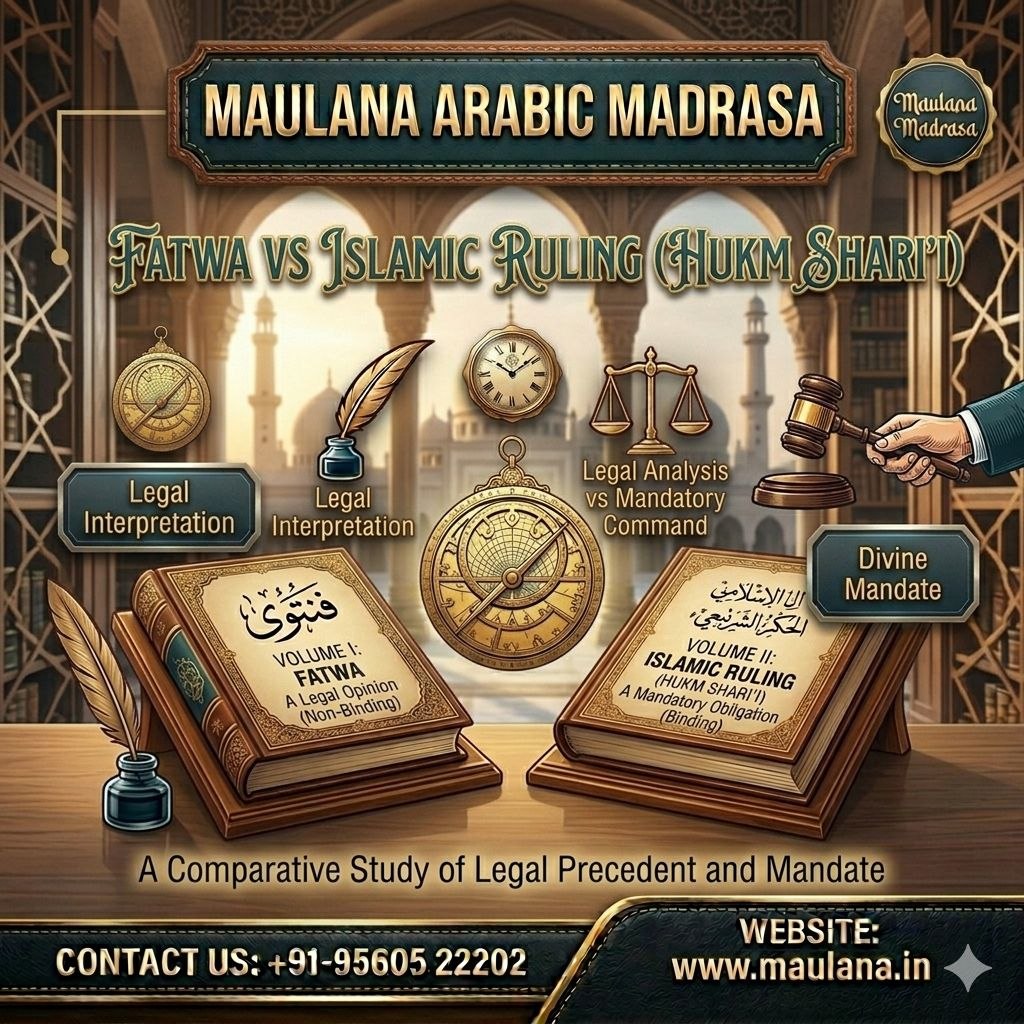
Fatwa vs Islamic Ruling
Uncategorized

Navigating Sacred Jurisprudence: Deconstructing Fatwa vs Islamic Ruling

For devout Muslims striving to live in full compliance with theological frameworks, modern life frequently presents intricate ethical scenarios. Whether managing cross-border commercial contracts, resolving complex inheritance structures, or determining personal spiritual duties, individuals must constantly look toward structural religious guidelines to ground their actions. When diving into traditional jurisprudence, two major concepts routinely dominate the legal conversation, leading many believers to seek a clear distinction regarding Fatwa vs Islamic ruling. Understanding the subtle structural differences highlighted in a Fatwa vs Islamic ruling comparison is incredibly vital for everyday believers; it allows the community to accurately gauge the legal authority, structural enforceability, and situational boundaries of any religious decree they encounter, protecting them from falling into misinformed interpretations or relying on unauthorized opinions found online.At Maulana Arabic Madrasa, we believe that deep, authentic religious education is the absolute foundation of a healthy, harmonious community. Through our central judicial board, we actively work to simplify complex legal terminologies, helping ordinary families implement classical Shariat guidelines across their modern daily routines. This comprehensive guide provides an exhaustive look into the distinct definitions, operational boundaries, and practical executions of these two foundational pillars of Islamic jurisprudence. Defining the Core Frameworks of Jurisprudence To properly compare these two theological pillars, we must first break down their distinct individual meanings, source materials, and execution methods within classical law.⚖️ Unpacking the Islamic Ruling (Hukm Shar’i)An Islamic ruling—traditionally referred to by scholars as a Hukm Shar’i—is a universal, absolute, and unchangeable decree derived directly from the foundational texts of the faith: the Holy Quran and the authentic traditions of the Prophet (Sunnah). These rulings apply universally to all responsible believers across all eras and geographic locations. For example, the daily obligation of performing five prayers (Namaz), the absolute prohibition of alcohol (Khamr), and the clear-cut rules of standard inheritance fractions are permanent structural realities that do not shift based on personal opinions or regional borders. This is a foundational element to consider when analyzing the application of a Fatwa vs Islamic ruling in daily life. Unpacking the Fatwa (Legal Opinion) A Fatwa, conversely, is a contextual, advisory legal opinion issued by a highly trained jurist (Mufti) in response to a specific, unique question submitted by an individual or a contemporary organization. It represents an expert application of universal rules to a highly specific set of real-world circumstances. While an Islamic ruling states that consuming intoxicants is strictly prohibited, a Fatwa is what determines whether a newly manufactured, complex medical drug containing a trace amount of chemical alcohol is permissible (Halal) for a patient under life-threatening conditions. Therefore, checking a direct Fatwa vs Islamic ruling dynamic helps clarify that one is a broad foundation while the other is a situational application. The Structural Breakdown: Enforceability and Scope Understanding how these concepts function in practice requires checking who possesses the right to issue them and how binding they are on everyday families.Universal vs Individual Application: An Islamic ruling stands as a universal banner for the entire global Muslim community. A Fatwa is heavily tailored to the specific context of the person or community asking the question, taking into account their unique geographic location, local civil laws, and personal hardpress conditions.Advisory Nature vs Absolute Command: Disobeying a clear, foundational Islamic ruling (such as completely refusing to pay Zakat) constitutes a direct spiritual violation. However, because a Fatwa represents a scholar’s expert interpretation of a unique situation, an individual who feels uncertain about a specific decree can consult a different qualified judicial board for a secondary opinion. This reality highlights why evaluating a Fatwa vs Islamic ruling matters for individual choice.The Power of Enforcement: In an established, classical judicial ecosystem, a court judge’s verdict (Qaza) carries mandatory civil enforceability. A Fatwa remains fundamentally advisory—it provides a spiritual map to guide a believer’s personal conscience and moral standing before the Almighty. How Our Council Generates Contextual Decrees Issuing a valid decree requires an exceptional degree of academic discipline and tracking. At Maulana Arabic Madrasa, our judicial department approaches every question with massive spiritual seriousness, keeping the conceptual distinction of Fatwa vs Islamic ruling at the center of our methodology.Sawal (Intake): A user submits a highly detailed, written question regarding a personal matter, real estate issue, or modern business challenge.Tehqeeq (Research): Our research scholars cross-reference the problem with classical legal texts to identify the absolute, foundational Islamic rulings that govern that broader category.Ifta (Contextualization): The Mufti analyzes the applicant’s specific local limitations and modern administrative contexts to derive a precise, customized legal opinion.Tasdeeq (Issuance): The text is verified, signed, and stamped with our institutional seal before being safely delivered to the applicant, serving as a practical demonstration of a Fatwa vs Islamic ruling moving from theory to reality. Addressing Contemporary Modern Challenges As global economics, healthcare systems, and digital landscapes advance at blistering speeds, the intersection of Fatwa vs Islamic ruling becomes incredibly obvious across several modern domains:📱 Digital and Financial AssetsThe core Islamic ruling strictly prohibits any form of exploitative finance or gambling (Qimar). However, as complex digital assets, cryptocurrencies, and automated trading algorithms enter the market, our panel must analyze the structural mechanics of each individual platform to issue a precise Fatwa regarding which digital instruments are completely clean for public investment.🔬 Advanced Medical EthicsWhile the preservation of human life is a primary, foundational Islamic ruling, modern technologies like life support systems, organ donations, and complex genetic therapies present intricate moral puzzles. Our Muftis evaluate detailed medical reports case-by-case to tell grieving families exactly how to proceed in full alignment with their spiritual values, resolving the practical loop of Fatwa vs Islamic ruling. Why Choose Maulana Arabic Madrasa for Clarification? When your family’s peace of mind, financial ethics, and spiritual well-being are on the line, navigating complex legal terminology demands an institution backed by complete integrity, deep historical roots, and communal respect:Highly Specialized Mufti Panel: Our Darul Ifta consists of senior jurists who have spent decades mastering comparative Islamic law and classical Arabic grammar across world-renowned traditional seminaries.Absolute Data Privacy:

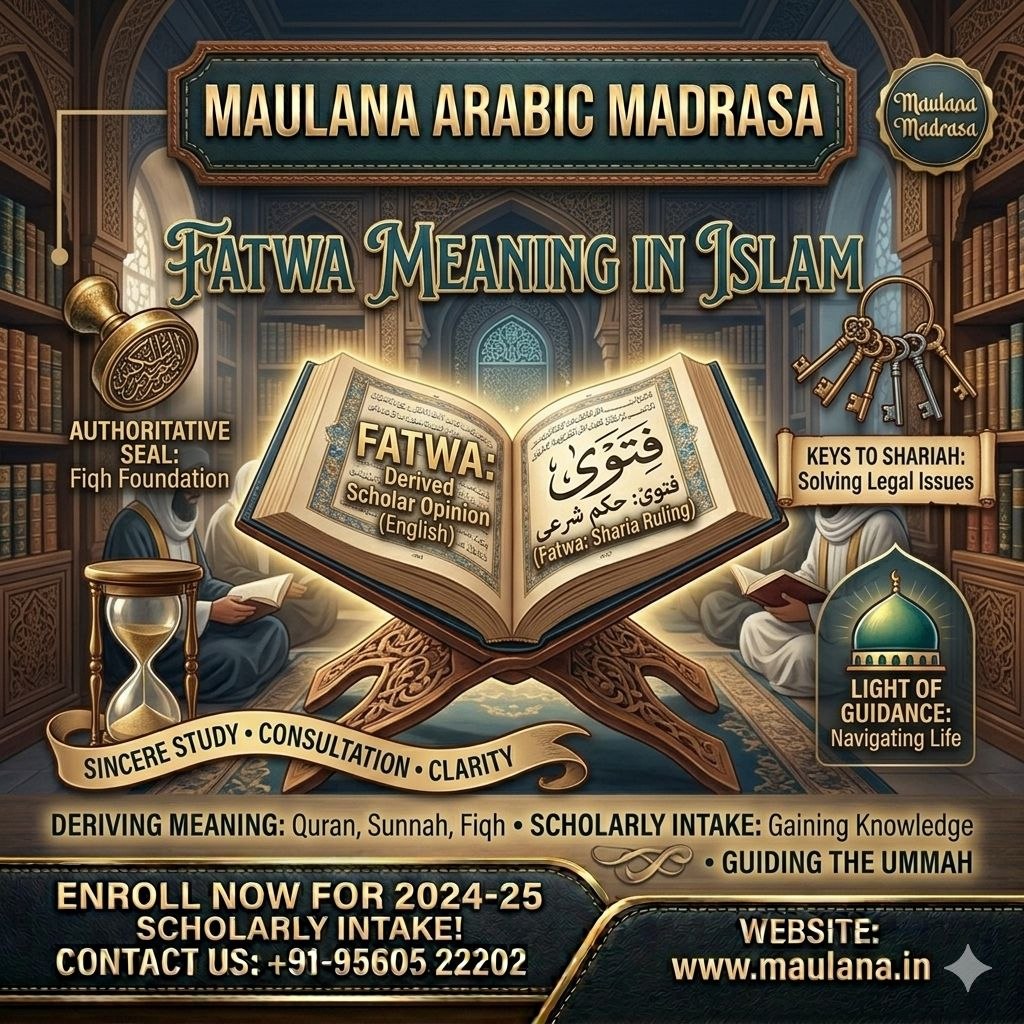
Fatwa Meaning in Islam
Uncategorized

Navigating Shariat Jurisprudence: The True Fatwa Meaning in Islam

For millions of devout Muslims around the world, practicing faith with absolute sincerity requires clear, authentic guidance on a daily basis. As modern society introduces rapid technological shifts, complex financial systems, and intricate family dynamics, regular believers naturally turn to classical scholarship for clear paths forward. In these moments of ethical crossroad, finding a verified explanation of the fatwa meaning in Islam is the single most important step toward separating unverified cultural rumors from pure theological clarity. Understanding the authentic fatwa meaning in Islam empowers everyday believers to grasp the formal role, legal weight, and scriptural boundaries of an expert legal opinion within traditional jurisprudence, ensuring the community seeks solutions from deeply qualified Islamic scholars (Muftis) rather than anonymous, unverified forums across the internet.At Maulana Arabic Madrasa, we are profoundly dedicated to protecting our classical academic heritage, educating the community, and providing balanced answers to modern problems. Through our central Darul Ifta (Department of Islamic Edicts), we carefully translate ancient Arabic legal methodologies into practical guidelines for contemporary households. This exhaustive guide explores the literal roots, operational characteristics, structural frameworks, and everyday applications of this essential legal concept. The Linguistic Roots: Breaking Down the Literal Translation To truly comprehend the comprehensive fatwa meaning in Islam, one must look closely at how the root word functions within classical Arabic grammar.Linguistically, the word stems from the root Fata, which contextually means to unveil a hidden reality, provide a fresh perspective, or remove dynamic confusion from a highly complex matter. In the context of religious vocabulary, the accurate fatwa meaning in Islam refers simply to an expert scholar giving a formal, textual answer to a specific legal inquiry submitted by an individual believer or community group. It represents an active link between static divine revelations and dynamic human situations, translating eternal principles into immediate personal directives.🛡️ Advisory Nature: What the Concept Means in Everyday LifeA critical part of any accurate fatwa definition is understanding that these legal decrees are fundamentally advisory rather than mandatory.Unlike a judicial court verdict (Qaza) issued by an appointed judge (Qazi), which carries mandatory civil enforcement, the true fatwa meaning in Islam clarifies that it is a voluntary, moral guide designed to inform a believer’s personal conscience. Because a decree represents a human scholar’s sincere application of eternal principles to a unique situation, if a believer receives a response that feels overly strict due to specific local hardships, they are fully permitted to seek a second opinion from another recognized judicial board. This safety valve prevents regional hardships from overwhelming a family’s practical capacity to survive. The Severe Academic Standards of True Jurisprudence To maintain the pristine integrity of divine law, traditional Islamic history has established an incredibly demanding set of academic benchmarks for any individual seeking to issue a legal decree. When exploring the deep fatwa meaning in Islam, it becomes obvious that a scholar cannot simply rely on personal insight or standard dictionary translations; they must spend decades mastering complex fields of study:Advanced Arabic Linguistics (Sarf and Nahw): Because the primary source texts are preserved in classical Arabic, a scholar must possess absolute fluency in its complex grammatical structures, historic metaphors, and semantic layers.Contextual Revelation Studies (Asbab al-Nuzul): Understanding the exact historical and environmental conditions under which specific verses descended prevents the misapplication of commands to mismatched modern situations.The Science of Hadith Verification (Mustalah al-Hadith): Jurists must possess complete mastery over the paths of narration, distinguishing verified prophetic statements from weaker or contextually isolated accounts.The Mechanics of Extraction (Usul al-Fiqh): This functions as the logical engine of Islamic lawmaking, teaching the scholar how to safely extract specific operational rules from broad raw scriptures. The Multi-Layered Method Behind Our Scholarly Decrees Generating a valid religious edict is a massive spiritual duty that demands an immense level of academic discipline. At our academy, we break down our processing system into four distinct phases to ensure absolute scriptural precision and protect the accurate fatwa meaning in Islam in our modern context:Istifta (The Written Petition): The process begins when an individual submits a detailed question outlining a real financial, medical, or family dilemma.Takhrij (Textual Extraction): Our research team dives deep into foundational textbooks to locate universal, unchangeable rules from the Holy Quran and authentic Hadith collections.Tahqiq (Contextual Analysis): The Mufti analyzes the specific local limitations and technological frameworks involved to ensure the text maps accurately to modern realities.Al-Jawab (The Official Issuance): The finalized text is carefully written out in clear, direct language, reviewed by a council of senior scholars, and stamped with our institutional seal. Core Operational Categories of Contemporary Decrees To see how a functional fatwa meaning in Islam plays out in real life, our academic board reviews thousands of unique inquiries across several major societal domains every single year:Worship and Daily Rituals (Ibadaat): Believers routinely ask questions regarding the exact mechanics of personal devotion. A common example includes determining whether modern medical inhalers, insulin drops, or blood tests disrupt the fast during the holy month of Ramadan.Financial and Business Contracts (Muamalat): As global digital commerce shifts toward online trading, banking rewards, and cryptocurrency, our scholars apply the authentic fatwa meaning in Islam framework to check the technical software logic behind each investment instrument, ensuring your family grows wealth ethically.Advanced Healthcare and Family Ethics (Munakahat): Complex scenarios like reproductive medical breakthroughs, organ donations, and life support systems present profound emotional choices. Our personalized written responses provide families with compassionate, text-backed pathways that honor human life in full alignment with sacred boundaries. Navigating Minority Legal Frameworks Globally For Muslims living in multi-cultural democracies like India, the practical deployment of a legal decree carries profound administrative and social value. Under national personal law frameworks, minority communities maintain the explicit legal right to govern sensitive internal matters—such as marriages, divorces, and complex family inheritance partitions—according to their respective faith traditions.In this specific environment, studying the fatwa meaning in Islam reveals that an official written decree from a recognized seminary serves as a crucial instrument for peaceful community arbitration. It provides families with

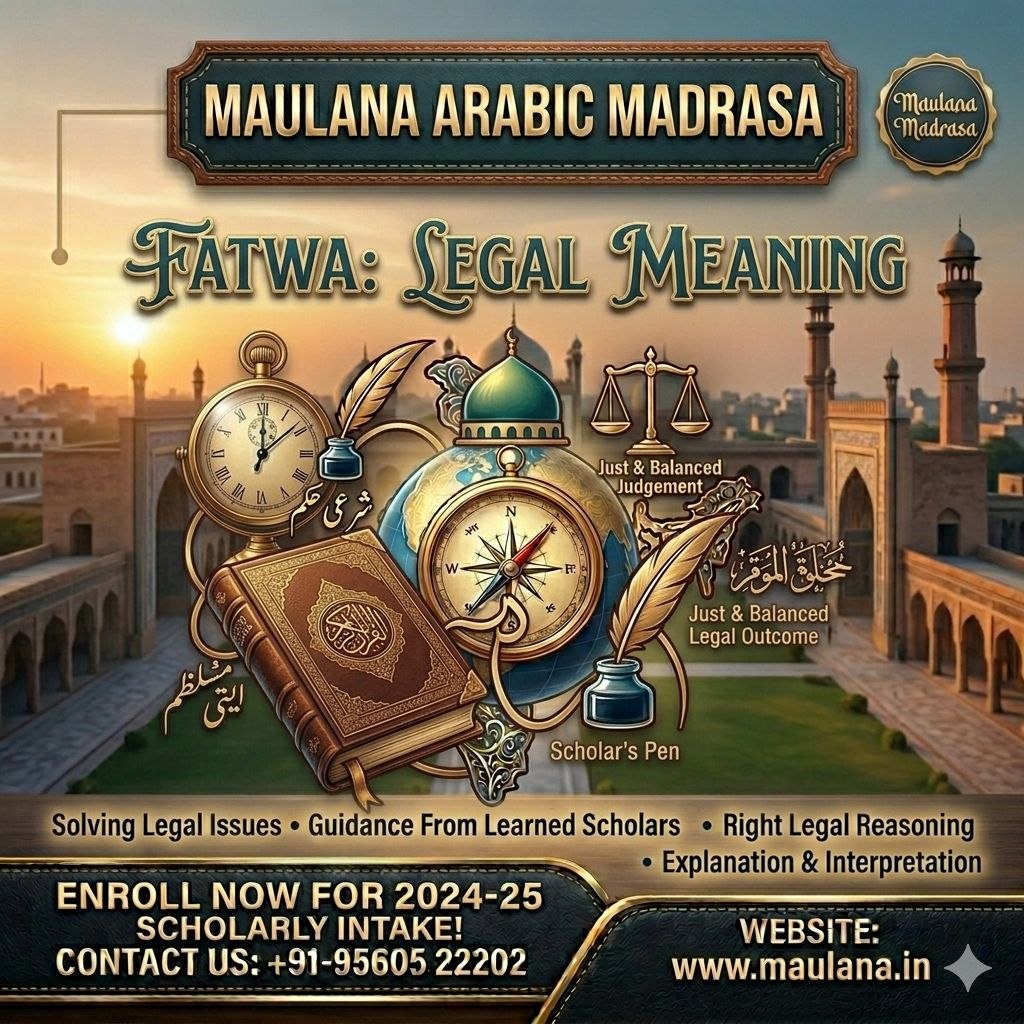
Fatwa Legal Meaning
Uncategorized

Navigating Shariat Jurisprudence: The True Fatwa Legal Meaning Explained

For millions of practicing Muslims living across the globe, balancing the spiritual demands of faith with the rapidly shifting complexities of modern society is a lifelong journey. Whether navigating the legality of digital investments, restructuring familial business partnerships, or settling sensitive personal disputes, access to reliable religious clarity remains an absolute necessity. When traditional theological texts do not explicitly mention a modern system, believers look toward the expert structural guidance of senior scholars, bringing the core concept of fatwa legal meaning directly into focus. Understanding the exact fatwa legal meaning helps everyday individuals separate dramatic media portrayals from actual Islamic jurisprudence, ensuring the community recognizes how an official legal opinion functions within a broader legal and spiritual framework without overstepping or underestimating its religious authority.At Maulana Arabic Madrasa, we are deeply committed to providing uncompromised religious education, preserving classical Islamic law, and delivering precise, practical solutions to modern dilemmas. Through our central Darul Ifta (Department of Islamic Edicts), our panel of expert jurists bridges the gap between ancient Arabic texts and contemporary societal realities. This extensive guide provides an exhaustive look into the linguistic roots, operational boundaries, and practical enforceability of a formal decree to give you absolute clarity. Defining the Core Concept: What is a Fatwa? To fully grasp the intricate layers of fatwa legal meaning, one must first understand its true definition and structural purpose within the rich history of Islamic law.An Expert Advisory Opinion: At its foundational level, the fatwa legal meaning points to an expert advisory opinion issued by a highly qualified scholar, known traditionally as a Mufti. It represents a sincere, highly educated application of unchanging Shariat principles to a unique real-world question submitted by a citizen or organization.The Qualifications of the Issuer: A Mufti does not make up new religious rules or speak on a personal whim. The professional fatwa legal meaning requires the scholar to have completed decades of advanced academic training in classical Arabic grammar, Quranic commentary (Tafseer), prophetic traditions (Hadith), and comparative jurisprudence (Fiqh).A Diagnostic Tool: Think of it as a specialized spiritual and legal diagnosis. Just as a senior doctor evaluates your unique health symptoms to provide a customized medical prescription, a jurist evaluates the precise facts of your life situation to provide a textually grounded religious path forward. Enforceability and Scope: Is a Fatwa Legally Binding? The most critical aspect of exploring the fatwa legal meaning is determining how much binding weight it carries over a believer’s life, especially when interacting with modern civil court systems.Fundamentally Non-Binding: From a strict scriptural and traditional perspective, the core fatwa legal meaning is advisory rather than mandatory. Unlike a formal court sentence (Qaza) issued by a state-appointed judge (Qazi), which carries civil enforceability and executive backing, a scholar’s opinion relies entirely on voluntary compliance and personal religious conscience.The Separation of Authorities: A clear breakdown of the fatwa legal meaning highlights that a Mufti operates in an educational and diagnostic capacity, telling you what the law is regarding your specific problem. A judge, conversely, operates in an executive capacity, possessing the institutional power to settle adversarial disputes and enforce financial or physical penalties.The Freedom of Choice: Because it is an interpretive legal opinion, if an individual feels a specific decree is excessively rigid or fails to account for their local hardpress conditions, they are completely permitted under Islamic law to seek a secondary opinion from another reputable judicial board. This built-in flexibility represents the organic mercy of Islamic jurisprudence. The Disciplined Processing Methodology of Our Council Deriving a valid religious opinion requires immense academic discipline and systemic checking. At our academy, the operational fatwa legal meaning is brought to life through a highly disciplined, multi-layered processing methodology.Phase 1 – Istifta (The Formal Submission): The process begins when an individual or corporate body submits a detailed, written question outlining a real-world dilemma regarding personal finance, medical ethics, or marital conflicts.Phase 2 – Takhrij (Textual Extraction): Our research team deep-dives into classical foundational texts to isolate the universal, absolute Islamic rulings that govern the general category of the problem.Phase 3 – Tahqiq (Contextual Analysis): The Mufti evaluates the specific modern variables, analyzing the technical software, corporate contracts, or medical realities involved to ensure the ancient definitions map perfectly onto the modern issue.Phase 4 – Al-Jawab (The Final Response): The official answer is drafted, clearly citing relevant Quranic verses and authentic traditions. It is then reviewed, signed, and stamped with our institutional seal before being delivered to the applicant. Interaction with Local Civil and Minorities Frameworks When studying the practical fatwa legal meaning within countries like India, it is essential to understand how these traditional opinions interact with secular civil structures.Protection of Personal Laws: Under existing minority protection acts, civil frameworks allow communities to manage personal matters like marriage, divorce, and family inheritance according to their religious traditions.Amicable Community Arbitration: Within this context, the fatwa legal meaning manifests as a powerful tool for peaceful out-of-court arbitration. It allows families to resolve complicated internal estate or marital friction smoothly and privately, avoiding long, expensive, and adversarial public civil court battles.Subservient to State Law: It is vital to note that a religious decree never overrides or replaces the supreme law of the land. It acts as a moral and spiritual roadmap for individuals who choose to align their private actions with their faith. Applying Jurisprudence to Complex Modern Realities The vital importance of clarifying the fatwa legal meaning becomes incredibly obvious when ordinary families confront modern technological and scientific breakthroughs that did not exist during classical times.Navigating Digital Financial Assets: The foundational rules of Shariat strictly prohibit exploitative lending or gambling. However, as complex digital assets, automated trading, and cryptocurrency platforms enter the market, our panel must analyze the software mechanics of each tool to tell professionals exactly which financial options are completely clean for investment.Resolving Complex Healthcare Ethics: Advanced medical treatments, life support decisions, organ donations, and genetic therapies present profound moral challenges for grieving families. A personalized decree analyzes detailed medical charts to provide compassionate,

Fatwa in Quran
Uncategorized

Divine Legislation: Understanding the Roots of Fatwa in Quran

For believers seeking to align their daily conduct with divine expectations, the search for authentic spiritual guidance begins and ends with sacred text. When modern lifestyle choices, complex household distributions, or intricate commercial disputes challenge our understanding, looking back at historical revelatory frameworks reveals how answers were originally delivered to humanity. Exploring the foundational concept of a Fatwa in Quran is the single most effective way to appreciate how the Almighty Himself addressed the urgent inquiries of the early Muslim community. By analyzing the structural instances of Fatwa in Quran, everyday believers can witness how the process of seeking legal clarification (Istifta) was established as a divine mechanism of mercy and education, ensuring that the faithful never have to navigate complex ethical landscapes without a clear scriptural anchor.​At Maulana Arabic Madrasa, our academic panel preserves classical traditions while making sacred knowledge entirely accessible to contemporary households. We understand that exploring how a specific Fatwa in Quran functions structurally provides a blueprint for modern Islamic legal interpretation (Ifta). Through our dedicated research departments, we work tirelessly to anchor modern legal opinions back to their original prophetic and revelatory roots, demonstrating that a valid Fatwa in Quran text remains the absolute criterion for true legal analysis. This extensive guide provides an exhaustive look into how the text of the Holy book handles, defines, and contextualizes the issuance of religious answers. The Linguistic Roots: What the Text Communicates To understand the concept completely, one must first explore how the Arabic root word appears across the verses of the holy book. The word stems from Fata, which contextually means to clarify, remove confusion, or unveil a hidden reality.​The Command to Explain: When the text records individuals approaching the Prophet for specific guidance, it utilizes forms of the word Ifta to signal a formal, definitive response that cuts through social doubt.​A Divine Prerogative: The text explicitly highlights that absolute clarity belongs to the Creator. When human intellect reaches its limits, looking to the foundational laws laid out by the Almighty is the only way to safeguard one’s conscience. Major Structural Examples of Legal Answers in the Text ​The holy scripture does not merely discuss abstract theories; it contains direct answers to practical everyday problems that faced the early believers. When tracing an explicit Fatwa in Quran passage, we discover several critical operational categories:​📐 Rulings on Inheritance Laws (Kalalah)​One of the most mathematically profound examples of a Fatwa in Quran appears at the very end of Surah An-Nisa. The companions faced a complex familial dilemma regarding Kalalah—a situation where a deceased person leaves behind no parents and no children. The verse opens with the explicit phrase stating that the people ask for a legal opinion, and immediately delivers the exact fractions to distribute among siblings, establishing a permanent baseline for Islamic estate management.​🏢 Clarifications on Social and Marital Welfare​Earlier in the same chapter, another prominent Fatwa in Quran example addresses highly sensitive societal concerns regarding vulnerable women and orphans. The revelation directly answers their queries, establishing strict rules of equity, protecting financial dowers (Mahr), and safeguarding personal safety within the family structure.​⚙️ The Revelatory Process: How Questions Were Solved​The historical narrative reveals a beautiful, highly disciplined pattern of how legal answers were introduced to the community, serving as a permanent model for future jurists.​The Companions’ Inquiry (Sawal): A real-world challenge would surface within the community—such as understanding permissible foods or trade ethics—prompting the companions to seek guidance.​Prophetic Mediation: The community would present their collective dilemma directly to the Prophet, awaiting spiritual intervention.​Divine Intervention: A fresh revelation would descend, opening with phrases like “They ask you… Say…” to provide a comprehensive, permanent solution rooted in eternal wisdom. Transforming Sacred Principles into Modern Guidance ​Understanding how an original Fatwa in Quran text functions within scripture helps modern Muslims realize that seeking a religious decree is not an innovation, but a fundamental part of practicing the faith.​Handling New Realities: While the original textual verses are fixed and unchangeable, the methodology of applying those laws to new situations—like digital transactions or advanced medical ethics—remains fully active.​Rejecting Casual Assumptions: The scripture strongly warns against making casual, unverified claims about what is permissible (Halal) or forbidden (Haram) without solid textual evidence.​The Value of Specialization: Just as the early community sought an authoritative Fatwa in Quran response directly from the source of revelation, modern families are instructed to consult deeply trained scholars who have spent decades mastering classical texts. Trust Maulana Arabic Madrasa for Verifiable Learning ​Navigating deep theological concepts while keeping your family’s daily practices clean requires an institution built on academic rigor, complete transparency, and spiritual integrity. At Maulana Arabic Madrasa, our research board ensures that every single legal response we generate is anchored directly back to classical principles, ensuring that the spirit of a Fatwa in Quran continues to enlighten our modern rulings.​Stop guessing your way through complex ethical dilemmas or relying on unverified online forums. Connect with our central administrative desk, explore our extensive library of verified resources, and let our experienced panel guide you with absolute scriptural precision. Contact us today to begin your educational journey! Connect with Our Central Administration Office ​If you have an urgent question regarding personal, financial, or family matters, or if you require an official copy of a study module for your personal records, please reach out to our coordination desk:​📱 Direct Helpline / WhatsApp: +91-95605 22202​📧 Official Support Email: maulanaarabicidara@gmail.com​🌐 Central Web Portal: www.maualna.in​📍 Central Campus Headquarters: Maulana Arabic Madrasa, Rz 2054 street 27 Tughlakabad extension New Delhi 110019

Fatwa in Islamic Law
Uncategorized

Understanding Shariat Authority: Who Gives Fatwa in Islamic Law?

For Muslims seeking to live their lives in total alignment with the pristine values of Shariat, finding reliable answers to complex modern questions is absolutely essential. Whether managing multi-layered financial investments, resolving delicate family conflicts, or understanding the rules of daily worship in a digital world, ordinary believers require an authoritative source of spiritual clarity. When faced with these contemporary dilemmas, a critical question inevitably arises for every seeker: Who gives fatwa with the necessary scriptural authority, and how can a believer verify the academic credentials of the person offering religious guidance? Knowing exactly who gives fatwa allows the community to separate untrustworthy, unverified internet opinions from authentic decrees issued by deeply learned scholars, ensuring that families protect their faith from misinterpretation while moving forward confidently with practical, textually grounded solutions.At Maulana Arabic Madrasa, we are deeply dedicated to preserving classical Islamic knowledge, educating the community, and providing balanced answers to modern challenges. Through our central department of Islamic jurisprudence, we guide seekers through the rigorous qualifications required to interpret sacred texts. This comprehensive guide provides an exhaustive look into the structural academic standards, personal integrity rules, and institutional processes that define the true authors of religious edicts. The Core Identity: Defining the Mufti To answer the fundamental question of who gives fatwa with total legal validity, one must look at the specific academic title established within classical jurisprudence.The Office of the Mufti: In Islamic legal tradition, the highly specialized scholar who is uniquely authorized to issue a decree is known as a Mufti. The act of compiling and delivering this guidance is called Ifta.An Advisory Jurisconsult: Unlike a Qazi (a court judge) who issues legally binding verdicts to settle adversarial disputes, a Mufti serves as an expert advisory consultant. They analyze personal scenarios to show individuals how Shariat applies to their specific circumstances.A Heavy Spiritual Weight: In traditional scholarship, the specific jurist who gives fatwa is described as signing on behalf of the Almighty. Because a decree guides a person’s conscience, the scholar bears an immense spiritual responsibility for the advice they give. The Intensive Academic Requirements for Issuing Decrees A scholar cannot simply wake up one morning and decide to issue religious rulings based on personal feelings or quick internet searches. When the community asks who gives fatwa, traditional academies point to individuals who have undergone decades of disciplined study:Mastery of Arabic Grammar (Sarf and Nahw): Because the primary sources of Islamic law are preserved in classical Arabic, a scholar must possess flawless fluency in its intricate linguistic structures, metaphors, and historical contexts.Quranic Exegesis (Tafseer): Deeply understanding the reasons behind divine revelations (Asbab al-Nuzul) and the rules regarding clear and metaphorical verses is completely mandatory.Prophetic Traditions (Hadith Studies): A jurist must master the vast science of narrators, separating weak accounts from authentic collections like Sahih Bukhari and Sahih Muslim.Foundational Jurisprudence (Usul al-Fiqh): This is the core engine of lawmaking. It teaches scholars the systematic methods used to extract practical rulings from raw scriptural texts. Beyond Books: The Mandatory Character Traits of a Jurist When evaluating who gives fatwa, classical Islamic law demands a rare combination of book smarts and deep personal integrity.Unblemished Piety (Taqwa): A true scholar must live a life of visible righteousness, completely avoiding major sins and maintaining a stellar moral reputation within the community.Deep Emotional Maturity: Issuing guidance requires immense patience, sharp emotional intelligence, and absolute neutrality. A jurist must never let personal biases, family rivalries, or political pressures alter their legal analysis.Thorough Contextual Awareness: A scholar cannot live in absolute isolation. Any modern expert who gives fatwa must deeply understand how modern banking, digital technologies, and medical systems function in the real world to apply ancient laws accurately to modern life. The Multi-Layered Method Behind Collective Decrees In the modern era, the question of who gives fatwa across complex social issues has shifted from isolated individuals toward collective institutional boards. This team-based approach protects the community from human error.Phase 1: Clear Problem Identification: The intake desk receives a written query from a believer, mapping out a real-world financial, medical, or family problem with total honesty.Phase 2: Comprehensive Textual Research: A team of research scholars dives into foundational legal textbooks, such as the Fatawa Hindiyyah or Hedaya, to locate established legal precedents.Phase 3: Cross-Disciplinary Consultation: For complex modern issues, like cryptocurrency or organ donation, the board invites financial analysts or medical doctors to explain the technical details thoroughly.Phase 4: Official Verification and Issuance: The final response is carefully drafted, reviewed by a council of senior Muftis, signed, and stamped with the institution’s official seal. Navigating the Digital World Safely With thousands of unverified blogs, anonymous social media accounts, and automated forums floating around the internet, finding out exactly who gives fatwa for your spiritual queries requires extra caution.Avoid Anonymous Text Forums: If an online response does not explicitly name the qualified Mufti who wrote it or list their academic background, it cannot be trusted for serious religious compliance.Beware of Instant Fixes: Authentic jurisprudence values patience and accuracy. Be careful around automated platforms, as the real authority who gives fatwa must be an expert human scholar, not an automated script processing highly complicated personal or family dilemmas.Look for Institutional Backing: Always seek guidance from established, brick-and-mortar academies that hold generational community trust and maintain transparent peer-review processes. Partner with Maulana Arabic Madrasa for Verified Guidance Navigating the complex realities of modern life while safeguarding your spiritual values requires mentorship rooted in absolute academic integrity. At Maulana Arabic Madrasa, our centralized Darul Ifta provides a secure, transparent platform for all your personal, financial, and ethical inquiries.Stop leaving your critical family choices or career ethics to random internet searches. Reach out to our central council, submit your questions through our secure administrative channels, and receive thoroughly researched, stamped guidance tailored precisely to your unique life circumstances. Contact our helpdesk today to access our complete archives or to schedule a private consultation.📞 Connect with Our Central Administration DeskIf you have a pressing question regarding personal, business, or family

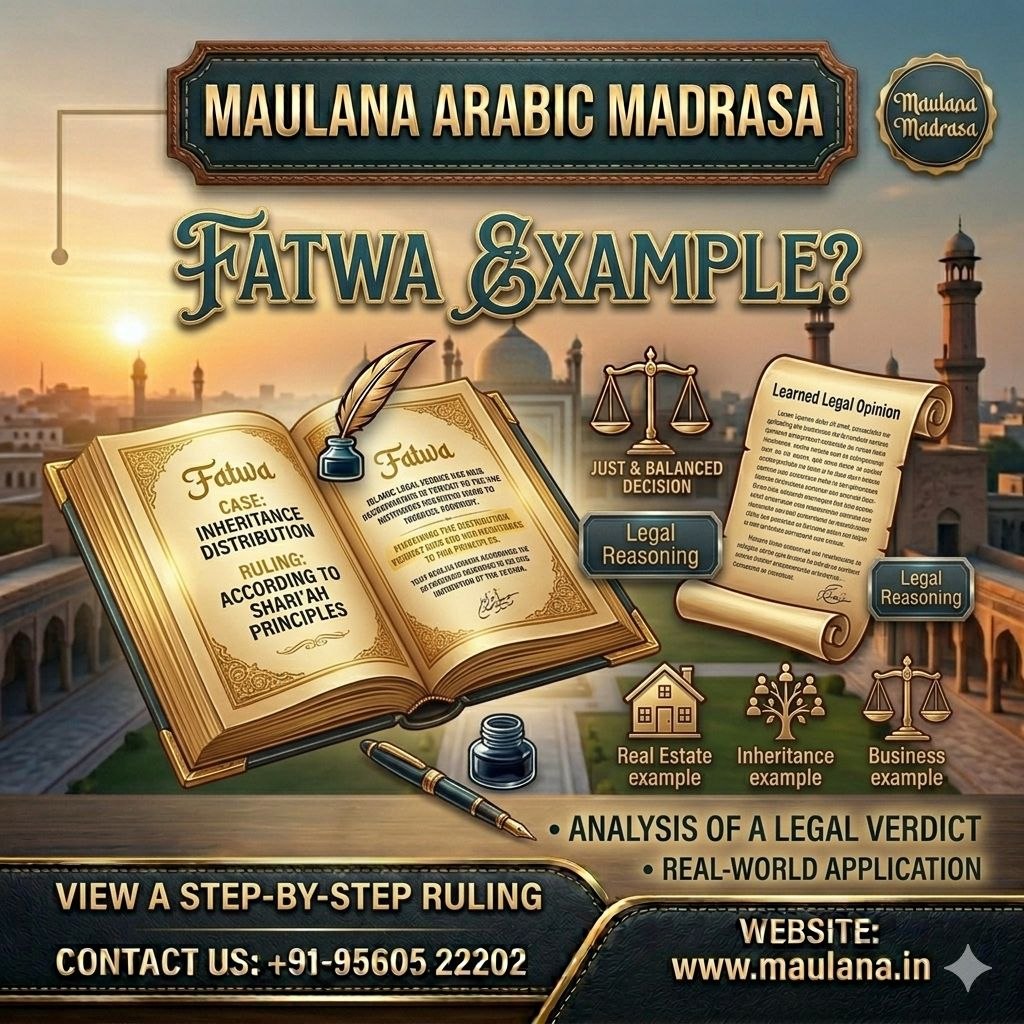
Fatwa Example
Uncategorized

Understanding Shariat Jurisprudence: A Deep Dive into a Practical Fatwa Example

In our rapidly evolving modern society, everyday believers routinely encounter complex scenarios that test their ethical and spiritual boundaries. From navigating digital currencies and automated stock trading to handling complex family inheritance disputes, contemporary life constantly demands precise, scriptural clarity. When traditional texts do not explicitly mention a modern technological tool or financial system, Muslims look to senior Islamic scholars (Muftis) to analyze the situation and provide a clear path forward. Examining a real-world Fatwa example is the single most effective way to demystify how classical Islamic jurisprudence operates in the modern era. Reviewing a detailed Fatwa example allows ordinary believers to witness firsthand how timeless principles of Shariat are systemically extracted from ancient texts and applied to modern issues, ensuring the community maintains complete religious compliance without disconnecting from modern economic and social advancements.At Maulana Arabic Madrasa, our central Darul Ifta (Department of Islamic Edicts) carries the heavy responsibility of addressing these modern dilemmas daily. Our panel of expert jurists bridges the gap between classical Arabic jurisprudence and contemporary global realities. This extensive guide provides an in-depth breakdown of how an authentic decree is constructed, exploring a concrete case study across modern banking and personal ethics. The Anatomy of a Decree: How a Case is Framed To understand how a scholar derives a ruling, one must first look at how a formal query is structured. An authentic decree is never a casual, one-line opinion; it is a highly disciplined legal document that consists of four core structural phases. We can see this structure clearly when analyzing any classical Fatwa example issued by our academy.Istifta (The Request): This is the initial written petition submitted by a believer or an organization, detailing a real-world ethical problem with absolute transparency.Takhrij (Textual Extraction): The research team searches classical texts to find direct foundational commands from the Quran, prophetic traditions (Hadith), and consensus (Ijma) related to the topic.Tahqiq (Contextual Analysis): The Mufti examines the operational details of the modern issue—such as checking the technical software logic behind a digital transaction—to map it accurately against classical definitions.Al-Jawab (Final Decree): The official, stamped decree written in clear, actionable language that provides the final religious ruling alongside its textual justifications. Case Study: A Contemporary Fatwa Example on Modern Finance To illustrate this complex process clearly, let us analyze a highly relevant, real-world Fatwa example regarding Online Stock Intraday Trading. This actual scenario highlights how a modern career path is systematically evaluated under traditional Islamic principles.📝 The Istifta (The Question Received)“Assalamu Alaikum. I am a software engineer looking to transition into full-time stock trading. I specialize in intraday trading, where I buy corporate shares and sell them within a few hours before the market closes to lock in minor price movements. I never take physical delivery of these shares; the transactions are entirely digital and settled online. Is this specific business model permissible (Halal) under Shariat law, or does it violate Islamic financial ethics?”🔍 The Scholarly Analysis & Research PhaseWhen our judicial board received this query, they broke down the mechanics of intraday trading against the classical Islamic laws of commerce (Kitab al-Buyu). This research stage is vital for creating a reliable Fatwa example that the public can look to for guidance.The Principle of Possession (Qabd): A foundational Islamic ruling states that a believer cannot sell an item they have purchased until they have taken full, undisputed possession of it. In digital trading, while the transaction happens instantly, the legal ownership settlement often takes up to 48 hours (T+2).Speculative Risk (Gharar): Shariat strictly prohibits transactions driven by extreme uncertainty or blind speculation, which closely mirror gambling elements. Intraday trading relies heavily on rapid, high-stress market rumors rather than long-term asset growth. The Official Al-Jawab (The Stamped Decree) Based on the extensive textual evidence, our Darul Ifta issued a definitive response. The text from this standard Fatwa example states:“While long-term value investing in Shariat-compliant companies is entirely permissible (Halal), short-term intraday trading where shares are bought and sold without taking structural delivery or completing ownership settlement is not permissible (Gharam/Najayz). Selling an asset before acquiring full risk-bearing possession violates core prophetic commands. We advise the questioner to pivot toward delivery-based, long-term equity holding where full ownership is established before any resale.” Core Operational Domains of Daily Decrees To give you a broader view of how these legal principles apply across other areas of life, our academic board addresses queries across multiple core paths. For instance, an Ibadaat (Worship) query often evaluates a Fatwa example such as using medical inhalers or insulin drops while fasting.In the realm of Muamalat (Finance), a typical Fatwa example covers modern dilemmas like earning cashback rewards, digital credit card points, or multi-level marketing setups. For Munakahat (Family Law), scholars regularly review queries regarding executing marital contracts via video conferencing or digital signatures. Finally, under Aadaab (Ethics), a frequent Fatwa example involves analyzing the permissibility of animal-derived enzymes in modern gelatin foods or pharmaceutical products. The Vital Role of Institutional Verification As this modern Fatwa example demonstrates, deriving a reliable religious decree requires exceptional academic discipline. Trying to find quick answers on unverified forums can easily lead to misinformed decisions that might conflict with your spiritual values.Deep Textual Mastery: A qualified Mufti spends decades studying complex Arabic grammar and comparative law to ensure every decree is rooted firmly in classical traditions.Contextual Awareness: True scholarship requires understanding how modern systems function in the real world. Our council consults with financial experts and medical doctors to analyze technical details before writing a single word for a contemporary Fatwa example.Balanced Guidance: True jurisprudence avoids extreme rigidity while completely rejecting compromised principles, offering everyday families balanced, practical paths forward. Partner with Maulana Arabic Madrasa for Authentic Guidance Navigating complex modern issues while safeguarding your faith requires an institution backed by generational trust, deep academic roots, and complete transparency. At Maulana Arabic Madrasa, our Darul Ifta treats every personal, financial, and family dilemma with the utmost spiritual seriousness.Stop leaving your critical ethical decisions to casual online searches. Reach out to

Scroll to Top
Call Now Button