
Understanding the various forms of marital dissolution is essential for maintaining the sanctity, justice, and balance of a Muslim household. At Maulana Arabic Madrasa, we are frequently asked, “What is khula in Islam?” and how it serves as a protective shield for women’s rights. Simply put, it is a vital religious provision that ensures women have an honorable, fair, and divinely sanctioned path to exit a marriage that has become unsustainable. By exploring the deep-seated question of what is khula in Islam, we can better appreciate the balanced rights granted to both spouses within the Sharia framework, ensuring that neither party is oppressed within the bond of marriage.
Defining the Concept: What is Khula in Islam?
To answer “What is khula in Islam” fundamentally, one must look at the linguistic, spiritual, and legal roots of the term. The word Khula literally translates to “to take off” or “to undress.” This is a powerful metaphor derived from the Quranic description of spouses being like “garments” for one another. Thus, Khula symbolizes the formal and respectful removal of the marital garment that once protected, covered, and beautified both individuals.
Legally and technically, it is a divorce initiated specifically by the wife. Unlike Talaq, which is the husband’s right to dissolve the marriage, what is khula in Islam represents the woman’s proactive right to seek a release from the marital contract. This is typically achieved through a mutual agreement where the wife offers a form of compensation—most commonly the return of the Mahr (dower) she received at the time of Nikah—in exchange for her legal and religious freedom.
The Quranic and Prophetic Basis
When people ask “What is khula in Islam,” it is important to point out that this is not a modern legal innovation or a cultural shift, but a divine right established over 1,400 years ago to prevent the exploitation of women.
The Quranic Mandate: In Surah Al-Baqarah (2:229), the Almighty mentions that if a couple fears they cannot keep within the limits set by Allah (meaning they cannot fulfill their mutual duties with love and respect), there is no blame on either of them if the wife gives something for her release. This verse confirms that a marriage should not become a source of sin or misery.
The Prophetic Precedent: A defining moment in understanding what is khula in Islam occurred during the time of the Prophet Muhammad (PBUH). The wife of Thabit ibn Qays approached the Prophet (PBUH), stating that while she did not fault her husband’s character or religion, she simply could not bear to live with him. The Prophet (PBUH) asked her if she would return the orchard her husband had given as a dower. Upon her agreement, the Prophet (PBUH) instructed the husband to accept the garden and divorce her, establishing the first formal Khula.
The Procedural Requirements and Conditions
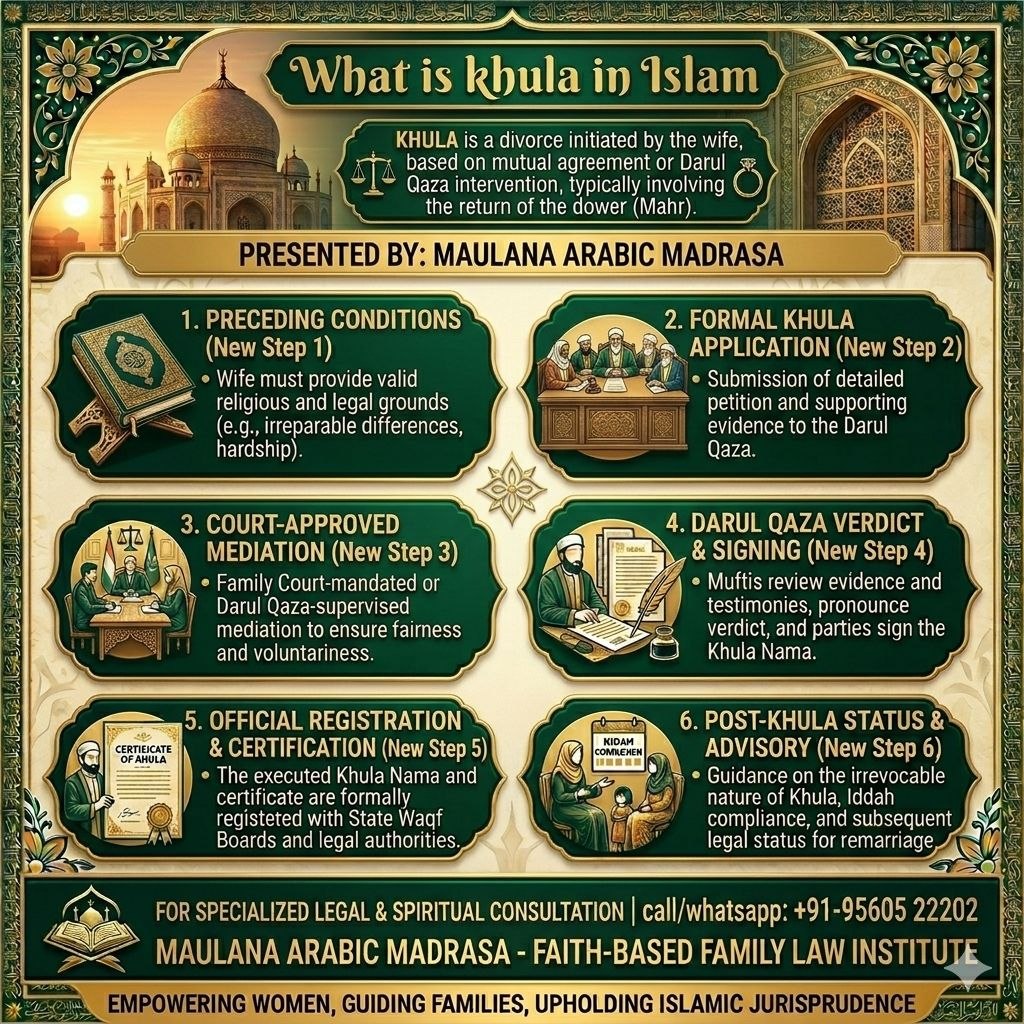
To truly grasp what is khula in Islam, one must understand the formal steps that ensure the process is conducted with justice (Adl) and excellence (Ihsan):
Sincere Initiation: The wife expresses her desire for separation. While she is not required to prove “fault” in the same way a civil court might require, she should have a sincere reason, such as incompatibility, dislike, or fear of failing her religious duties as a wife.
The Financial Settlement: The core of what is khula in Islam involves the “ransom” or compensation. Usually, this is the return of the Mahr. It is a key rule that the husband should not demand more than what he originally gave, as doing so is considered unjust.
Consent and Mediation: Ideally, the husband accepts the offer, and the marriage ends amicably. However, if a husband is being intentionally difficult or abusive by refusing the Khula, an Islamic Council or a Madrasa like Maulana Arabic Madrasa can act as a judicial authority to grant the divorce (Faskh).
Finality of the Bond: Once the process is finalized, the separation is considered a Talaq-e-Bain (irrevocable). Unlike a revocable Talaq, the husband cannot “take her back” during the waiting period. If they wish to reunite later, a brand-new Nikah contract and a new dower are required.
Why Knowledge of Khula Matters in Modern Times
In today’s world, knowing what is khula in Islam is more crucial than ever. Many women feel trapped in “limbo” because they have obtained a civil court divorce but remain religiously tied to their husbands because they haven’t performed a Khula. This can prevent them from moving on with their lives or remarriage.
At Maulana Arabic Madrasa, we help women navigate this intersection of faith and law. By understanding what is khula in Islam, women can reclaim their agency while remaining within the boundaries of their faith. It allows for a “release with kindness,” as the Quran suggests, ensuring that the transition from marriage to a single life is handled with the highest level of integrity and spiritual clarity.
Compassionate Guidance from Maulana Arabic Madrasa
If you are still searching for clarity on “What is khula in Islam” or if you are ready to begin the formal procedure, our learned scholars are here to provide the support you need. We offer confidential mediation, expert legal advice on personal law, and the formal certification required to verify your status.
📍 Address: RZ-2054, TKD Extension, Near Tara Apartment, New Delhi – 110019
📞 Phone: +91 95605 22202 | +91 84476 15753
✉️ Email: maulanaarabicidara@gmail.com
🌐 Website: www.maulan.in