
The legal landscape of matrimonial unions for the Muslim community is a unique blend of ancient religious principles and modern statutory governance. At Maulana Arabic Madrasa, we are dedicated to helping individuals navigate the complexities of Muslim Marriage Rules Under Indian Law, ensuring that their union is not only spiritually blessed but also legally fortified. Understanding the specific Muslim Marriage Rules Under Indian Law is essential for every couple to protect their rights, clarify their obligations, and ensure that their family life is established on a firm, recognized foundation.
The Foundation: The Shariat Act of 1937
The primary authority governing Muslim Marriage Rules Under Indian Law is the Muslim Personal Law (Shariat) Application Act, 1937. This landmark legislation ensures that in matters regarding marriage, dower (Mahr), divorce, and inheritance, the courts in India must apply the principles of Islamic Personal Law rather than a general civil code. This means that a Nikah performed in accordance with Sharia is fully recognized by the Indian state, provided it meets the essential criteria of a valid contract.
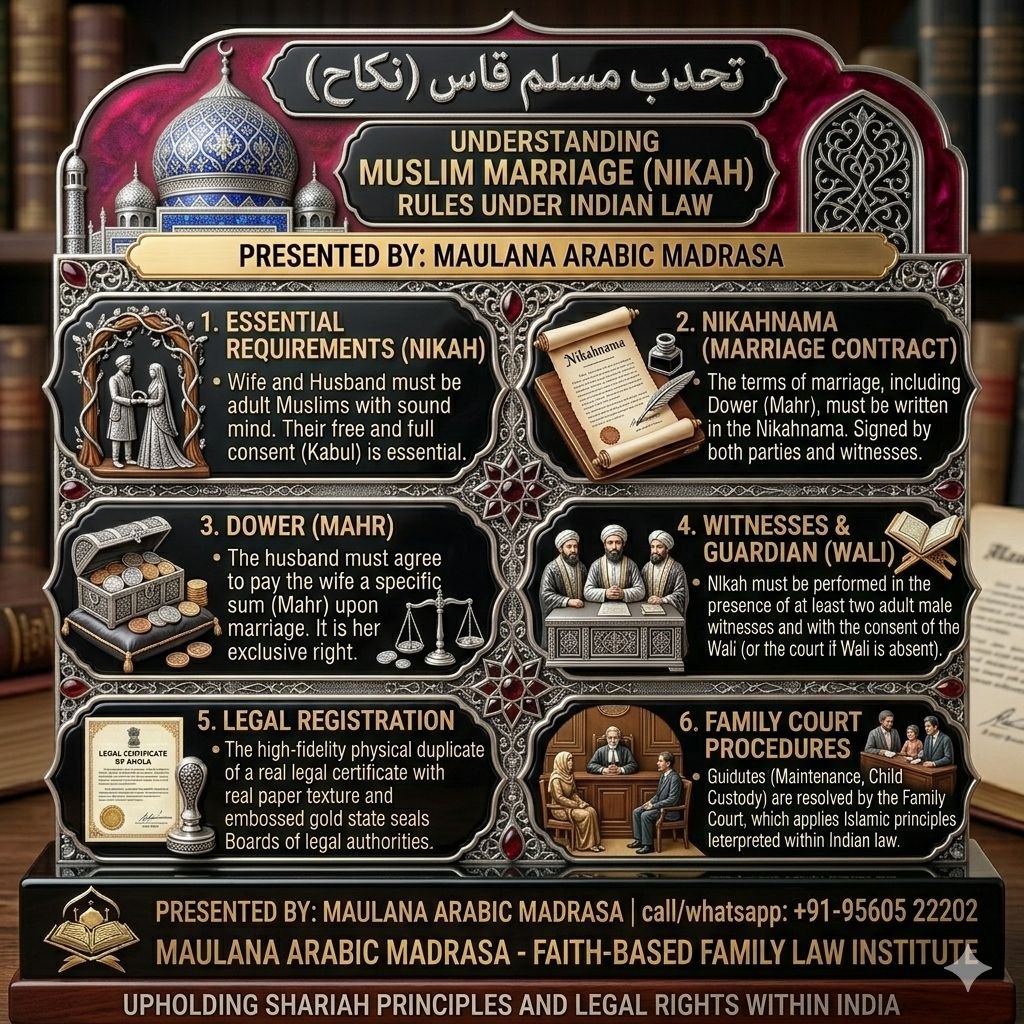
Essential Requirements for a Valid Nikah
According to the Muslim Marriage Rules Under Indian Law, marriage is considered a civil contract (Aqad) rather than a mere religious sacrament. To be legally binding, the following conditions must be met:
Proposal and Acceptance (Ijab-o-Qabul): There must be a clear proposal from one party and an equally clear acceptance from the other. This must take place in a single sitting and in the presence of witnesses.
Capacity to Contract: Both the bride and groom must have reached the age of puberty (Bulugh) and be of sound mind. Under the Muslim Marriage Rules Under Indian Law, consent must be given freely and without any form of coercion or fraud.
The Presence of Witnesses: For a Sunni marriage, the presence of two sane, adult Muslim witnesses is a mandatory requirement.
Mahr (Dower): The husband must agree to pay a specific amount or give a gift to the wife as a mark of respect and financial security. The Muslim Marriage Rules Under Indian Law strictly protect the wife’s right to this dower, which remains her exclusive property.
The Importance of Nikahnama and Registration
While a religious ceremony is sufficient for a marriage to exist, the Muslim Marriage Rules Under Indian Law increasingly emphasize the importance of formal documentation. The Nikahnama serves as the primary contract, detailing the terms of the marriage and the amount of Mahr.
Furthermore, many states in India now mandate the registration of all marriages. Even where it is not strictly compulsory, registering your marriage under the Compulsory Registration of Marriage Act (specific to individual states) is highly recommended. This provides a government-issued certificate which is vital for:
Applying for passports and visas.
Opening joint bank accounts and claiming insurance.
Resolving legal disputes regarding inheritance or matrimonial rights.
⚔️ Divorce and Dissolution of Marriage
The Muslim Marriage Rules Under Indian Law also provide clear paths for the dissolution of marriage. While the husband has the right of Talaq, the wife can initiate separation through Khula or Mubarat (mutual consent).
If a woman seeks a judicial divorce based on grievances like cruelty or desertion, she can utilize the Dissolution of Muslim Marriages Act, 1939. This act provides a statutory framework for Muslim women to obtain a decree from the court, ensuring that the Muslim Marriage Rules Under Indian Law protect vulnerable parties from being trapped in harmful situations.
Why Seek Guidance from Maulana Arabic Madrasa?
Navigating the intersection of faith and the Indian legal system can be daunting. At Maulana Arabic Madrasa, we bridge the gap by providing expert guidance on Muslim Marriage Rules Under Indian Law. We assist in:
Conducting authentic Nikah ceremonies that comply with Sharia and state laws.
Drafting comprehensive Nikahnamas that protect the rights of both parties.
Providing mediation and counseling for couples facing disputes.
Issuing recognized religious certificates for Khula or Talaq.
By understanding and following the Muslim Marriage Rules Under Indian Law, you ensure that your marriage is a source of peace, stability, and legal protection for your entire family.
Contact Us for Legal and Religious Support
Whether you are planning a wedding or require assistance with matrimonial issues, our learned scholars are here to provide confidential and professional help.
📍 Address: RZ-2054, TKD Extension, Near Tara Apartment, New Delhi – 110019
📞 Phone: +91 95605 22202 | +91 84476 15753
✉️ Email: maulanaarabicidara@gmail.com
🌐 Website: www.maulan.in