
Navigating the legalities of marriage and its dissolution can be complex, especially when balancing personal faith with statutory regulations. For individuals seeking clarity, understanding Muslim divorce law India is crucial to ensuring that all procedures align with both Islamic jurisprudence and country legislation. In India, the dissolution of marriage among Muslims is primarily governed by the Muslim Personal Law (Shariat) Application Act of 1937, along with historical statutory updates like the Dissolution of Muslim Marriages Act of 1939. This framework provides distinct paths for both men and women to dissolve a marriage contract legitimately, upholding the core ethical standards of fairness and mutual respect.
At Maulana Arabic Madrasa, we believe that proper knowledge of Muslim divorce law India empowers the community to handle familial disputes with wisdom, justice, and adherence to Islamic values. This comprehensive guide outlines the recognized modes of divorce, the rights of both parties, and how traditional Shariah practices interface with modern Indian law.
Key Modes of Dissolution Under Muslim Law
Islamic jurisprudence offers multiple pathways for ending a marriage, categorized by which party initiates the process or whether it is mutual.
Talaq (Initiated by the Husband): This refers to the repudiation of marriage by the husband. While traditional law recognizes forms like Talaq-e-Ahsan and Talaq-e-Hasan (which involve intervals and periods for potential reconciliation), arbitrary practices have seen strict legal interventions.
Khula (Initiated by the Wife): A formal separation where the wife initiates the divorce, usually by agreeing to give up or return her dower (Mahr) to the husband as consideration for releasing her from the marital tie.
Mubarat (Mutual Consent): A peaceful separation where both the husband and wife mutually agree that they can no longer live together compatibly, and dissolve the marriage by joint consent.
⚖️ Significant Statutory Reforms in India
While personal laws guide standard procedures, the Indian legal system has introduced legislative acts to codify rights and protect individuals from malpractice.
📌 The Dissolution of Muslim Marriages Act, 1939
This historic act grants a Muslim woman the explicit right to obtain a decree for the dissolution of her marriage through a court of law on several specific grounds. These grounds include the husband’s whereabouts being unknown for four years, failure to provide maintenance for two years, severe cruelty, or long-term imprisonment.
📌 The Muslim Women (Protection of Rights on Marriage) Act, 2019
This crucial piece of modern legislation strictly addresses Talaq-e-Biddat (instantaneous triple talaq pronounced in a single sitting). Under this act, the practice of instant triple talaq in any form—spoken, written, or electronic—is declared void and illegal, making it a punishable offense to protect women from sudden and arbitrary abandonment.
📋 Essential Rights Post-Divorce: Mahr and Maintenance
A core aspect of Muslim divorce law India revolves around safeguarding the financial welfare of women following the dissolution of a marriage.
Payment of Mahr: Upon divorce, any remaining unpaid dower (Mahr), whether prompt or deferred, becomes immediately payable to the divorced woman.
Iddat Period Maintenance: A husband is legally obligated to provide reasonable and fair maintenance to his wife during the Iddat period (the waiting period observed post-separation) to ensure she is supported.
The Muslim Women (Protection of Rights on Divorce) Act, 1986: As upheld by landmark judicial precedents in India, a divorced Muslim woman is entitled to a reasonable and fair provision for her lifetime maintenance from her former husband, extending beyond the Iddat period if she is unable to maintain herself.
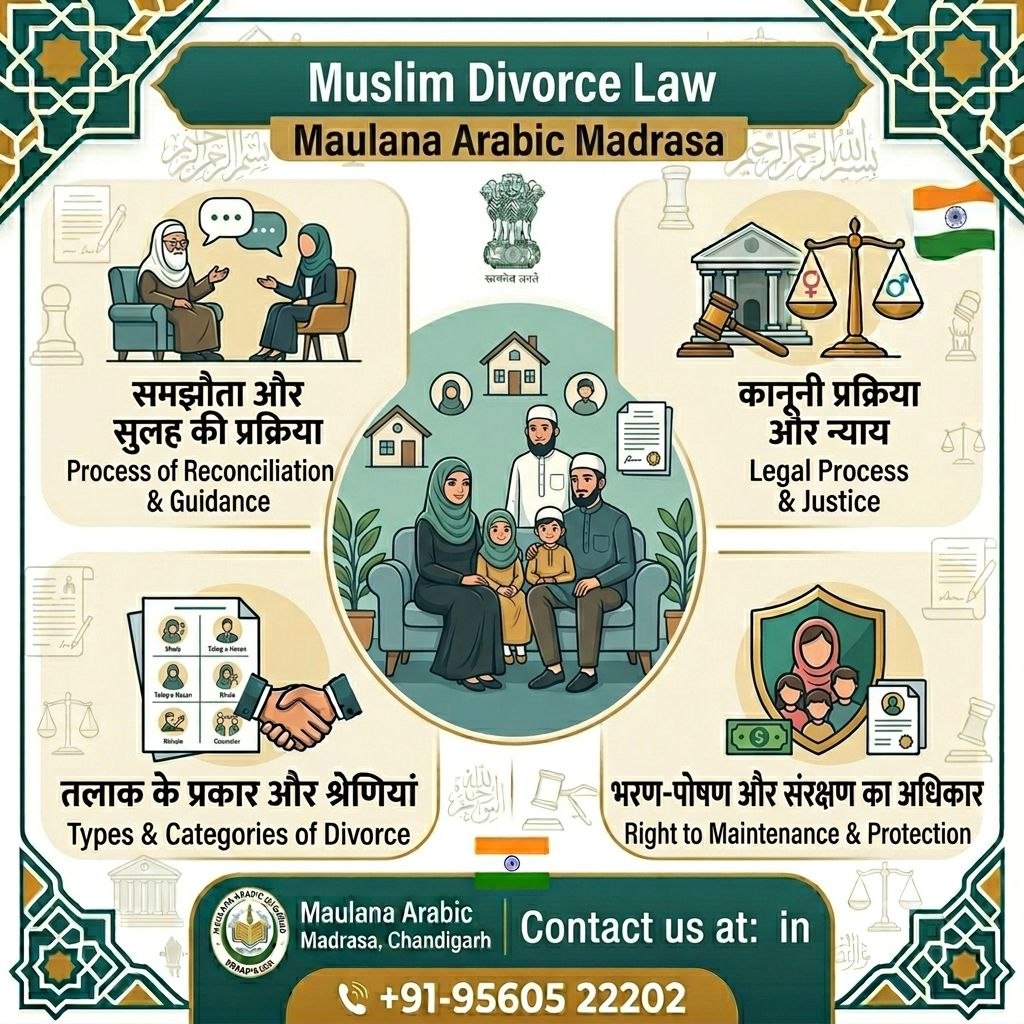
Seeking Amicable Solutions via Darul Qaza
Before approaching formal courts, Islamic jurisprudence strongly encourages mediation, arbitration, and counselling to resolve marital discord.
Family members from both sides are urged to step forward and facilitate a reconciliation wherever possible. When internal resolution fails, traditional community boards and Darul Qaza (arbitration forums managed by certified Islamic scholars) offer essential mediation services. They guide couples through Muslim divorce law India using structured counseling, ensuring that if a separation must occur, it happens with dignity, fairness, and absolute transparency for both households.
Strengthen Your Knowledge with Maulana Arabic Madrasa
Understanding the intricate balance between religious scriptures and national laws is vital for community leaders, scholars, and families alike. Maulana Arabic Madrasa offers specialized courses in Islamic Jurisprudence (Fiqh), legal studies, and classical Arabic to help individuals interpret and apply personal laws correctly within modern legal frameworks.
Equip yourself with authentic knowledge to guide the community toward just solutions. Reach out to our academic cell for curriculum details, counseling support, or enrollment options.
Contact Maulana Arabic Madrasa
For admissions, academic queries, or religious counseling regarding family matters, please connect with us via our official channels:
🌐 Official Website: www.maulana.in
📧 General Email: maulanaarabicidara@gmail.com
📱 Admission Support: +91-98765 43210
📍 Main Campus Office: Maulana Arabic Madrasa Campus, Educational Enclave, New Delhi – 110002