
Marriage in Islam is considered a sacred covenant built upon the pillars of mutual love, respect, and emotional tranquility. However, Islamic jurisprudence realistically acknowledges that some marriages may hit an irreconcilable impasse where living together harmoniously becomes impossible. While a husband holds the right of Talaq (divorce), a wife is granted an equal right to seek separation through a process known as Khula. Following a structured Step-by-Step Khula Procedure in Islam allows a woman to initiate a divorce by returning her dower (Mahr) or offering financial compensation as agreed upon by both parties. Understanding the formal Step-by-Step Khula Procedure in Islam ensures that the dissolution of marriage remains entirely valid, legally binding, and spiritually sound under Shariah law.
At Maulana Arabic Madrasa (Maulana Arabic Idara), we provide authentic religious counseling, fatwa services, and structural guidance on matters of Islamic family law. Below is an exhaustive, 1000-word comprehensive guide designed to walk you through the essential stages of initiating and completing a valid Khula.
The Theological Foundation of Khula
Islamic law strictly protects a woman’s right to exit an unhappy or abusive marriage. The concept of Khula is directly derived from the Holy Quran and the established Sunnah of Prophet Muhammad (peace be upon him).
The Quranic Basis:
“And it is not lawful for you to take anything of what you have given them unless both fear that they will not keep [within] the limits of Allah… Then if you fear that they will not keep the limits of Allah, there is no blame upon either of them concerning that by which she ransoms herself.” (Surah Al-Baqarah, 2:229)
The most famous historical precedent involves the wife of Thabit ibn Qays, who approached the Prophet stating she did not find fault with her husband’s character or religion but simply could not live with him. The Prophet instructed her to return the orchard her husband had given her as a dower, and ordered Thabit to accept it and release her. This established that a woman does not need to prove physical abuse or infidelity to request a separation; a deep, irreconcilable incompatibility is a fully justifiable ground.
Prerequisite Conditions Before Initiating Khula
Before entering the formal legal and religious pathways, specific baseline conditions must be met to preserve the integrity of the process:
Free Will and Sound Mind: The wife must initiate the request out of her own free will, without external coercion, threats, or manipulation from family members.
Irreconcilable Breakdown: The couple must genuinely believe they can no longer maintain the boundaries set by Allah (i.e., fulfill marital rights and duties with mutual kindness).
Compensation Assessment: The wife must be prepared to return the Mahr (dower) received during the Nikah, or a mutually agreed-upon portion of it, to initiate the formal Step-by-Step Khula Procedure in Islam.
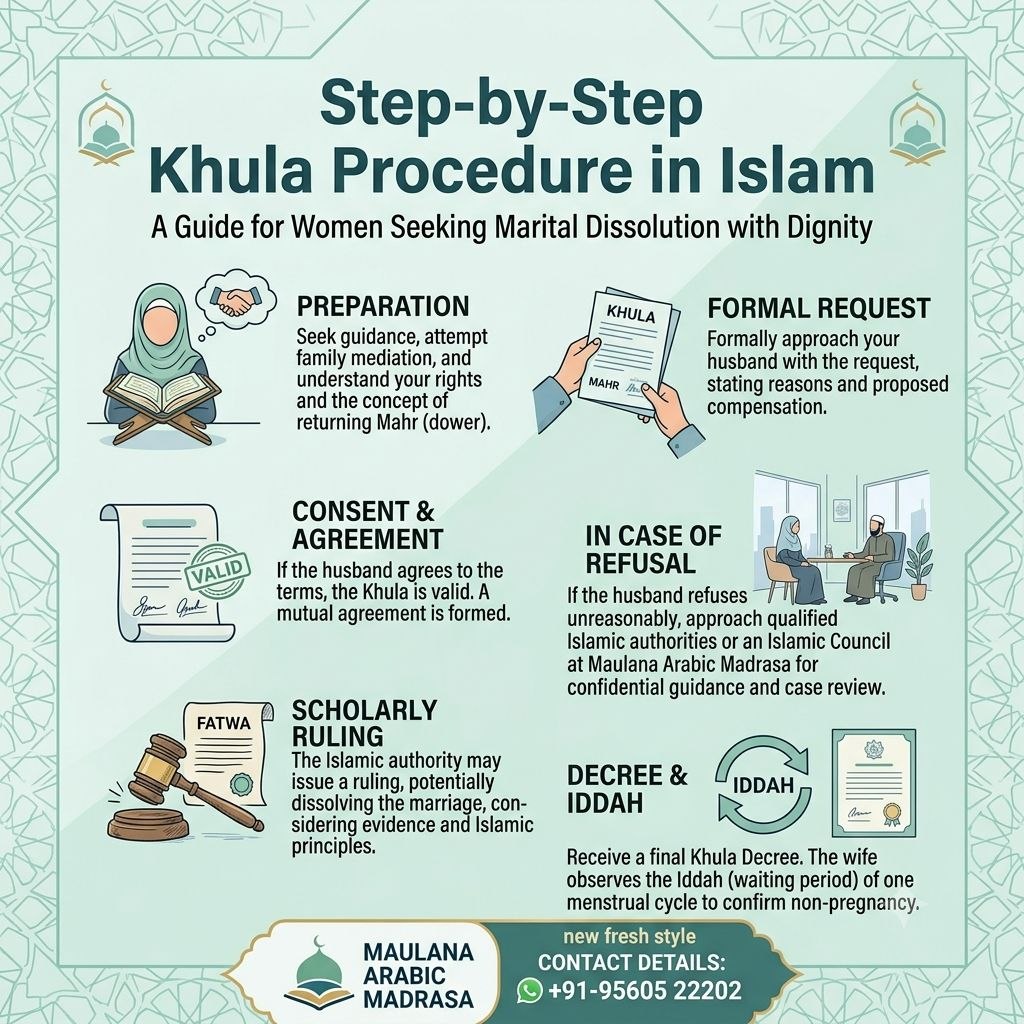
The Structural Step-by-Step Khula Procedure in Islam
To ensure that the separation is legally recognized and religiously valid, the process must follow these structured chronological steps:
🔹 Step 1: Formal Proposal and Mutual Dialogue
The initial step always begins with open communication. The wife communicates her desire for a Khula to her husband, proposing the return of the dower in exchange for her release. If the husband accepts the proposal, the separation can be finalized privately through a written contract signed by both parties and reliable witnesses.
🔹 Step 2: Mediation and Family Arbitration
If the husband refuses to grant the separation or if terms cannot be agreed upon, Islamic jurisprudence mandates a mediation phase. As recommended in the Quran, a representative from the wife’s family and a representative from the husband’s family should gather to mediate. The primary goal is to see if reconciliation is possible. If mediation fails and the wife remains steadfast in her decision, the matter moves to an Islamic council or court.
🔹 Step 3: Submission of Petition to a Shariah Council
If mutual agreement cannot be reached, the wife submits a formal application to a recognized Shariah Council or Darul Qaza (Islamic Court). In this petition, she formally requests judicial dissolution of the marriage via Khula. Institutions like Maulana Arabic Madrasa assist women in drafting these applications accurately according to standard Islamic legal principles.
🔹 Step 4: Issuance of Summons and Council Hearing
Upon receiving the petition, the Shariah Council issues a formal summons to the husband to attend a hearing. The council will listen to both sides, attempt a final round of reconciliation, and verify that the wife is acting out of her own independent volition. If the husband refuses to attend multiple consecutive hearings without a valid excuse, the Islamic court possesses the judicial authority to grant the separation unilaterally to prevent harm to the woman.
🔹 Step 5: Finalization of Terms and Returning the Mahr
Once the council determines that the marriage cannot be saved, they fix the financial compensation. By default, the wife returns the original Mahr she received. It is highly discouraged in Shariah for a husband to demand an amount significantly greater than the original dower he paid. Once the compensation is transferred or legally waived, the husband signs the declaration, or the judge pronounces the marriage dissolved.
The Iddah (Waiting Period) Following Khula
A crucial distinction between a standard Talaq and a Khula lies in the duration and nature of the subsequent waiting period (Iddah).
Duration: While the Iddah for a standard divorce is three menstrual cycles, the widely accepted prophetic opinion states that the Iddah for a Khula is only one menstrual cycle (or until delivery if the woman is pregnant). This brief period is strictly meant to ascertain whether the woman is expecting a child.
Irrevocability: A Khula constitutes a Talaq-e-Bain (an irrevocable divorce). Unlike a regular revocable divorce (Talaq-e-Raji), the husband cannot unilaterally claim his wife back during the waiting period. If the couple wishes to reconcile in the future, they must perform an entirely new Nikah with a fresh dower and explicit mutual consent.
How Court Marriage Affects the Khula Process
In modern legal systems, a religious divorce alone may not be sufficient if the marriage was officially registered under civil state laws. If a couple underwent a civil court marriage, the wife must secure a civil divorce from a family court alongside the religious Step-by-Step Khula Procedure in Islam.
Failing to align religious separation with civil decree can result in legal complications, such as charges of bigamy if either party attempts to remarry under civil law. A balanced approach ensures that your marital status is completely clear both in the eyes of the law and before Allah.
Compassionate Guidance at Maulana Arabic Madrasa
Navigating family disputes can be emotionally draining and confusing. The scholarly team at Maulana Arabic Madrasa (Maulana Arabic Idara) offers confidential Islamic counseling, family mediation, and authentic Shariah guidance to ensure your rights are protected throughout the Step-by-Step Khula Procedure in Islam. We help ensure that your paperwork, procedures, and ultimate separation adhere precisely to the established schools of Islamic jurisprudence (Fiqh).
Reach Out to Maulana Arabic Idara
If you need professional counseling, fatwa services, or clarification regarding marital separation and Islamic family rights, do not hesitate to contact our head office today:
📱 Phone / WhatsApp: +91 95605 22202 | +91 84476 15753
📧 Email: maulanaarabicidara@gmail.com
🌐 Official Website: www.maulana.in
📍 Head Office Address: Maulana Arabic Idara, RZ-2054, TKD Extension, Near Tara Apartment, New Delhi – 110019