
Within Islamic jurisprudence, marriage is a sacred contract designed to foster peace, mutual respect, and spiritual growth. However, Islamic law pragmatically recognizes that some marriages may face unresolvable breakdowns. To ensure fairness, Shariat provides distinct avenues of dissolution for both partners. While a husband may initiate a divorce through Talaq, a wife possesses the legal right to seek a separation through Khula in Hanafi law. Navigating the specific conditions of Khula in Hanafi law requires a clear understanding of its distinct rulings on consent, financial settlements, and the exact role of judicial arbitration. Failing to understand these specific legal nuances can leave a woman in a state of administrative or spiritual limbo, which makes formal guidance from an established Islamic institution absolutely essential.
For millions of Muslims across the Indian subcontinent, the Hanafi school of jurisprudence provides the foundational framework for personal law. At Maulana Arabic Madrasa, through our specialized Darul Qaza (Islamic arbitration court), we provide clear, empathetic, and authentic guidance based strictly on classical Hanafi texts. This comprehensive guide breaks down the essential principles, procedural rules, and financial implications governing this vital legal right.
The Foundational Concept of Khula in the Hanafi School
The Hanafi school defines Khula as a contract of separation entered into by the mutual consent of the husband and the wife, where the wife provides financial consideration to be released from the marriage bond.
⚖️ The Essential Pillar of Mutual Agreement
A defining characteristic of Khula in Hanafi law is that it is primarily viewed as a consensual contract (Aqd). Unlike some other schools of Islamic thought where a judge can easily dissolve a marriage at the wife’s simple request, standard Hanafi jurisprudence emphasizes that both the husband and the wife must ideally agree to the terms of the separation for the initial out-of-court agreement to be valid.
📖 Scriptural Justification
The legal basis for this process is derived directly from the Holy Qur’an and the Sunnah. Surah Al-Baqarah (2:229) explicitly states that there is no blame upon either of them if the woman ransoms herself to secure her freedom, provided they cannot maintain the limits ordained by Almighty Allah.
🚫 The Role of Consent: What If the Husband Refuses?
Because classical Khula in Hanafi law emphasizes mutual consent, a common challenge arises when a husband stubbornly refuses to accept his wife’s proposal for separation. This can leave women feeling trapped, but Hanafi jurisprudence offers structured institutional remedies to prevent injustice.
The Private Limitation
If a wife approaches her husband privately and offers to return her dower, he has the initial right to reject the offer if he sincerely wishes to reconcile or resolve their differences. In this private sphere, she cannot force the separation unilaterally.
🔨 The Power of the Darul Qaza (Islamic Court)
When a private agreement fails due to the husband’s unreasonable obstinacy, the wife can escalate her case to an authorized Islamic body like the Darul Qaza at Maulana Arabic Madrasa.
Investigation: The Qazi (Islamic judge) thoroughly reviews the marital situation, checking for evidence of abuse, long-term desertion, or severe financial neglect.
The Decree of Faskh: If the Qazi determines that the marriage is entirely dead and the husband is using his refusal as a tool for harassment, the court steps in. Under Hanafi rules of necessity (Dharurah), the court can exercise the power of Faskh (judicial annulment), dissolving the marriage contract without the husband’s signature.
💰 Financial Rulings and Mahr Adjustments
The financial aspect is a central element in any discussion regarding Khula in Hanafi law. Because the separation is initiated by the wife, the financial implications vary depending on who is at fault for the marital breakdown.
📉 When the Husband is at Fault
If the separation is driven by the husband’s cruelty, continuous abuse, or open neglect, Hanafi scholars state that it is highly disliked (Makruh) for him to demand or accept any financial compensation or the return of the Mahr. He should release her graciously without taking back his gifts.
📈 When the Wife Initiates Due to Personal Incompatibility
If the husband has fulfilled his marital duties but the wife simply cannot develop affection for him and wishes to exit the marriage, it is permissible for the husband to ask for the return of the original Mahr. However, Hanafi jurists strongly advise against demanding anything more than the value of the original dower.
Standard Legal Process for Obtaining a Khula
To ensure total validity under both Islamic personal law and Indian administrative frameworks, the process must follow a clean, structured pathway.
🗂️ Step 1: Formal Application Submission
The wife submits a comprehensive written petition to our central office, detailing the grounds for the separation, the history of the marriage, and the status of the Mahr.
👥 Step 2: Issuance of Summons and Arbitration
The Darul Qaza issues up to three formal notices to the husband, directing him to appear for mediation. Our scholars attempt to resolve the disputes through intensive marital counseling sessions.
✍️ Step 3: Execution and Registration
If reconciliation proves impossible, the terms of the financial settlement are officially written down. The husband signs the Khula deed, or the Qazi issues a judicial decree of annulment. A formal certificate is then registered and stamped.
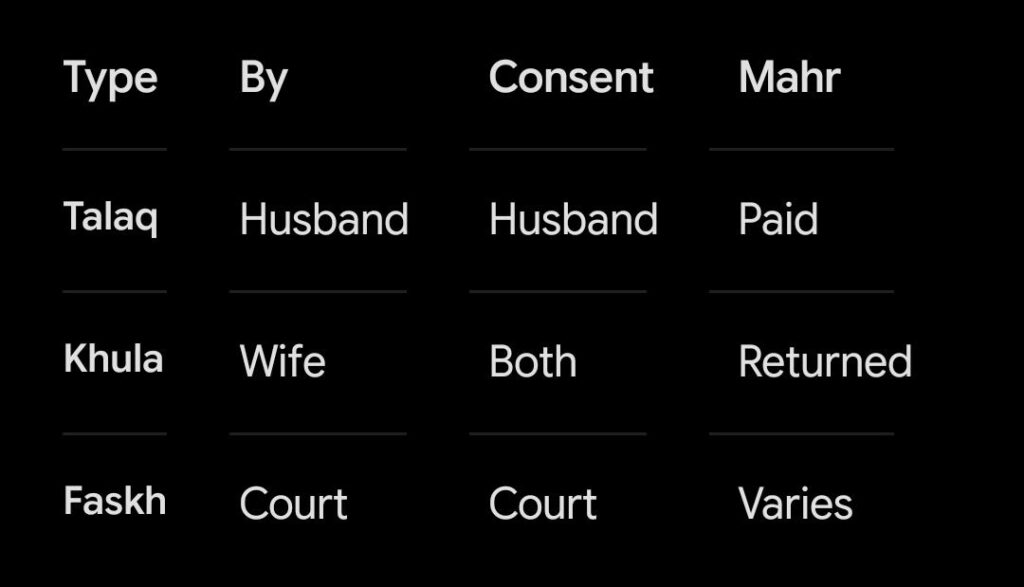
A Quick Comparison of Divorce Types under Hanafi Jurisprudence
To help applicants distinguish between the various legal avenues available, this table provides a high-level structural comparison:
Rulings Regarding Iddah and Remarriage
Once the process of Khula in Hanafi law is successfully completed, specific post-divorce legal rules take effect immediately:
The Status of the Divorce: A successful Khula results in a Talaq-e-Bain (an irrevocable divorce). The husband cannot unilaterally undo the divorce during the waiting period. If they ever wish to get back together, a brand-new Nikah contract with a new Mahr is mandatory.
The Iddah Period: The divorced woman must observe a waiting period (Iddah) of three complete menstrual cycles (or until delivery if she is pregnant) before she is religiously permitted to remarry.
Maintenance During Iddah: Under mainstream Hanafi interpretation, the husband remains responsible for providing safe housing and basic food maintenance to his ex-wife for the entire duration of her Iddah period.
Why Rely on Maulana Arabic Madrasa?
Dealing with matrimonial issues requires deep legal precision, extreme confidentiality, and a compassionate approach. Maulana Arabic Madrasa serves as a trusted pillar of support for the community:
Authentic Scholars: Our legal panel consists of senior Muftis deeply trained in classical Hanafi jurisprudence textbooks like the Hedaya and Fatawa Hindiyyah.
Balanced Mediation: We ensure that the rights of both parties are fully protected, preventing financial exploitation or lengthy legal deadlocks.
Valid Civil Proof: The official certificates issued by our institution carry high credibility, making it simple to update your civil documents like passports and national IDs.
Connect With Our Central Administrative Office
If you require personal counseling, legal clarification, or wish to initiate an official application regarding your marriage, reach out to our administration team directly:
📱 Phone Support: +91-95605 22202
📧 Official Email: maulanaarabicidara@gmail.com
🌐 Web Portal: www.maulana.in
📍 Central Campus Address: Maulana Arabic Madrasa, TUGHLAKABAD EXTENSION street 27 New Delhi, New Delhi – 110019