
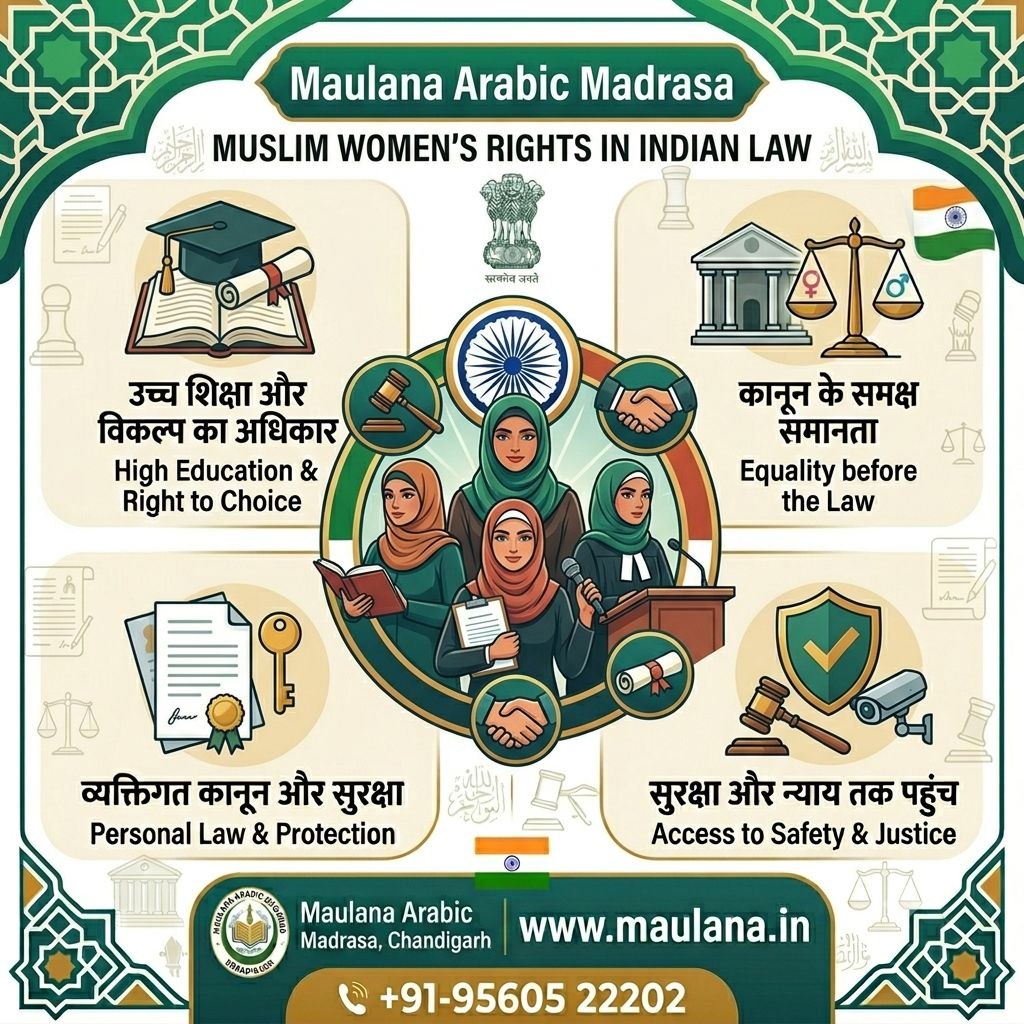
Navigating the complexities of legal protections is essential for fostering an informed, just, and equitable society. For those seeking comprehensive clarity on Muslim women rights India law, understanding the intersection of historical personal statutes and progressive judicial reforms is paramount. In India, the legal framework governing these protections is uniquely shaped by statutory enactments, judicial pronouncements, and Islamic jurisprudence. At Maulana Arabic Madrasa, we believe that academic enlightenment must seamlessly align with legal awareness. By exploring the true parameters of Muslim women rights India law, individuals within the community can better assert their legal safeguards while upholding their foundational cultural identity.
Through this detailed guide, we aim to demystify the critical pillars of Indian legislation and personal laws that preserve the financial, social, and marital dignity of Muslim women across the nation.
The Foundation of Muslim Personal Law in India
The legal rights of Muslim women in India are historically rooted in a combination of traditional personal practices and legislative acts passed by the Indian Parliament.
The Shariat Application Act, 1937: This act ensures that matters concerning marriage, dower (Mahr), divorce, and inheritance are governed by Islamic personal laws rather than secular civil statutes.
Constitutional Safeguards: Article 14 (Right to Equality) and Article 15 (Prohibition of Discrimination) provide a constitutional umbrella that constantly influences how courts interpret individual legal cases involving personal laws.
💍 Protection of Rights on Marriage and Dower (Mahr)
Under Muslim women rights India law, marriage is viewed as a solemn, legally binding social contract (Nikah). This contractual nature ensures specific unalterable rights for the bride at the very inception of the union.
🪙 The Right to Absolute Ownership of Mahr
Mahr is a mandatory payment or possession promised by the groom to the bride as a token of respect and security. Unlike a dowry, Mahr belongs strictly and exclusively to the woman. She retains full autonomy over how it is spent, invested, or maintained, free from interference by her husband or in-laws.
📝 The Nikahnama as a Safeguard
Modern legal frameworks strongly encourage the clear documentation of terms within the Nikahnama (marriage contract). Specialized conditions—such as the prohibition of a second marriage or the delegation of the right to divorce (Tafweez)—can be legally integrated to protect the woman’s long-term interests.
🏛️ Legal Recourse and Protections Against Divorce
One of the most rapidly evolving areas of Muslim women rights India law pertains to dissolution of marriage and post-divorce rehabilitation. Significant legislative changes have drastically altered the legal landscape over recent decades.
🚫 The Abolition of Triple Talaq (Talaq-e-Biddat)
With the enforcement of the Muslim Women (Protection of Rights on Marriage) Act, the practice of instant, unrecoverable triple talaq was rendered entirely illegal and void. The law provides criminal liability for violations, granting the aggrieved woman the right to claim a subsistence allowance for herself and her dependent children, alongside custody of her minor children.
⚖️ The Right to Seek Judicial Separation
Under the Dissolution of Muslim Marriages Act, a Muslim woman possesses the independent right to initiate divorce through the court system on various specified grounds, including:
Cruelty or physical/mental abuse.
Failure of the husband to provide financial maintenance for a period of two years.
Desertion or unknown whereabouts of the husband for four years.
Maintenance Rights After Divorce
A pivotal aspect of Muslim women rights India law is the guaranteed economic security provided to a woman following the breakdown of a marriage. The legal system provides multiple pathways to prevent destitution.
The Muslim Women (Protection of Rights on Divorce) Act: This statute dictates that a reasonable and fair provision of maintenance must be paid to the divorced woman by her former husband within the Iddat period. This includes the payment of any unpaid Mahr and the restoration of all properties given to her during or after the marriage.
The Secular Pathway (Section 125 of CrPC / BNSS): The Supreme Court of India has consistently upheld that a divorced Muslim woman who is unable to maintain herself can alternatively seek lifelong maintenance from her ex-husband under secular criminal procedure provisions, provided she does not remarry.
Inheritance and Property Rights
Unlike historical systems where women were excluded from estate planning, Islamic jurisprudence and Indian statutory adaptations secure explicit property rights for women. Under Muslim women rights India law, a woman enjoys complete absolute ownership over her inherited assets, with no concept of “joint family property” restricting her share.
As a Daughter: She inherits a legally specified share of her parents’ property, which is generally equal to half of the share inherited by a brother, owing to the structural distribution of financial responsibilities in traditional frameworks.
As a Wife: She is legally entitled to a fixed fraction of her deceased husband’s estate (one-fourth if there are no children, or one-eighth if there are surviving children or lineal descendants).
Connect with Maulana Arabic Madrasa
For more information on educational courses, community guidance, and research initiatives, feel free to reach out to our administrative campus:
🌐 Website: www.maulana.in
📧 Email Support: maulanaarabicidara@gmail.com
📍 Main Office: Maulana Arabic Madrasa Campus, Educational Block, New Delhi, India