
The legal framework governing family life, marriages, inheritance, and personal relationships plays a foundational role in maintaining social harmony and spiritual integrity. For the Islamic community, these crucial matters are handled under a distinct legal structure known as personal law for Muslims in India. Understanding how personal law for Muslims in India operates alongside statutory civil rules is absolutely essential for every believer who wishes to manage their household, secure their property rights, and execute marital agreements in full compliance with sacred Shariat principles. This legally recognized framework ensures that traditional Islamic customs are given formal weight under the Indian judicial structure, allowing individuals to lead their personal lives according to their faith while seamlessly utilizing modern administrative rights. Because family laws directly impact civil documentation, property titles, and community welfare, gaining an accurate, scholarly understanding of this system protects families from lengthy court disputes and spiritual errors.
At Maulana Arabic Madrasa, we are dedicated to helping our community navigate these legal pathways with absolute confidence. Through our active central advisory panel and our dedicated Darul Qaza (Islamic arbitration desk), we break down advanced judicial statutes into accessible guidance. This exhaustive guide explores the history, primary components, and modern administrative application of Islamic family rules across the country.
The Historical and Legal Foundations of the Act
The application of Islamic legal frameworks to civil family affairs is not merely a social custom; it is a legally enforced statutory right backed by decades of historical legislation.
The Shariat Application Act of 1937: This foundational colonial-era legislation serves as the formal bedrock for the system. It explicitly dictates that in matters concerning marriage, dissolution of marriage, dower, maintenance, gifts, trusts, and successions, the rule of decision for Muslim parties shall be Islamic Personal Law.
Constitutional Guarantees: Freedom of religion under Article 25 to Article 28 of the Indian Constitution safeguards the community’s right to manage their internal religious affairs, personal customs, and institutional charities without arbitrary state overreach.
The Role of Selective Jurisprudence: Since the vast majority of Muslims across India follow the Hanafi school of thought, standard family disputes are evaluated primarily through classical Hanafi legal texts, while separate provisions protect Shia and other schools.
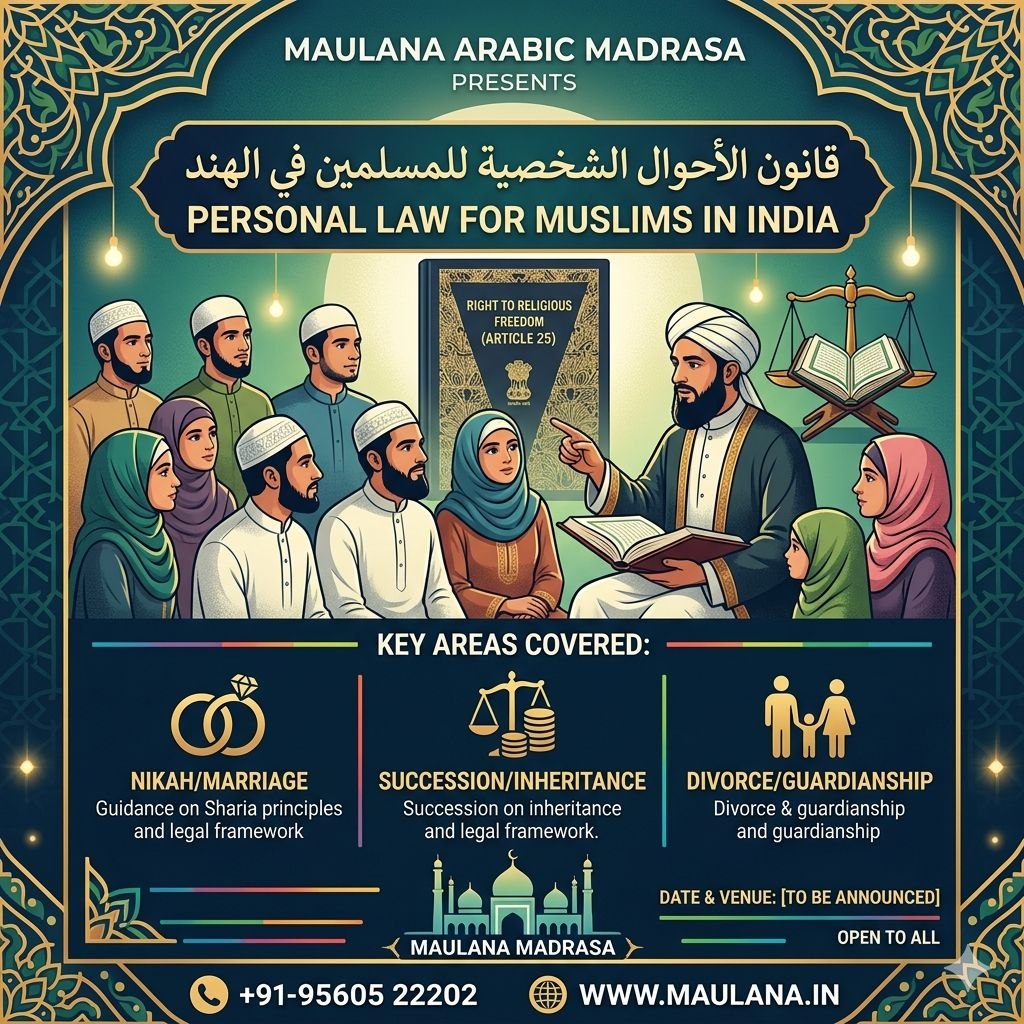
Rulings Governing Matrimony (Nikah)
Under Islamic family law, a marriage is treated fundamentally as a sacred, civil contract between two consenting parties, rather than an irreversible sacrament.
The Pillars of a Valid Contract: For an Islamic marriage contract to be completely valid, it requires a clear proposal (Ijab) and an explicit acceptance (Qubool) expressed in a single sitting, in the presence of two sane adult male witnesses.
The Mandate of Dower (Mahr): The husband is legally and spiritually bound to grant a financial consideration or asset called Mahr to his wife. This belongs strictly to her and acts as a vital layer of financial security.
Registration Protocols: While the contract is complete upon signing the traditional Nikahnama, modern state laws heavily encourage registering your marriage with local state Waqf boards or municipal registrars to smooth out future passport and visa updates.
Avenues for the Dissolution of Marriage
When a marital relationship faces an absolute breakdown, the personal law for Muslims in India ecosystem provides separate, structured exit paths to protect the rights and dignity of both partners.
Talaq (Husband-Initiated): The traditional mechanism through which a husband can dissolve the marriage. Modern statutory updates have strictly outlawed the practice of instantaneous triple talaq (Talaq-e-Biddat), emphasizing that any valid separation must follow a gradual, meditative process spread over multiple weeks to allow for family reconciliation.
Khula (Wife-Initiated): The legal right of a Muslim woman to seek a separation by returning her dower or waiving specific financial claims. If a husband unreasonably rejects her private request, an authorized institutional court can step in and override his refusal completely.
Faskh-e-Nikah (Judicial Annulment): Under the Dissolution of Muslim Marriages Act of 1939, a woman can approach an authorized Islamic judge or civil family court to dissolve her marriage on concrete grounds such as long-term abandonment, cruelty, or absolute failure to provide basic financial maintenance.
Inheritance, Wills, and Succession Rules
The distribution of an individual’s estate after their passing is strictly regulated under traditional Shariat tables of distribution, which operate independently from the regular Indian Succession Act.
No Absolute Wills: A Muslim cannot execute a will (Wasiyat) for more than one-third of their total net estate after paying off outstanding debts and funeral costs. This rule protects the automatic rights of legal heirs.
Fixed Legal Heirs: The remaining two-thirds of the estate must be distributed among mandatory heirs (such as parents, spouses, and children) in exact mathematical ratios dictated directly by Quranic text.
The Law of Gifts (Hiba): An individual has the full right to transfer their entire property to anyone they choose during their lifetime via a gift (Hiba), provided the gift includes a clear declaration, acceptance, and an immediate transfer of physical possession.
The Role of Darul Qaza and Institutional Guidance
While state family courts have the power to resolve domestic disputes, millions of citizens choose to present their personal matters before an institutional Darul Qaza operated by respected seminaries like Maulana Arabic Madrasa.
Efficient and Peaceful Arbitration: Traditional courts are often plagued by massive backlog delays and high legal fees. An Islamic arbitration desk resolves complex family and property issues in a matter of weeks through empathetic counseling.
Robust Evidentiary Support: The certified decrees, marriage catalogs, and divorce deeds issued by an established madrasa carry deep community respect. Should a dispute end up in a civil court later, these documents serve as highly credible evidence of valid Islamic procedures.
Why Turn to Maulana Arabic Madrasa?
Managing family life, estate planning, and marital contracts under the framework of personal law for Muslims in India requires an institute that balances deep theological knowledge with a practical understanding of civil requirements. Maulana Arabic Madrasa serves as a reliable guide for the community for several key reasons:
Elite Juristic Authority: Our advisory board features highly accomplished Muftis who are deeply trained in traditional jurisprudence and fully aware of modern Indian civil statutes.
Absolute Privacy Protection: We treat all marital counseling, mediation details, and family inheritance distributions with total, unbroken confidentiality.
Flawless Documentation Standards: Every certificate, deed, and legal declaration generated by our administrative desk is carefully structured, stamped, and cataloged to ensure wide acceptance across government and civil offices.
Reach Out to Our Central Administration
If you require expert legal counseling, need to draft a Shariat-compliant will, or want to register a personal family matter, please connect with our central administrative desk directly:
📱 Direct Helpline / WhatsApp: +91-95605 22202
📧 Official Operations Email: maulanaarabicidara@gmail.com
🌐 Central Web Portal: www.maulana.in
📍 Central Campus Headquarters: Maulana Arabic Madrasa, Rz 2054 street 27 Tughlakabad extension New Delhi – 110019
📍 Regional Coordination Hub: SCO 35, Sector 16D, Chandigarh – 160015