
The structural framework of Muslim personal law in India has undergone significant legislative transformations in recent years. For couples experiencing severe marital discord, understanding the current statutory position of traditional divorce mechanisms is vital to ensuring full legal compliance and protecting individual civil rights. A pivotal development in this legal landscape is the enactment of the triple talaq law India, which explicitly addresses the practice of Talaq-e-Biddat (instantaneous triple divorce in a single sitting). Under the triple talaq law India, the pronouncement of instant divorce has been rendered completely void and illegal under civil law, carrying strict statutory penalties for non-compliance. Navigating these modern intersection points between classical Islamic jurisprudence and statutory Indian criminal law requires reliable guidance from an established institutional body. This ensures that personal separations are conducted through valid, legally recognized avenues that stand up to court scrutiny while completely honoring religious values.
At Maulana Arabic Madrasa, we are committed to providing clarity, pastoral care, and authentic advice to the community. Through our dedicated Darul Qaza (Islamic arbitration and counseling council), we help individuals understand how statutory updates interface with Shariat law. This comprehensive guide breaks down the essential legal realities, procedural changes, and legitimate paths available for families navigating marital dissolution in the modern era.
The Legal Context of Talaq-e-Biddat
To fully comprehend the current statutory laws, it is important to distinguish between the different forms of divorce recognized in classical Islamic theology.
Talaq-e-Sunnah: This is the structurally approved, Quranic method of divorce. It is executed over a prolonged period, leaving ample time for family mediation, emotional cooling-off periods, and reconciliation efforts. It can be performed via Talaq-e-Ahsan or Talaq-e-Hasan.
Talaq-e-Biddat: This refers to the instantaneous pronouncement of the word “Talaq” three times in a single breath, via a text message, over a phone call, or in a single written document. While historically tolerated under specific schools of thought as a sinful yet effective mechanism, it lacked structural scriptural backing.
The modern triple talaq law India focuses exclusively on eliminating Talaq-e-Biddat, leaving the valid, traditional forms of Talaq-e-Sunnah entirely untouched and protected under personal law frameworks.
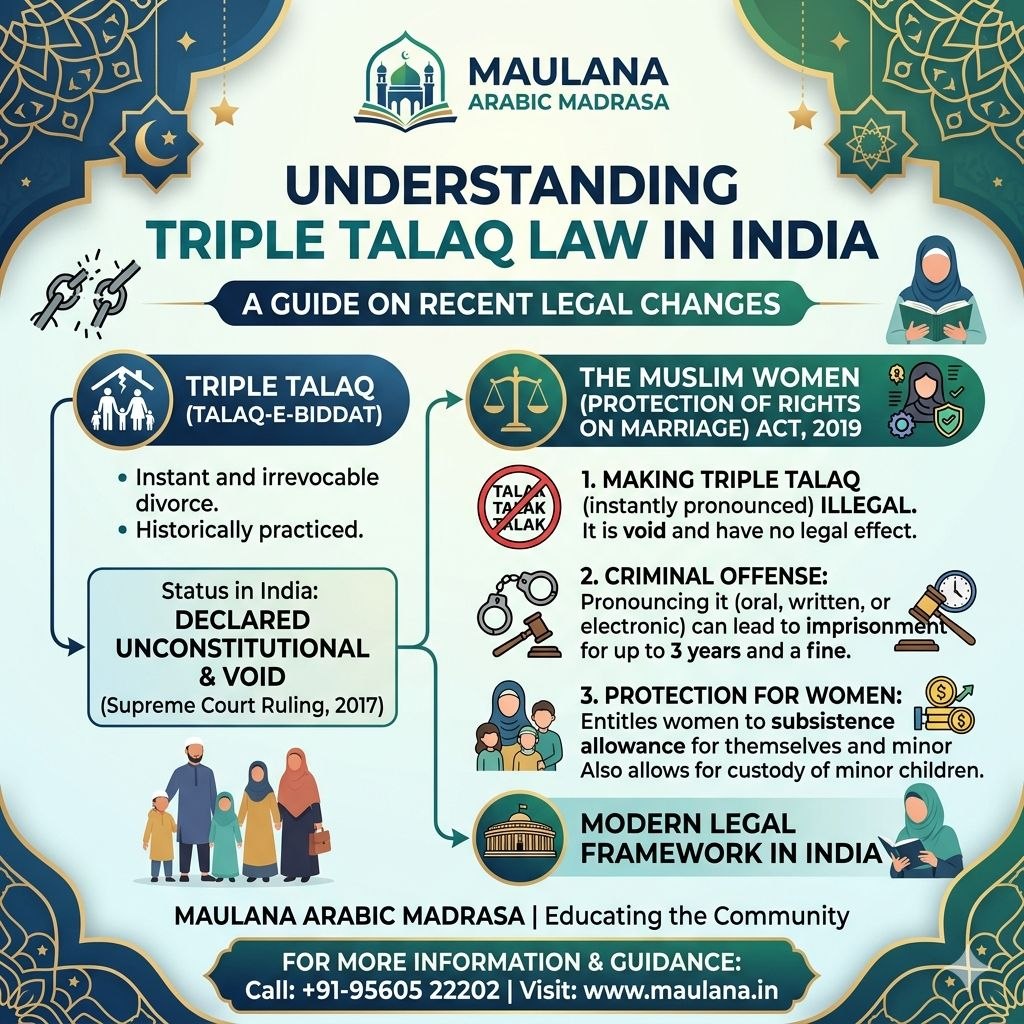
Key Provisions of the Modern Act
Formally known as the Muslim Women (Protection of Rights on Marriage) Act, the statutory framework introduces severe legal implications that every citizen must be fully aware of.
Absolute Nullity: Any pronouncement of instant triple talaq—whether spoken, written, or communicated electronically—holds zero legal validity. The marriage remains completely active and legally binding in the eyes of the state.
Cognizable Offense: The act classifies the pronouncement as a cognizable offense, meaning law enforcement can make an arrest without a prior warrant, provided the complaint is filed by the wife or her close blood relatives.
Imprisonment and Penalties: A husband found guilty of pronouncing instant divorce can face a statutory prison sentence of up to three years, along with a dynamic financial fine determined by the magistrate.
Because the triple talaq law India enforces strict criminal liability, relying on outdated social practices can lead to immediate legal crises, making formal institutional consultation an absolute necessity.
Statutory Rights and Protections for Women
The primary legislative objective of the triple talaq law India is to establish absolute legal security and social dignity for married Muslim women. The act builds in specific safeguards to ensure women are not left financially vulnerable or socially isolated:
Subsistence Allowance: A married woman against whom instant divorce is attempted is legally entitled to receive a monthly subsistence allowance from her husband. This financial amount is determined by a judicial magistrate to cover the basic living expenses of the wife and her dependent children.
Custody of Minor Children: The law prioritizes the well-being of minors, granting the mother the primary right to retain absolute custody of her young children in the event of an illegal instant divorce dispute.
Bail Thresholds: The magistrate can only grant bail to the accused husband after listening directly to the wife’s testimony and ensuring that reasonable terms for family safety or financial support are established.
Legitimate Pathways for Separation Under Law
Since instant triple divorce is entirely void under the triple talaq law India, couples who find their marriages completely unworkable must use legitimate, legally recognized pathways to execute a separation cleanly.
The Path of Talaq-e-Hasan: This involves pronouncing a single revocable talaq over three consecutive monthly cycles (Tuhr). This methodology strictly satisfies personal law requirements and avoids all criminal liabilities under modern statutes.
The Path of Khula: If the wife wishes to initiate the separation due to incompatibility or neglect, she can file a formal application for Khula. This process is managed smoothly through an authorized institutional panel.
Judicial Dissolution: Couples can approach a civil family court or an established Darul Qaza to secure a formal decree of dissolution, ensuring a clean break without violating statutory regulations.
The Vital Role of Maulana Arabic Madrasa
Navigating family disputes under the shadow of stringent criminal statutes can cause intense emotional and legal panic. Maulana Arabic Madrasa serves as an essential guide for the community during these stressful transitions:
Expert Mediation: Our panel of qualified scholars and legal experts works diligently to resolve disputes through marital counseling, aiming to save homes whenever possible.
Faultless Execution: If a separation is unavoidable, we ensure the documentation and pronouncements adhere strictly to the valid rules of Talaq-e-Hasan, keeping the family safe from any violations of the triple talaq law India.
Credible Institutional Proof: The certificates and records generated by our main office provide clear, definitive proof of your marital status, helping you update passports, national identity cards, and civil records without administrative delays.
Connect with Our Central Administrative Office
If you require personal family counseling, legal clarification regarding personal laws, or wish to explore legitimate mediation services, reach out to our central coordination desk today:
📱 Direct Helpline / WhatsApp: +91-95605 22202
📧 Official Administration Email: maulanaarabicidara@gmail.com
🌐 Central Web Portal: www.maulana.in
📍 Central Campus Headquarters: Maulana Arabic Madrasa, Rz 2054 street 27 Tughlakabad extension New Delhi – 110019
📍 Regional Coordination Center: SCO 35, Sector 16D, Chandigarh – 160015