
For millions of Muslims living across the Indian subcontinent, navigating daily life while remaining steadfast in their faith requires continuous access to reliable religious clarity. When complex contemporary issues arise regarding family dynamics, financial ethics, or personal worship, believers naturally look toward traditional Islamic law for definitive answers. In these moments of uncertainty, the term Fatwa is frequently brought up in spiritual discussions, but many individuals still wonder: What does fatwa mean in Urdu, and how does it practically shape a believer’s spiritual and social responsibilities? Understanding exactly what does fatwa mean in Urdu helps ordinary Muslims separate sensationalized media misconceptions from authentic theological realities, ensuring that the community looks to properly qualified Islamic scholars (Muftis) rather than unverified online sources when seeking divine guidance.
At Maulana Arabic Madrasa, we are deeply committed to educating the community, preserving classical Islamic heritage, and providing clear, accessible solutions to modern challenges. Through our central Darul Ifta (Department of Islamic Edicts), we carefully bridge the gap between ancient Arabic legal texts and the everyday linguistic and cultural realities of Urdu-speaking communities across India. This extensive guide provides an exhaustive look into the linguistic roots, theological boundaries, and practical applications of this vital Islamic concept.
The Linguistic Breakdown: Translating the Concept into Urdu
To truly understand the essence of a Fatwa, one must explore how the word translates both literally and contextually into the Urdu language.
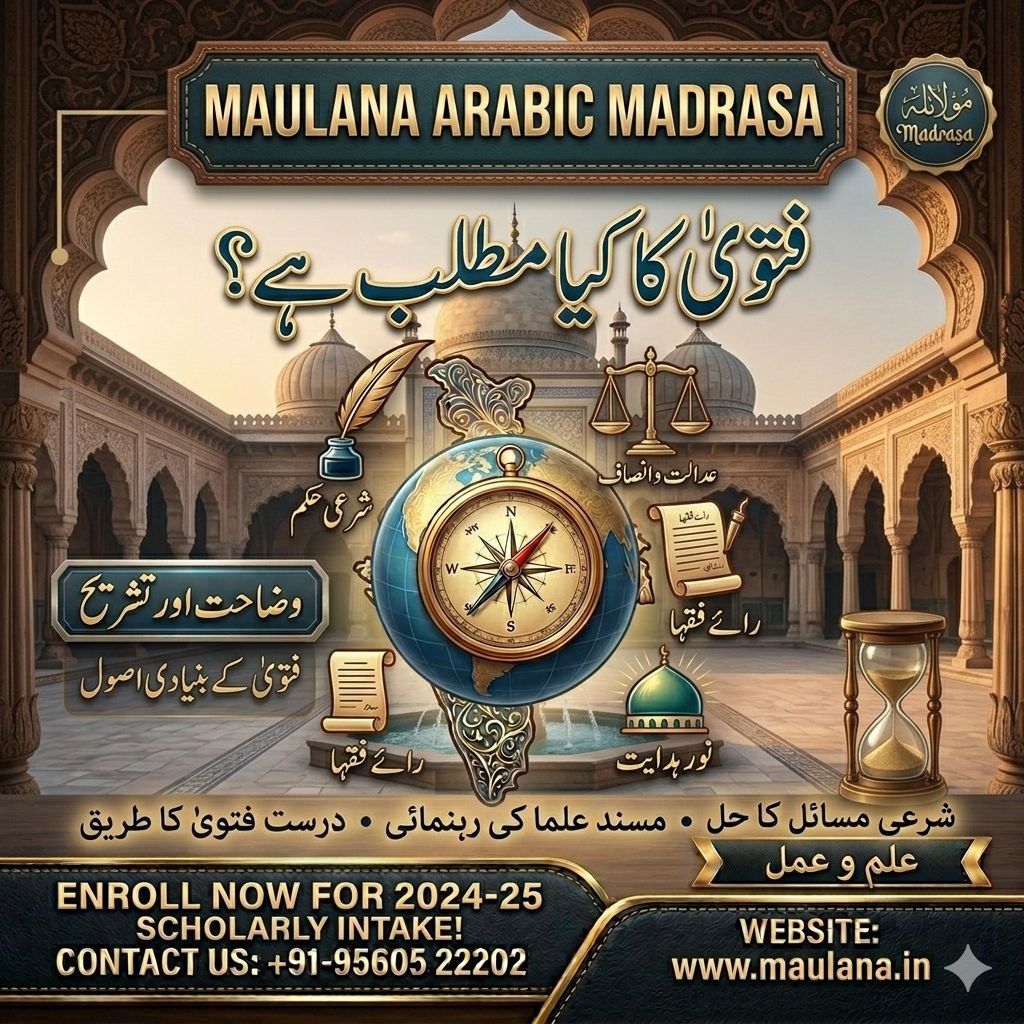
In everyday Urdu vocabulary, exploring what does fatwa mean in Urdu leads directly to the phrases “Shar’i Raaye” (شرعی رائے) or “Deeni Hukm” (دینی حکم). This signifies a formal religious opinion or legal clarification based on the rules of Shariat. It stems from the Arabic root word Fata, which relates to youth, clarity, and the unpacking of a complex or hidden matter.
In Urdu-speaking societies, the scholar who possesses the structural authority to issue this opinion is known as a Mufti (مفتی). The process of writing and delivering this guidance is termed Ifta (افتاء). A Mufti must complete decades of advanced training in classical Arabic grammar, Quranic commentary (Tafseer), prophetic traditions (Hadith), and comparative Islamic jurisprudence (Fiqh). Therefore, when exploring what does fatwa mean in Urdu, it is deeply tied to the scholarly authority of a qualified jurist rather than casual personal opinions.
Common Misconceptions: What a Fatwa is NOT
To prevent social confusion, it is just as crucial to understand what a Fatwa is not, especially given how the term is frequently misrepresented in modern global media.
It is NOT a Court Sentence (Adalati Faisla): In Islamic law, a judicial court sentence (Qaza) is legally binding and enforceable by state authorities. A Fatwa, on the other hand, is an expert advisory opinion.
It is NOT a Tool for Personal Revenge: A qualified Mufti never issues a decree based on personal biases, political motives, or family rivalries. Every word must be rigidly backed by scriptural evidence.
It is NOT Unchangeable Law: While the core pillars of Islam (like prayer and fasting) are eternal, Fatwas handling modern technological or financial matters can evolve as societal contexts change.
The Methodical Process of Writing a Fatwa
Issuing a religious decree is a heavy spiritual responsibility that requires a highly disciplined, multi-layered review process to ensure absolute alignment with divine law.
Sawal (Question Submission): The process begins when an individual submits a detailed, written question to the madrasa. The question must outline a real, non-hypothetical problem regarding personal life, business, or marital conflicts.
Tehqeeq (Scriptural Research): Our research scholars analyze the query deeply, cross-referencing it with foundational Islamic legal texts, such as the Fatawa Hindiyyah or Fatawa Ridawiyah, which form the cornerstone of Hanafi jurisprudence in the subcontinent. This methodical breakdown helps illustrate what does fatwa mean in Urdu as a highly academic and technical process rather than a random decree.
Tasdeeq (Council Verification): The Mufti drafts the final answer in clear, accessible language, explicitly citing the exact Quranic verses and authentic Hadith used to reach the conclusion.
Fatwa Issued with Stamped Seal: The text is verified, signed, and stamped with our institutional seal before being delivered to the applicant.
Core Thematic Categories of Islamic Edicts
To maintain administrative and educational clarity, our central archive organizes incoming queries across several core operational domains. When people ask what does fatwa mean in Urdu, they are usually seeking guidance in one of these vital areas of human life.
First is Ibadaat (عبادات), which covers worship and rituals. This involves clarifying proper methods of Namaz, Roza rules, and Zakat calculations based directly on the foundational commands of the Quran and Sunnah.
Second is Muamalat (معاملات), which handles financial and commercial transactions. This sector addresses modern banking structures, crypto assets, insurance, and business contracts using the principles of equity and the strict prohibition of Usury (Riba).
Third is Munakahat (مناکحات), which focuses on family and marriage. It deals with clean Nikah rules, Khula documentation, and child custody issues in full alignment with Islamic family jurisprudence.
Fourth is Aadaab (آداب), which governs social ethics and behavioral norms. This covers dietary laws (Halal and Haram tracking), digital interaction ethics, and everyday lifestyle guidelines.
Why the Urdu Context Matters for Muslims in India
Deeply studying what does fatwa mean in Urdu is incredibly important because Urdu serves as the primary cultural, historical, and educational language for Islamic scholarship across the Indian subcontinent.
🏢 Preservation of Personal Identity
Under the Muslim Personal Law (Shariat) Application Act, Indian civil frameworks recognize the rights of minority communities to manage personal matters like marriage, divorce, and inheritance according to their religious laws. A well-drafted, Urdu-language Fatwa provides families with the clear scriptural proof needed to settle internal disputes amicably without entering into lengthy, expensive civil court battles. Knowing what does fatwa mean in Urdu empowers families to seek peaceful community-driven dispute resolutions.
🏢 Navigating Modern Structural Dilemmas
As the world shifts toward digital banking, online stock trading, insurance policies, and advanced medical procedures, modern Muslims face daily ethical puzzles. Our Urdu portal translates these complex global issues into easily understood spiritual boundaries, helping ordinary believers protect their faith while participating fully in modern economic life.
Why Choose Maulana Arabic Madrasa for Guidance?
When your family’s peace of mind and spiritual well-being are on the line, you need an educational institution backed by unblemished integrity, deep academic roots, and community trust. Understanding what does fatwa mean in Urdu highlights the need for premium, verified scholarship rather than casual guesswork:
Elite Scholarly Panel: Our Darul Ifta is led by senior Muftis who hold advanced postgraduate degrees in Islamic jurisprudence from world-renowned traditional seminaries.
Perfect Privacy Security: We understand that personal family matters can be sensitive. Our intake platform ensures your personal data and identities are kept completely private.
Clear, Practical Answers: We avoid overly abstract academic jargon, ensuring our Urdu and English responses are direct, practical, and easy for everyday families to implement.
Connect with Our Central Administrative Office
If you have a critical question regarding any personal, financial, or family matter, or if you require an official, stamped physical copy of a decree for your records, reach out to our central coordination desk today:
📱 Direct Phone / WhatsApp Helpline: +91-95605 22202
📧 Official Support Email: maulanaarabicidara@gmail.com
🌐 Central Web Portal: www.maulana.in
📍 Central Campus Headquarters: Maulana Arabic Madrasa, Rz 2054 street 27 Tughlakabad extension New Delhi 110019