
Navigating the dissolution of a marriage is a deeply sensitive journey, especially when balancing personal faith with the legal requirements of the land. At Maulana Arabic Madrasa, we specialize in guiding sisters through the Khula process in India, ensuring that every step taken is in strict accordance with Islamic Sharia. Understanding the Khula process in India is vital for any woman who seeks a separation that is both spiritually valid and legally recognized, as it protects her rights, clarifies her status, and provides a clear, dignified path toward a new beginning.
What is Khula?
In the Islamic tradition, marriage is a contract based on mutual consent and compassion. When these foundations crumble, the religion provides an honorable exit for women. While a husband may pronounce Talaq, the Khula process in India allows a wife to initiate the release from the marital bond. This typically involves the wife returning the Mahr (dower) or reaching a mutual financial settlement to be freed from the marriage. This ensures that no woman is forced to remain in an unsustainable or harmful marriage against her will, upholding the Quranic principle of “release with kindness.”
📜 The Legal Framework: Shariat Act and Personal Law
The Khula process in India is primarily governed by the Muslim Personal Law (Shariat) Application Act, 1937. This legislation ensures that matters of marriage, succession, and divorce for the Muslim community are handled according to Islamic principles rather than general civil codes.
For a Khula to be considered religiously official and socially recognized within the community, it must be documented and processed by a recognized religious authority. Institutions like Maulana Arabic Madrasa or a Darul Qaza serve as the necessary bridge, ensuring that the Khula process in India follows authentic Fiqh (jurisprudence) while respecting the constitutional rights of the individual.
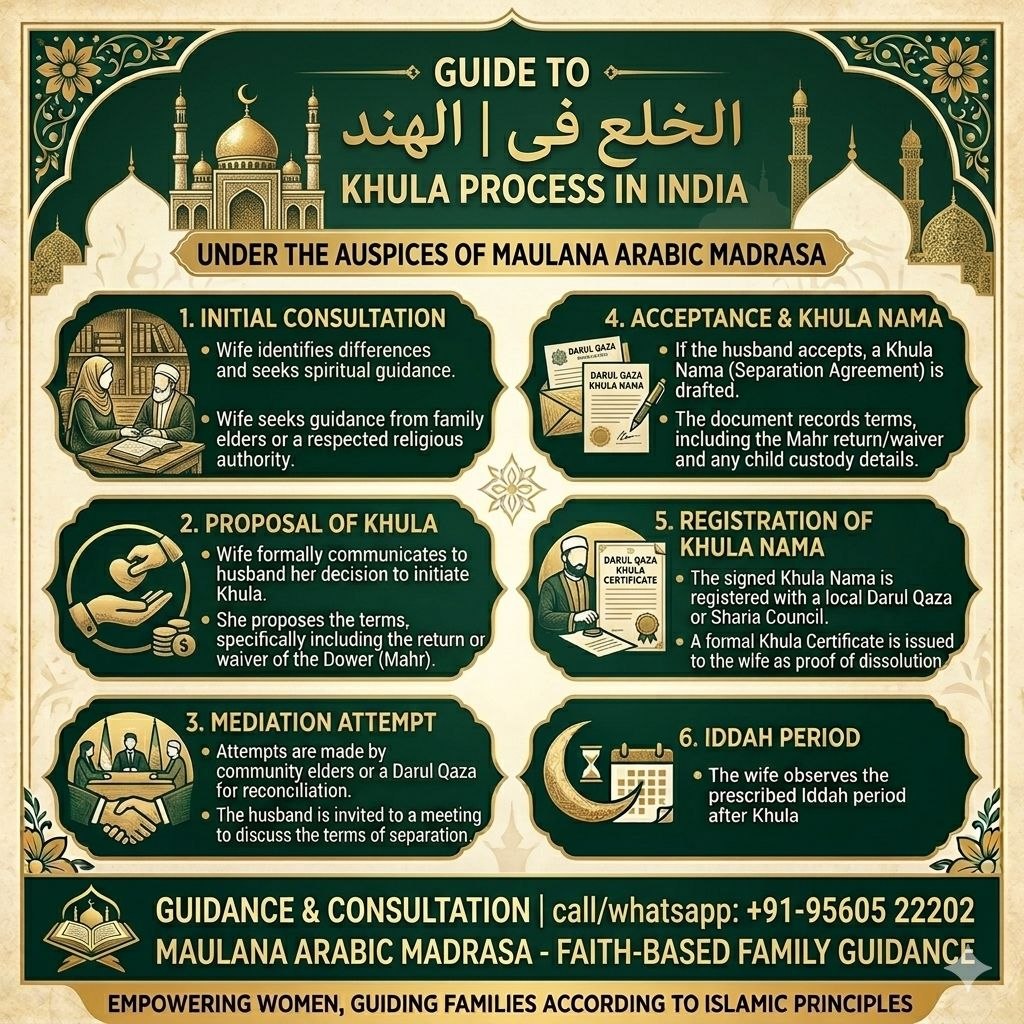
Step-by-Step Breakdown of the Khula Process in India
If you are considering this path, it is important to understand that the Khula process in India is structured to be fair to both parties. Here is how the procedure generally unfolds:
1. Application & Confidential Consultation: The wife submits a formal request for Khula to the Madrasa. Our scholars conduct an initial private consultation to understand the grievances—such as cruelty, desertion, or incompatibility—and ensure the woman is making the decision of her own free will without external pressure.
2. Mediation and Reconciliation (Sulah): A mandatory and beautiful part of the Khula process in India is the attempt at reconciliation. We invite the husband to a joint session to discuss the issues and see if the marriage can be saved through counseling and mediation.
3. The Offer and Ransom (Fidya): If reconciliation fails and the wife remains firm in her decision, she offers to return the Mahr. The husband’s acceptance of this compensation finalizes the Khula.
4. Judicial Intervention (Faskh-e-Nikah): In some cases during the Khula process in India, a husband may be uncooperative or refuse to grant the Khula without a valid reason. In such instances, the Sharia Council or Madrasa has the authority to dissolve the marriage judicially to prevent the woman from being “held in limbo.”
5. Issuance of the Khula Certificate: Upon successful completion, we provide a formal, stamped certificate. This is a crucial document in the Khula process in India, as it serves as definitive proof of your single status for future religious needs, such as a second Nikah.
Coordination with Civil Family Courts
It is important to remember that the Khula process in India handles the religious and personal law aspect of the divorce. If your marriage was originally registered under the Special Marriage Act or at a government registrar’s office, you must also obtain a decree from a civil family court. This dual approach ensures that your government-issued identity documents, including your Aadhar card, Passport, and bank records, accurately reflect your legal status, avoiding any future administrative hurdles.
Why Choose Maulana Arabic Madrasa?
We provide a safe, respectful, and confidential environment for women to navigate the complexities of the Khula process in India. Our scholars are well-versed in traditional Fiqh as well as the practicalities of modern Indian society. By choosing our services, you ensure:
Authenticity: The separation is religiously sound and follows the Sunnah.
Protection: Your financial and social rights are guarded against exploitation.
Clarity: You receive a valid, recognized certificate that clarifies your status to the community.
Securing professional and scholarly guidance is the most effective way to ensure that the Khula process in India is handled with the integrity and respect you deserve as you move toward a peaceful future.
Contact Us for Expert Assistance
If you have questions regarding the Khula process in India or wish to begin the application for counseling, our doors are open to support you.
📍 Address: RZ-2054, TKD Extension, Near Tara Apartment, New Delhi – 110019
📞 Phone: +91 95605 22202 | +91 84476 15753
✉️ Email: maulanaarabicidara@gmail.com
🌐 Website: www.maulan.in