
Islamic family law provides a balanced framework that safeguards the rights and dignity of both spouses within a marriage contract. While a husband holds the right to pronounce Talaq, Islamic jurisprudence grants a parallel right to the wife to seek a separation when the marriage becomes unworkable. This female-initiated separation process is called Khula. However, a critical question frequently arises among women navigating marital distress: Can husband refuse Khula, and what happens to her legal and religious status if he declines to give his consent? Understanding the intricate answers to whether a can husband refuse Khula scenario freezes a woman’s right to separate is vital for anyone seeking a valid, dignified exit from an unsustainable marriage contract.
Many women suffer silently in broken marriages under the false impression that their husband’s explicit permission is the absolute end-all of their freedom. At Maulana Arabic Madrasa, through our dedicated Darul Qaza (Islamic arbitration court), we clarify these complex legal realities. Islamic law does not trap a woman in a state of perpetual misery; instead, it establishes structural pathways to dissolve a marriage even when a spouse proves uncooperative.
The Foundational Definition of Khula
To fully grasp the dynamics of consent in this form of divorce, it is essential to look at how Khula is structured under Shariat law. Unlike a standard divorce, which can be unilaterally executed by the husband, Khula is essentially a mutual agreement or a judicial intervention initiated strictly by the wife.
💰 The Concept of Separation by Compensation
In a standard, amicable Khula proceeding, the wife approaches her husband and requests a separation. In return for releasing her from the marital tie, she agrees to offer financial consideration—most commonly by returning the Mahr (dower) she received at the time of the Nikah, or by waiving any pending financial maintenance.
🏛️ The Ideal Scenario: Mutual Agreement
In a seamless situation, the husband accepts the financial return, agrees to the separation, and signs the divorce documents. The marriage is then immediately dissolved, and the wife enters her mandatory waiting period (Iddah).
🚫 Can Husband Refuse Khula? The Core Jurisprudence
So, what happens when things do not go smoothly? If a wife explicitly states she can no longer live with her husband due to cruelty, neglect, desertion, or emotional incompatibility, does the husband have the absolute right to reject her demand?
The short answer is: He can refuse the initial private request, but he cannot block her right to separation once the matter is brought before an authorized Islamic authority (Darul Qaza).
Here is a detailed breakdown of how classical Islamic jurisprudence handles a husband’s refusal:
❌ The Husband’s Initial Refusal
On a purely private level between a couple, if a wife asks for Khula, the husband might reject it out of anger, an obstinate desire to complicate her life, or a genuine wish to reconcile. If he refuses, the private, out-of-court Khula agreement cannot take place immediately, because Khula by definition implies an agreement between two parties.
🔨 The Authority of the Islamic Judge (Qazi)
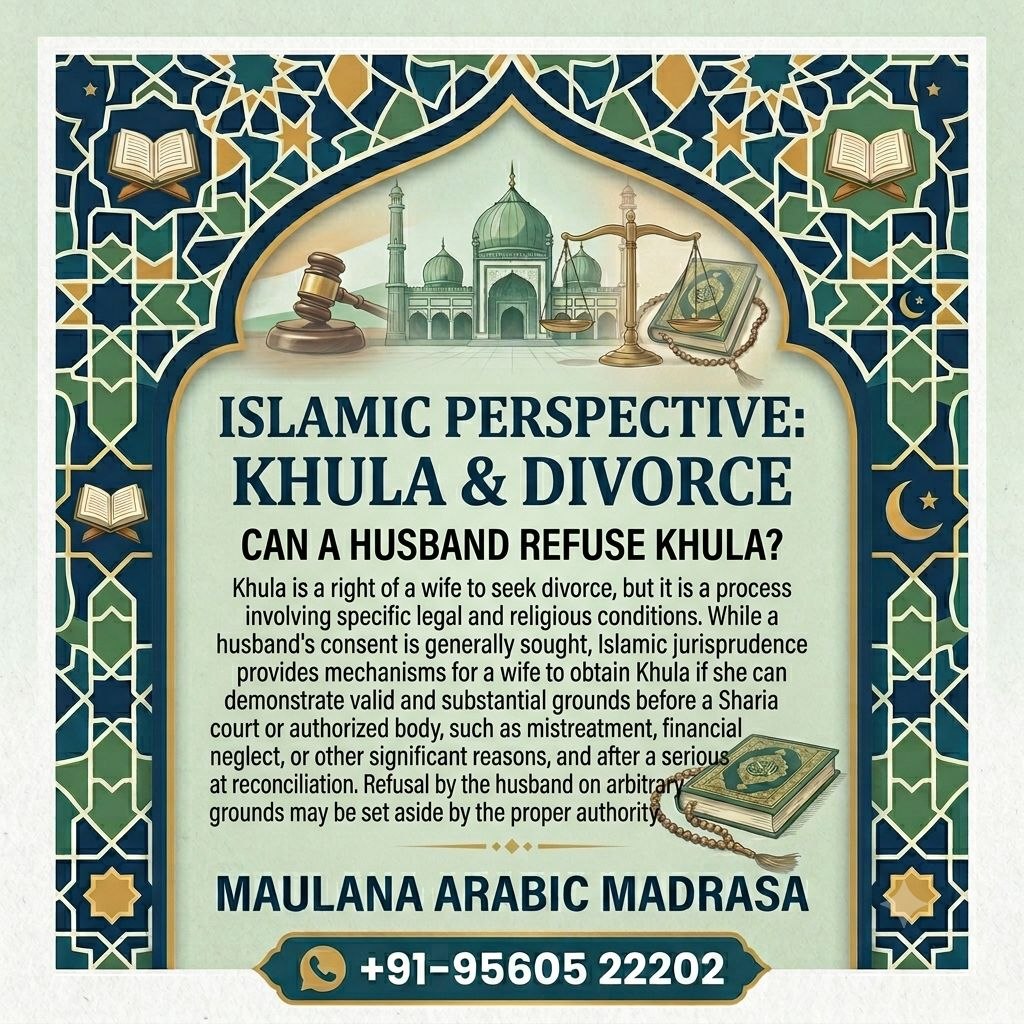
This is where the protection of Islamic law manifests. If the husband unreasonably refuses, the wife is not left helpless. She has the absolute right to escalate the matter to an institutional Islamic court, such as the one operated by Maulana Arabic Madrasa.
The Legal Rule: If a wife establishes before a qualified Qazi (Islamic judge) that she genuinely detests living with her husband and fears she cannot maintain the limits ordained by Almighty Allah, the Qazi possesses the legal authority to dissolve the marriage forcibly, even if the husband completely refuses to sign the papers.
The Institutional Process When a Husband Refuses
When a wife approaches Maulana Arabic Madrasa stating that her husband is uncooperative, our Darul Qaza follows a highly structured legal procedure to ensure justice is served without violating Shariat principles.
📩 Step 1: Issuing Official Summons
Upon receiving the wife’s formal application, the Darul Qaza does not issue an immediate divorce decree. Instead, it sends an official legal notice (summons) to the husband, calling him to present his side of the case. A total of three consecutive notices are sent over a reasonable timeframe.
👥 Step 2: Mandatory Reconciliation and Mediation
If the husband appears, the Qazi appoints arbitrators from both families to see if a reconciliation is possible. If the husband claims he loves his wife and refuses Khula because he wants to save the marriage, the court evaluates his conduct. If his claims of love are backed by a history of cruelty or non-maintenance, his objections are set aside.
📜 Step 3: Dissolution of Marriage via Faskh-e-Nikah
If the husband ignores all three notices entirely, or if he attends court but stubbornly refuses to grant the separation without valid Islamic justification, the Qazi steps into the shoes of the guardian. Utilizing the Islamic legal principle of Faskh (judicial annulment), the Qazi pronounces the marriage dissolved.
In this scenario, the question of whether a can husband refuse Khula becomes practically irrelevant, as the judicial decree overrides his personal refusal completely.
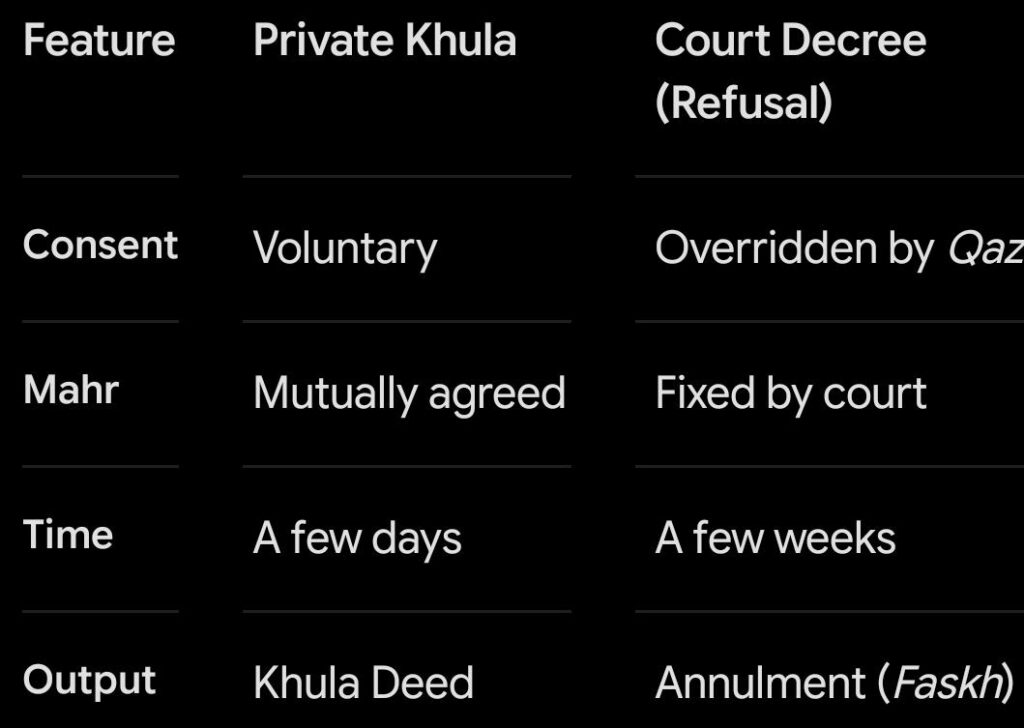
Comparing Private Khula vs. Court-Decreed Separation
When a husband is cooperative, the process looks very different compared to when he refuses and institutional intervention becomes necessary.
Valid Grounds for a Court to Override a Husband's Refusal
A Muslim woman does not need to prove extreme physical torture to seek a separation, though severe issues certainly fast-track the process. A Qazi will readily grant a dissolution over a husband’s refusal based on any of the following valid grounds:
Financial Neglect: Constant failure to provide basic food, clothing, and shelter (Nafaqah).
Desertion: The husband has abandoned the wife or his whereabouts have been unknown for an extended period.
Cruelty: Physical, verbal, or severe emotional abuse that makes a peaceful domestic life impossible.
Incompatibility: A profound, deep-seated hatred where the wife sincerely feels that remaining in the marriage will cause her to transgress religious boundaries.
Why Choose Maulana Arabic Madrasa to Resolve Your Case?
Navigating a marital separation when your spouse is hostile or uncooperative requires deep legal clarity, patience, and authoritative standing. Maulana Arabic Madrasa serves as a trusted guide for women facing this precise challenge:
Flawless Shariat Authenticity: Our judicial decrees are drafted carefully by senior Muftis, ensuring they are valid across the Islamic world.
Protection of Women’s Rights: We ensure that uncooperative husbands cannot use stall tactics or financial extortion to exploit vulnerable women.
Robust Documentation: The final certificate issued by our institution serves as clear, credible evidence of your single status, useful for updating passport, civil ID, and government records.
Connect With Our Central Administrative Office
If your husband is refusing to grant you a separation, or if you need expert counseling regarding your marital rights under Islamic law, do not hesitate to contact our central administrative desk:
📱 Phone Support: +91-9560522202
📧 Official Email: maulanaarabicidara@gmail.com
🌐 Web Portal: www.maulana.in
📍 Central Campus Address: Maulana Arabic Madrasa, TUGHLAKABAD EXTENSION NEW Delhi, New Delhi – 110019